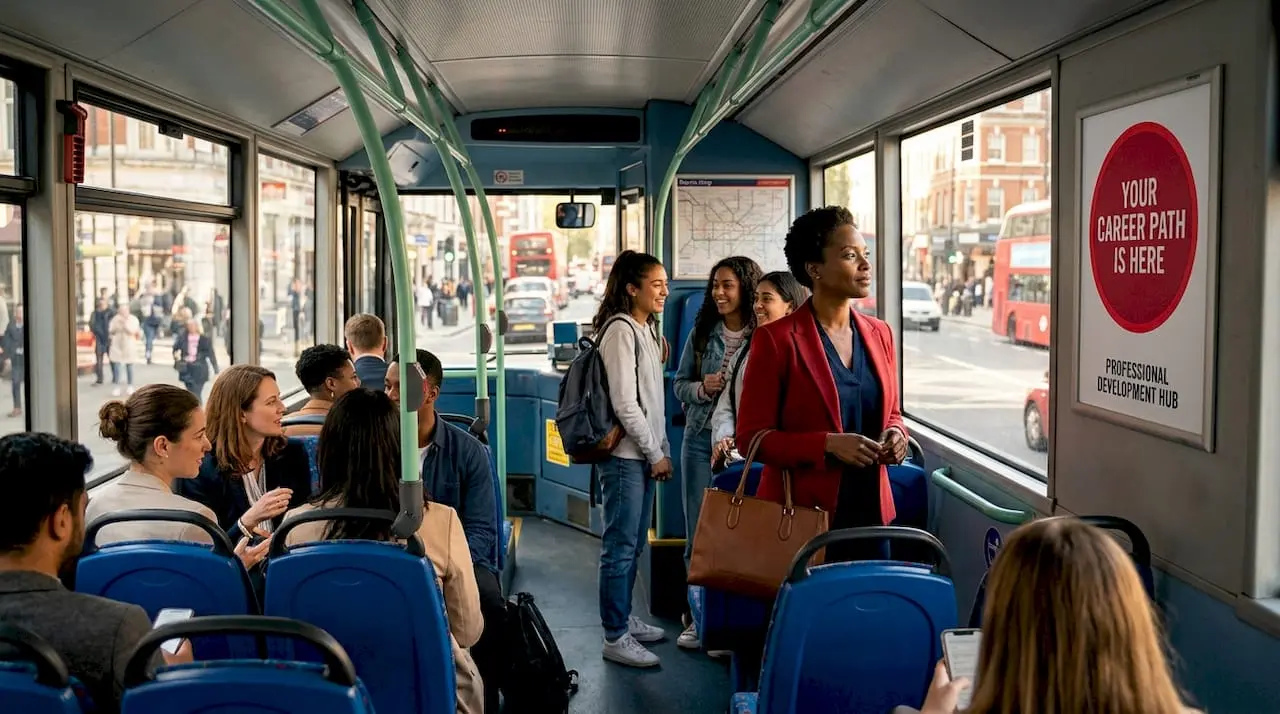
Passenger transport is far broader than most people assume. Ask someone what it means and they will likely picture a bus or a train. In reality, what is passenger transport covers everything from on-demand taxis and community minibuses to ferries, trams, and even scheduled air services. The distinctions matter, because how a service is classified shapes how it is regulated, funded, and planned. Whether you are researching urban mobility, studying transport policy, or considering a career in the sector, understanding the full scope of passenger transport is the right place to start.
Table of Contents
- Key takeaways
- What is passenger transport and why it matters
- Core passenger transport modes
- Regulatory frameworks for passenger services
- Passenger transport and urban planning
- How passengers choose between modes
- Integrated passenger transportation systems
- My perspective on where passenger transport thinking goes wrong
- Build a career in passenger transport
- FAQ
Key takeaways
| Point | Details |
|---|---|
| Passenger transport is multimodal | It spans buses, rail, ferries, taxis, community services, and air, not just traditional public transport. |
| Regulation is service-based, not vehicle-based | Authorisation categories differ by service type, so the same vehicle can fall under different rules depending on how it operates. |
| Urban planning now uses outcomes-based thinking | Modern local transport plans focus on mobility outcomes across all modes rather than simply predicting and supplying road capacity. |
| User priorities drive good service design | Safety, cost, travel time, and comfort consistently rank as the most important factors for passengers choosing between modes. |
| Integration is the goal of modern systems | The best passenger transportation systems combine multiple modes with shared information and ticketing to maximise accessibility. |
What is passenger transport and why it matters
Passenger transport refers to any organised service that moves people from one location to another, using a vehicle or vessel, in exchange for a fare or as part of a publicly funded network. That definition sounds straightforward, but the details carry enormous weight in practice.
Public transport systems typically operate on fixed routes and schedules with standardised fares, often subsidised by public funds. But passenger transport as a broader category also includes demand-responsive services, tourism coaches, school buses, and community transport schemes that serve specific groups with specific needs. These services share one thing: they carry passengers rather than freight.
The reason the definition matters goes beyond semantics. Planning authorities, operators, and researchers need precise language to identify which rules apply, what funding streams are available, and how services contribute to wider mobility goals. Mixing up “passenger transport,” “public transport,” and “mass transit” leads to poorly scoped research and misinformed policy.
Core passenger transport modes
Understanding the types of passenger transport means looking beyond the bus stop. Common modes include bus, coach, rail, metro, tram, ferry, taxi, rideshare, and community transport. Each has distinct operational characteristics worth unpacking.
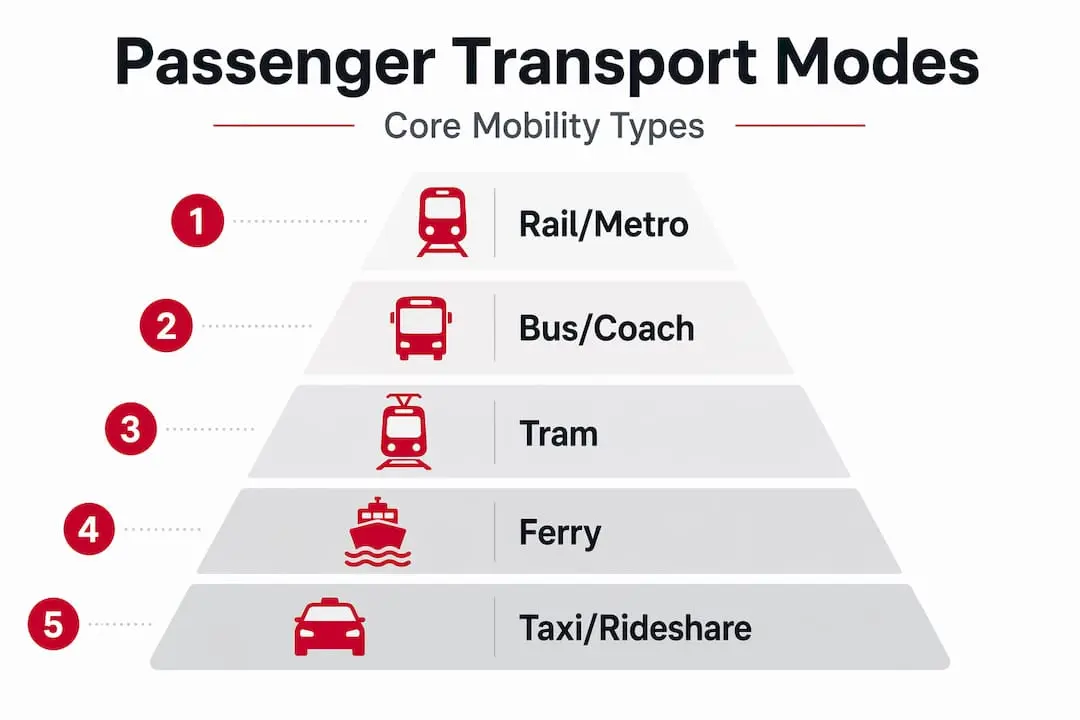
| Mode | Typical capacity | Typical range | Infrastructure needs |
|---|---|---|---|
| Urban bus | 60–100 passengers | Local/regional | Roads, stops, depots |
| Metro/underground | 800–2,000 per train | Urban | Dedicated tunnels/track |
| Light rail/tram | 150–300 per vehicle | Urban/suburban | Tracks, overhead power |
| Regional rail | 200–600 per train | Regional/national | Heavy rail track |
| Ferry | 100–2,000 | Coastal/river | Ports, waterways |
| Taxi/rideshare | 1–8 | Local | Roads only |
| Community transport | 8–20 | Local | Roads, adapted vehicles |
| Scheduled air | 50–500+ | National/international | Airports, air traffic control |
Rail and metro services are the backbone of high-density urban movement. A single metro train can shift the equivalent of hundreds of cars off a congested road corridor, which is why cities from London to Singapore invest so heavily in underground capacity.
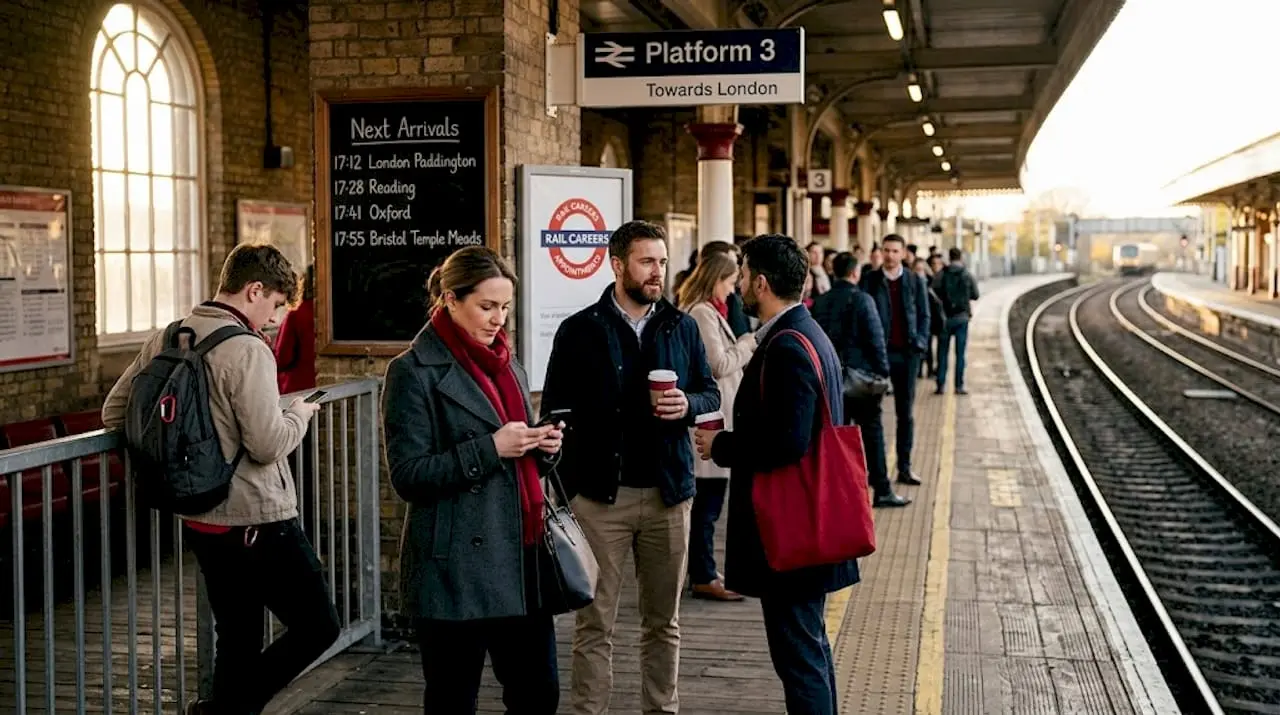
Buses are more flexible. They can be rerouted, scaled up or down, and introduced to new areas without major infrastructure investment. Community transport, often overlooked in formal research, fills critical gaps for elderly, disabled, and rural passengers who cannot use mainstream services.
Air travel is frequently excluded from public transport discussions because it operates in a competitive market with variable pricing, rather than the standardised fare structures associated with urban transit. This does not make air travel irrelevant to passenger transport overall. It simply means it belongs to a different regulatory and planning context.
Taxis and rideshare services occupy a hybrid position. They are private in operation but increasingly integrated into urban mobility networks, particularly as app-based platforms enable real-time matching between drivers and passengers.
Regulatory frameworks for passenger services
Regulation is where passenger transport gets genuinely complex, and where researchers often encounter confusion. The legal treatment of a service depends not on the vehicle type but on the service pattern and its authorisation category.
Authorisation categories typically include:
- On-demand rank/hail services. Taxis and rideshare platforms that pick up passengers without a pre-booked schedule.
- Charter services. Vehicles hired for a specific journey or group, not open to the general public.
- Regular passenger transport. Fixed-route, fixed-schedule services that anyone can board, including most bus and rail services.
- Tourism passenger transport. Scheduled or semi-scheduled services oriented around visitor itineraries, often with commentary or sightseeing stops.
The practical implication is significant. Authorisation categories differ for on-demand, regular routes, and tourism transport even when the vehicles used are physically identical. A coach operating a tour and the same coach running a commuter route may look the same from the outside but operate under entirely different licensing frameworks, insurance requirements, and driver certification rules.
This service-based regulatory model exists because the risks and expectations associated with each service type differ. An on-demand taxi has different safety obligations to a scheduled school bus, even if both use a seven-seat vehicle.
Pro Tip: When researching passenger transport regulations, always identify the authorisation category first. Applying the wrong regulatory framework to a service type is one of the most common errors in transport policy analysis.
Jurisdictions vary considerably in how they structure these categories. UK transport law, Australian state transport legislation, and European Union directives each use different terminology and enforcement mechanisms. Researchers working across borders need to map local terminology against functional definitions before drawing comparisons.
Passenger transport and urban planning
Transport planning and passenger transport are deeply intertwined. Local transport plans cover walking, cycling, bus, and driving, and authorities have statutory planning duties under the Transport Act 2000 to develop integrated plans across all these modes.
Modern planning has moved decisively away from older approaches. The shift matters enormously for how passenger transportation systems are designed and evaluated:
- Predict and provide (legacy approach). Planners would forecast traffic growth and build infrastructure to accommodate it. This approach consistently underestimated induced demand and led to more congestion, not less.
- Vision and outcomes-based planning (current approach). Authorities now set mobility outcomes first, such as reducing car dependency or improving access to employment, then design transport interventions to achieve those outcomes.
- Statutory integration duties. Under UK law, transport authorities must produce plans that address the full spectrum of local movement, not just roads or buses in isolation.
- Connectivity as a core metric. Modern plans measure how well modes connect to each other, recognising that a train journey is only useful if passengers can reach the station and continue at the other end.
Transport planning has shifted to vision-based outcomes covering multimodal transport, which has direct consequences for researchers and planners. Evaluating passenger transport performance now means assessing whether the system as a whole meets people’s mobility needs, not just whether individual services run on time.
How passengers choose between modes
Understanding how does passenger transport work from a user perspective is essential for both planners and researchers. People do not select modes based purely on availability. They weigh a set of criteria, and the relative weight of those criteria varies by demographic, journey purpose, and local context.
A 2026 study on mode choice criteria ranked safety, costs, travel time, and comfort as the highest priority factors for passengers. COVID-19 risk and weather conditions ranked considerably lower. The implications for service design are direct.
Safety covers both personal security on vehicles and stops and the perceived risk of accidents. Services that score poorly on safety will lose passengers to alternatives regardless of how competitive they are on cost or time. Travel cost is particularly sensitive for low-income passengers, where even modest fare increases can shift behaviour significantly. Travel time includes not just in-vehicle time but also waiting time and the time taken to walk to stops or transfer between services.
Pro Tip: When evaluating a passenger transport service, map the full door-to-door journey time rather than just the in-vehicle segment. Waiting and transfer time often accounts for more than half of total trip duration on multimodal journeys.
The research also makes clear that frequency, reliability, and fare policy should align with dominant user priorities rather than being treated as secondary technical details. A bus route with excellent frequency but unpredictable reliability will frustrate passengers more than a less frequent route that arrives exactly as scheduled.
Integrated passenger transportation systems
The goal of modern passenger transport is integration. No single mode can meet every need across a diverse urban or regional area. The benefits of passenger transport multiply substantially when bus, rail, ferry, and active travel infrastructure are connected into a coherent network.
TransLink in Metro Vancouver is a frequently cited example. It combines rail, bus, SeaBus ferry services, and cycling infrastructure into a single network with unified ticketing and real-time information. The result is a system where passengers can move between modes without needing to understand different pricing structures or timetable formats.
| System feature | Benefit to passengers | Benefit to planners |
|---|---|---|
| Unified ticketing | Single fare covers multiple modes | Simplifies revenue allocation |
| Real-time information | Reduces uncertainty at transfers | Identifies pinch points in the network |
| Coordinated timetables | Minimises transfer waiting time | Improves network utilisation |
| Multimodal hubs | Enables seamless interchange | Concentrates infrastructure investment |
| Shared wayfinding | Reduces navigational barriers | Supports consistent branding |
The challenges are equally real. Transfer design requires physical infrastructure, such as covered walkways, secure cycle parking, and accessible platforms, as well as information systems that work across operators. Integrated systems operate with bus, rail, and sea services plus cycling and walking infrastructure, but achieving that integration typically takes decades of sustained investment and political commitment.
For researchers, the key analytical insight is that passenger transport systems are networks, not collections of individual routes. Removing or degrading one element of the network affects journeys that never directly use that element, because connectivity ripples across the whole system.
My perspective on where passenger transport thinking goes wrong
I have spent years observing how transport professionals, researchers, and policymakers approach passenger transport, and one pattern stands out. Most people still think in modes. They advocate for buses or for rail, debate the merits of trams versus light rail, and design policies around individual service types. This mode-centric thinking is the primary obstacle to genuinely useful transport systems.
What I have come to believe is that the regulatory complexity around passenger transport is not bureaucratic noise. It reflects real differences in how services function and who they serve. The problem is that few researchers take the time to understand those distinctions before drawing conclusions. Studies comparing “public transport use” across cities often compare things that are not comparable, because the underlying service categories are different.
The shift to outcomes-based planning is genuinely promising, but I see it applied superficially far too often. Setting a vision statement about reducing car dependency is not the same as redesigning fare structures, transfer infrastructure, and service frequencies to make the alternative genuinely competitive. The gap between stated vision and practical service design remains the most important problem in this field.
Emerging technologies, from demand-responsive minibuses to integrated mobility apps, will only add further complexity to an already layered system. Getting the foundations right, particularly the regulatory categories and the user-priority framework, is the work that makes everything else possible.
— Rob
Build a career in passenger transport
Understanding passenger transport systems is one thing. Building a career shaping them is another. The sector spans transport planning, operations management, policy analysis, transport technology, and infrastructure project delivery. Whether you are a researcher moving into practice or a professional looking to specialise, the opportunities are genuinely wide.
Jobs-in-Transport has connected transport professionals with employers across the UK and internationally since 2005. From transport planning roles to bus operations, traffic management, and transport technology, the platform covers the full breadth of the sector. You can browse live vacancies, upload your CV, and set up alerts so relevant roles reach you directly. Find out more about how Jobs-in-Transport works for jobseekers and take the next step in your transport career.
FAQ
What is passenger transport?
Passenger transport is any organised service that moves people between locations using vehicles or vessels, including buses, rail, ferries, taxis, and community transport. It operates across a spectrum from publicly funded fixed-route services to private on-demand hire.
What are the main types of passenger transport?
The main types of passenger transport include bus, metro, tram, regional rail, ferry, taxi, rideshare, community transport, and scheduled air services. Each operates under distinct regulatory frameworks and serves different journey types and passenger groups.
How does passenger transport differ from public transport?
Public transport is a subset of passenger transport that typically uses fixed routes, published schedules, and standardised fares open to anyone. Passenger transport is broader and includes charter, tourism, and on-demand services that are not always publicly accessible or subsidised.
Why do passenger transport regulations differ between service types?
Regulations differ because the safety requirements, operational patterns, and passenger expectations for on-demand, charter, regular route, and tourism services are genuinely distinct. The same vehicle can carry different authorisations depending on how and for whom it operates.
What factors most influence passenger mode choice?
Research ranks safety, travel cost, travel time, and comfort as the highest-priority factors when passengers choose between transport modes, ahead of environmental considerations or weather-related concerns.
Recommended
- Jobs in Transport, Bus jobs, Highways & Traffic jobs, Transportation Planning jobs, Transport Technology jobs, Project Management jobs, Transport Leaders jobs
- Jobs in Transport, Bus jobs, Highways & Traffic jobs, Transportation Planning jobs, Transport Technology jobs, Project Management jobs, Transport Leaders jobs


