
Public transport integration is defined as the coordinated connection of multiple transit modes, including buses, trains, trams, and cycle hire, into a single network that functions as one system. The industry term for this is multimodal integration, and it sits at the heart of modern public transport planning. Cities like Singapore and Berlin achieve ridership rates exceeding 70% and emissions reductions of up to 45% through this approach. Those figures are not accidental. They are the direct result of AI-synchronised schedules, unified digital fare wallets, and real-time predictive data working together across every mode in the network.
What is public transport integration and how does it work?
Public transport integration coordinates buses, trains, trams, and on-demand services so that passengers move between them without friction. Three operational layers make this possible: schedule synchronisation, fare unification, and shared passenger information.
Schedule synchronisation uses AI-driven timetabling to align departure times across modes. A bus arriving at a rail station, for example, is timed to meet the incoming train rather than depart two minutes before it. This single change eliminates the most common reason passengers abandon public transport for private cars.

Fare unification removes the need to buy separate tickets for each operator. Singapore’s EZ-Link card and Germany’s Deutschlandticket, which offers unlimited regional travel on buses, trams, U-Bahns, and trains for a fixed monthly price of 63 euros, are the clearest examples. Both systems use fare capping, meaning passengers never pay more than a set daily or weekly maximum regardless of how many modes they use.
Shared passenger information delivers real-time updates across every touchpoint, from apps to station displays. Predictive data tells passengers not just when the next bus arrives, but whether it will connect with their onward train. That level of information shifts passenger behaviour at scale.
Pro Tip: When assessing an integrated network, test the information layer first. If real-time data is absent or inconsistent across modes, the fare and schedule layers will underperform regardless of how well they are designed.
How does transport integration improve mobility and reduce congestion?
Integrated public transport systems produce measurable gains in mobility, emissions, and household finances. The mechanism is straightforward: when passengers trust the network to connect reliably, they leave their cars at home.
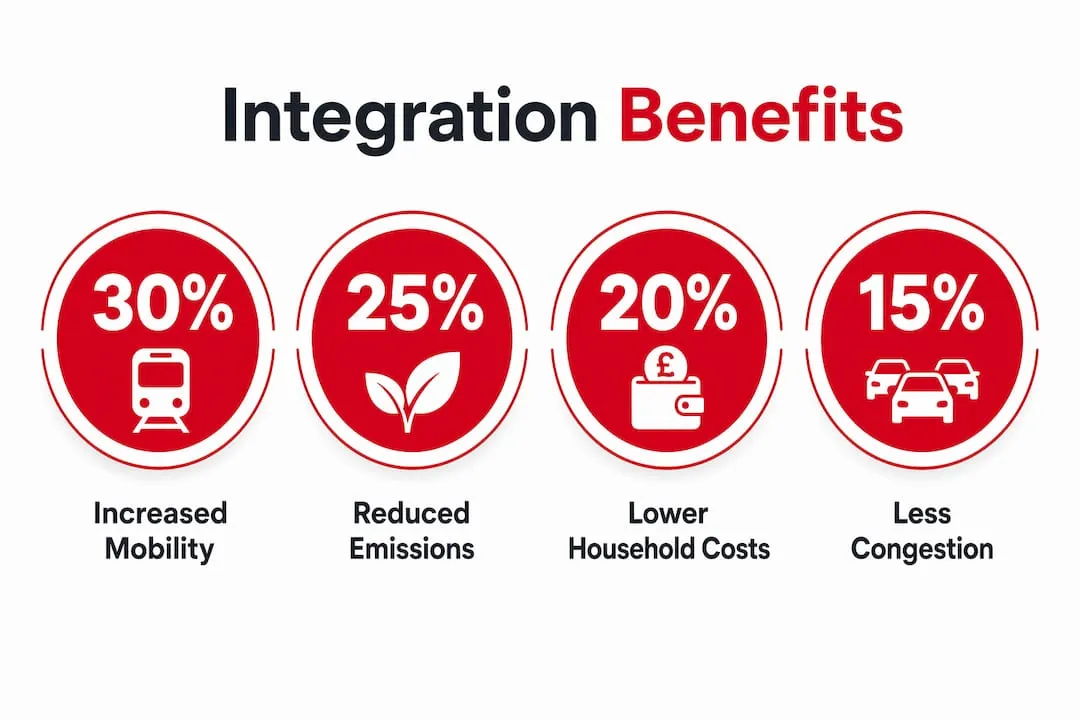
Ridership in integrated cities regularly exceeds 70% of daily commuters. That modal shift directly reduces road congestion, which in turn cuts journey times for everyone, including freight and emergency services. The knock-on effect on urban productivity is significant.
The four most consistent benefits documented across integrated urban transport systems are:
- Emissions reduction. Integrated cities cut transport-related emissions by up to 45% compared with car-dependent equivalents. This is the single largest lever available to urban planners targeting net-zero transport.
- Household savings. Unified fare schemes with capping reduce monthly travel costs. Passengers on Germany’s Deutschlandticket pay a predictable fixed sum rather than accumulating per-journey charges across operators.
- Improved access to employment and education. Modal shift expands the geographic reach of commuters without requiring car ownership. Demand analysis shows that matching transit supply to actual population mobility patterns, rather than replicating existing routes, opens up job and education access for lower-income households.
- Reduced journey times. Priority infrastructure, such as dedicated bus lanes and signal priority for trams, cuts in-vehicle time. Combined with synchronised connections, total door-to-door journey times fall substantially.
Quality of service metrics are now shifting towards user-centric standards defined by European norms, focusing on reliability, frequency, and ease of transfers. That shift matters because it moves the performance benchmark from operator convenience to passenger experience.
What challenges must planners overcome to achieve integration?
The biggest barrier to public transport integration is not technology. It is governance. No single mayor or authority typically oversees both bus and rail networks fully, and that fragmented oversight prevents timetable synchronisation and multi-modal ticketing from functioning as intended.
The core institutional and technical obstacles are:
- Fragmented authority. Bus networks and rail networks in most Western cities answer to different bodies with competing commercial interests. Without a unified authority holding service and fare control, operators have no incentive to synchronise.
- Absence of shared data. Shared GTFS real-time feeds are indispensable for operational coordination. Without a common data backend, a bus operator cannot hold a service for a delayed train even if the timetable suggests it should. Unified fares alone do not solve this.
- Legal barriers. Governance reform requires legislative change in most jurisdictions. Assigning unified control to a single entity means overriding the legal autonomy of existing operators, which is politically and legally complex.
- System fragility. Integrating too many modes without robust Intelligent Transport Control Systems creates a single point of failure. If one platform goes down, the entire network can stall. Modular, semi-independent systems reduce this risk.
Pro Tip: Planners implementing integration for the first time should adopt a modular approach. Integrate two or three modes fully before expanding. This limits exposure to system fragility and allows governance structures to mature before the network grows.
Centralised governance is the prerequisite that unlocks every other layer of integration. Technology can be procured; authority must be legislated.
Which digital tools support public transport planning and integration?
Planning software has become the practical engine of integration. The right tools allow planners to model demand, build unified timetables, and manage real-time operations from a single interface.
| Tool | Primary function | Key integration feature |
|---|---|---|
| Nexfeld Planning System | Timetable, routing, duties, and rosters | Interfaces with ticketing and financial systems |
| Remix by Via | Network planning and scheduling | Reduces scheduling time by up to 75% |
| PTV Group platforms | Demand modelling and network design | Supports MaaS and on-demand integration |
Nexfeld’s modular architecture is particularly relevant for agencies managing multiple operators. It unifies timetable planning, rostering, and operational control in one system, and connects directly to ticketing and passenger information platforms. That connectivity is what allows schedule changes to propagate across the entire network in real time.
Remix by Via approaches integration from the planning side. Its scheduling tools can reduce routine timetabling work by up to 75%, freeing planners to focus on network design rather than administrative coordination. It also supports on-demand service integration, which is increasingly important as cities add flexible transit options to fixed-route networks.
PTV Group’s platforms focus on demand analysis and network modelling. Their tools support Mobility as a Service (MaaS) concepts, which integrate different transport services into a single digital platform covering trip planning, booking, and payment. MaaS is the logical endpoint of fare and informational integration, and PTV Group’s modelling capabilities help planners assess whether a proposed network will actually meet passenger demand before a single service runs.
The choice between these tools depends on where a network sits in its integration journey. Agencies building from scratch benefit most from Remix’s planning capabilities. Agencies managing existing complexity benefit most from Nexfeld’s operational depth.
Key takeaways
Public transport integration delivers its greatest benefits when governance reform, shared data infrastructure, and modular planning tools are developed together rather than in isolation.
| Point | Details |
|---|---|
| Integration requires three layers | Schedule synchronisation, fare unification, and shared real-time information must all function together. |
| Governance is the primary barrier | Fragmented authority over bus and rail networks prevents timetable and fare coordination in most Western cities. |
| Emissions and ridership gains are proven | Integrated cities achieve ridership above 70% and emissions reductions of up to 45%. |
| Shared data is non-negotiable | GTFS real-time feeds across all operators are required for practical operational coordination, not just unified fares. |
| Modular tools reduce planning workload | Software like Nexfeld and Remix by Via cuts scheduling time and connects timetabling directly to ticketing systems. |
Why governance reform matters more than any app
The transport sector has a habit of reaching for technology first. New apps, new ticketing systems, new data platforms. I understand the appeal. Technology is procurable; political reform is not. But after years of watching integration projects stall, the pattern is clear: cities that invest in governance first, and technology second, are the ones that actually deliver integrated networks.
London’s Transport for London model is instructive. A single authority controls fares, frequencies, and contracts across buses, the Underground, the Overground, and the Elizabeth line. That unified control is why the Oyster card worked before contactless payments existed, and why real-time coordination across modes is possible today. The technology followed the governance, not the other way around.
The MaaS model being developed across Scandinavia and parts of Germany points to where integration is heading. A single digital platform covering planning, booking, and payment across every mode, including cycle hire and on-demand services, is achievable. But it requires operators to share data and yield commercial control to a central platform. That is a governance decision, not a technical one.
My recommendation for urban planners in 2026 is to treat user-centric service quality as the design brief and governance reform as the first deliverable. Build the institutional structure before you procure the software. The tools are ready. The question is whether the political will exists to use them properly.
— Rob
Transport integration careers at Jobs-in-transport

Public transport integration is reshaping how cities hire. Demand is growing for professionals who understand both the technical and governance sides of multimodal networks. Roles in transportation planning, transport technology, and project management are expanding as cities across the UK and internationally push integration programmes forward.
Jobs-in-transport has connected transport professionals with relevant opportunities since 2005. The platform lists roles across highways, traffic management, transport technology, and planning, with CV hosting and job alerts to keep your search focused. Whether you are a planner building integrated networks or a policymaker shaping the governance frameworks that make them work, Jobs-in-transport carries the roles that match your expertise.
FAQ
What is the difference between fare integration and operational integration?
Fare integration unifies ticketing and payment across operators, while operational integration synchronises schedules and real-time services. Both are required for a fully functioning integrated network.
Why do most cities struggle to achieve full transport integration?
Fragmented governance is the primary cause. Bus and rail networks typically answer to separate authorities, which prevents unified timetabling and fare coordination.
What is GTFS and why does it matter for integration?
GTFS (General Transit Feed Specification) is a data standard that allows transit agencies to share real-time schedule and location data. Without shared GTFS feeds, operators cannot coordinate services dynamically even when fares are unified.
What is Mobility as a Service (MaaS)?
MaaS integrates different transport services into a single digital platform covering trip planning, booking, and payment. It represents the most advanced form of public transport integration currently in deployment.
How do planning tools like Remix by Via support integration?
Remix by Via reduces routine scheduling time by up to 75% and supports on-demand service integration alongside fixed-route networks, making it a practical tool for planners managing multimodal systems.


