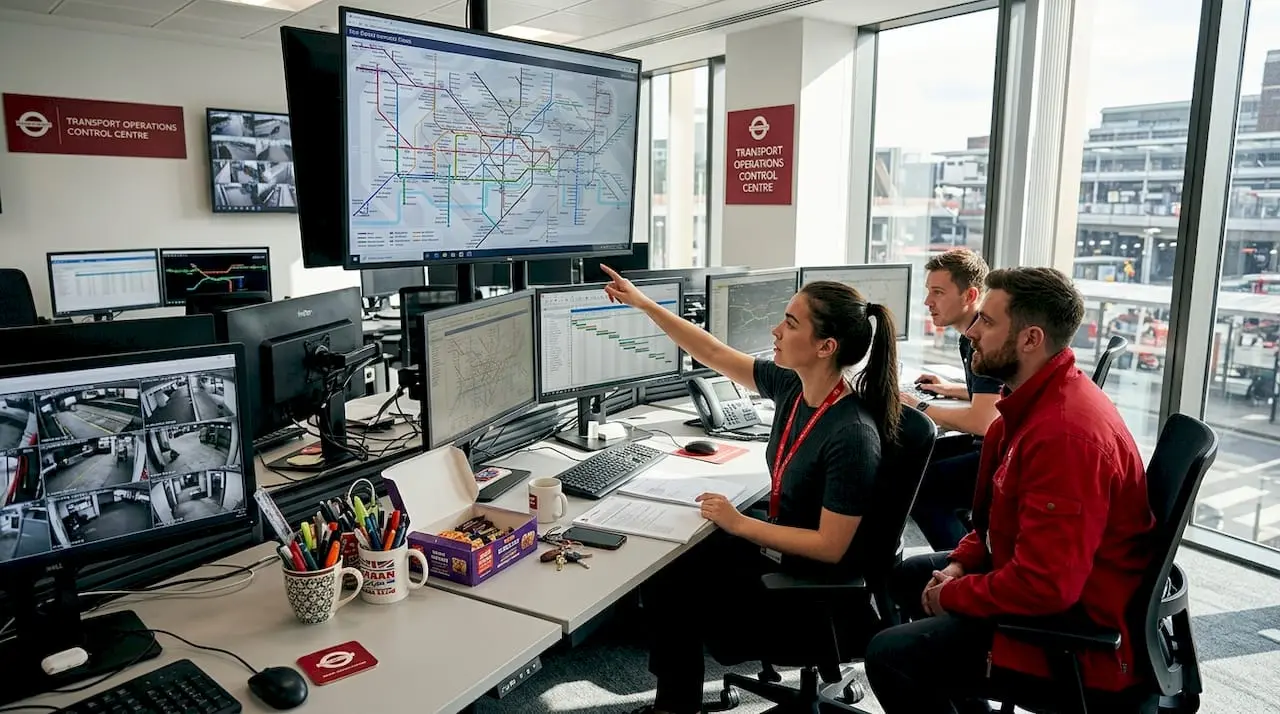
Most people board a bus or train and think very little about what makes that service run. The vehicle arrives, passengers board, and it departs. What is public transport operations, then, beyond the visible moment of a vehicle on a route? The honest answer is that it is an intricate, interdependent system of scheduling, fleet management, regulatory compliance, real-time control, and financial planning. Understanding how this system works matters enormously, whether you are a student of urban planning, a researcher analysing transit policy, or a professional looking to build a career in transport management.
Table of Contents
- Key takeaways
- What is public transport operations: scope and core functions
- Scheduling and timetabling in detail
- Fleet availability and maintenance
- Regulatory frameworks and performance obligations
- Real-time operations control
- Rob’s perspective: the hidden complexity operators carry
- Build a career in public transport operations
- FAQ
Key takeaways
| Point | Details |
|---|---|
| Operations cover far more than movement | Public transport operations include scheduling, fare collection, fleet maintenance, regulation, and passenger information. |
| Fleet availability is a measurable KPI | Best practice targets 85 to 90% revenue vehicle availability to maintain reliable service. |
| Non-revenue time is often underestimated | Driver activities such as pre-trip inspections and deadheading significantly affect staffing costs and scheduling accuracy. |
| Regulation shapes every operational decision | Public service obligations set contractual targets for punctuality, frequency, and capacity with direct financial consequences. |
| Real-time control prevents cascading disruptions | Operations control centres use live fleet monitoring and incident management to keep services on schedule. |
What is public transport operations: scope and core functions
Public transport operations are the daily activities required to run passenger services on fixed routes and schedules, supported by fare collection and public funding. This definition, while accurate, understates the breadth of what operations teams actually manage. A public transport system overview must account for multiple interconnected workstreams running simultaneously, not just the movement of vehicles.
The core functions of public transport can be grouped into several distinct but overlapping areas:
- Service delivery: Vehicles operating on defined routes according to published timetables, serving passenger demand across a network.
- Fleet management: Procuring, allocating, maintaining, and retiring vehicles to match operational requirements.
- Scheduling and timetabling: Building driver rosters and vehicle duties that translate planning decisions into workable shift patterns.
- Fare collection: Managing revenue streams through ticketing systems, contactless payment infrastructure, and concessionary fare administration.
- Passenger information: Providing real-time and static information at stops, on vehicles, and through digital channels.
- Performance monitoring: Tracking adherence to timetables, passenger load, and reliability metrics against agreed standards.
Transport modes typically covered under public transport operations include urban buses, metro and heavy rail, light rail and trams, ferries, and on-demand or flexible services in lower-density areas. Each mode carries different operational characteristics, but the underlying logic of public transport management is consistent: match supply to demand, keep vehicles running reliably, and serve passengers safely.
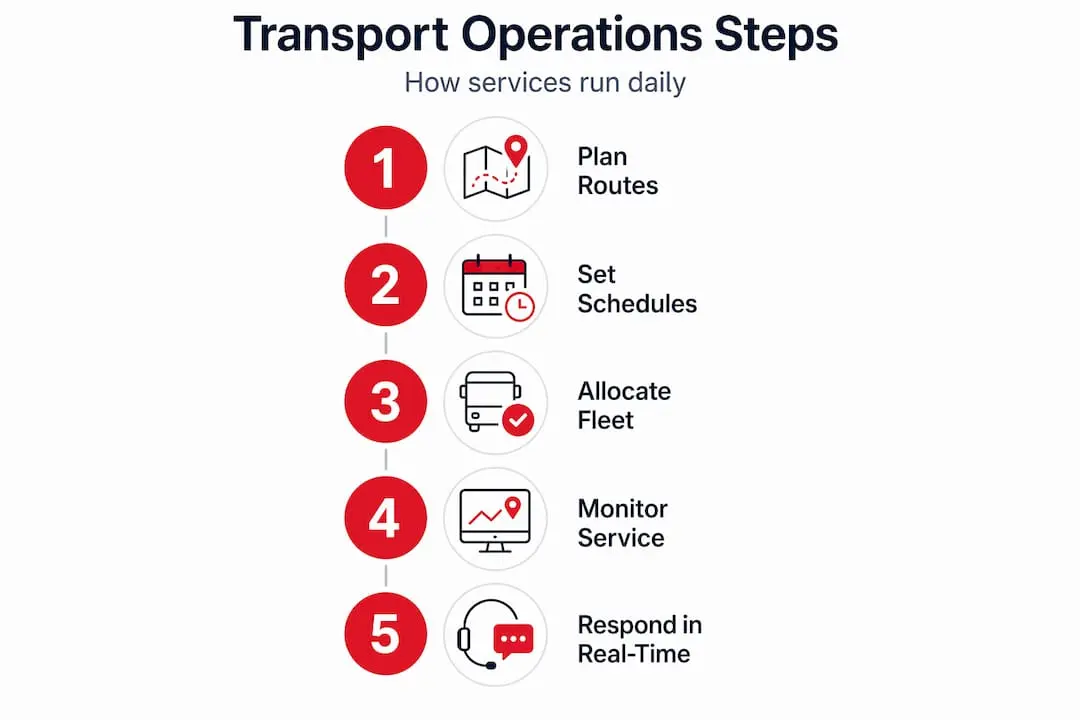
Operations and planning are closely linked but distinct. Planning sets the routes, frequencies, and fare structures. Operations delivers those decisions on the ground, every day, with all the constraints that real life introduces: traffic congestion, mechanical failures, driver absences, and sudden spikes in passenger demand.
Scheduling and timetabling in detail
Scheduling is where the gap between theory and practice in transit operations becomes most visible. The public timetable showing departure times is only one output of a much more complex scheduling process.
Operators must build two parallel schedules: the vehicle duty schedule, which assigns each trip to a specific vehicle, and the crew schedule, which assigns drivers to duties across their working day. These two schedules must align whilst also complying with working time regulations, union agreements, and operational constraints such as depot location.
A common misconception concerns what counts as “working time” for a driver. Non-revenue tasks like pre-trip inspections and deadhead movements, where a vehicle travels without passengers to position itself for the next service, must be factored into every schedule. Deadheading costs money and consumes driver hours without generating direct passenger value. Scheduling software attempts to minimise this, but it cannot eliminate it entirely.
The sequence a scheduling team typically follows looks like this:
- Timetable construction: Determine trip frequencies and departure times based on passenger demand data and service standards.
- Vehicle blocking: Group trips into vehicle duties, minimising gaps and deadhead movements between runs.
- Crew rostering: Assign drivers to vehicle duties, building daily and weekly rosters that meet legal and contractual requirements.
- Relief point planning: Identify locations where driver changeovers can happen, balancing operational efficiency with accessibility for staff.
- Schedule validation: Check the full schedule for conflicts, compliance gaps, or unrealistic travel times before publishing.
Ignoring non-revenue driver tasks consistently leads to underestimates of staffing need and operational cost. Many agencies discover this only when services begin failing due to driver shortages that the schedule never properly accounted for.
Pro Tip: When analysing a transit schedule for research or planning purposes, always ask for the operator schedule alongside the passenger timetable. The gap between them reveals where an operation is under pressure.
Connection timing is another scheduling consideration that directly affects the passenger experience. Coordinating transfer points so that passengers can move between services without long waits requires precise timetable design and operational discipline to maintain it.
Fleet availability and maintenance
If scheduling is the brain of public transport operations, fleet maintenance is the circulatory system. Vehicles that are not in service cannot carry passengers, and every unplanned cancellation damages the reliability record that passengers and authorities use to judge an operator.
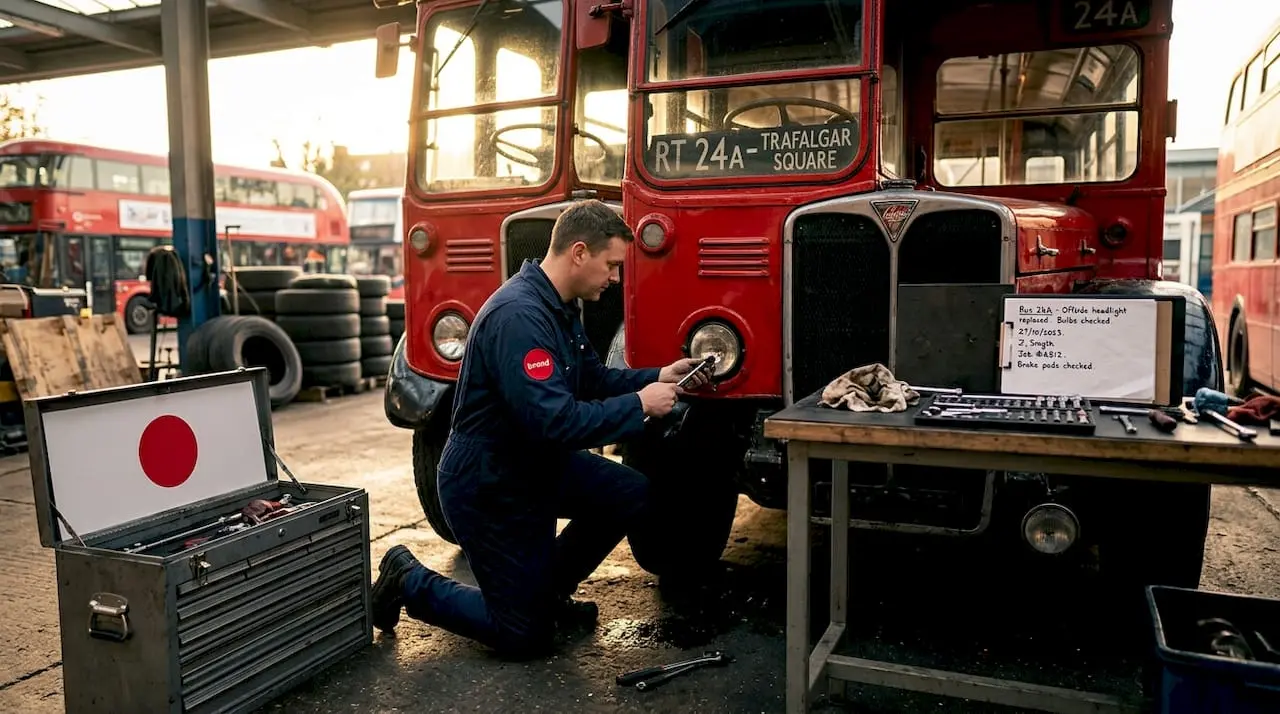
The most important maintenance metric in transit operations is revenue vehicle availability, defined as the percentage of the fleet that is operationally ready to enter service at any given time. This is distinct from simply counting how many vehicles an agency owns.
| Availability level | Operational impact | Typical cause |
|---|---|---|
| Above 90% | Minimal service disruption, reserve vehicles available | Strong preventive maintenance programme |
| 85 to 90% | Acceptable performance, tight reserve margin | Standard maintenance with some reactive repair |
| Below 85% | Service cancellations likely, passenger trust erodes | Reactive-only maintenance, ageing fleet |
| Below 75% | Significant timetable reductions, contractual penalties | Fleet crisis or systemic underfunding |
Best practice targets 85 to 90% availability to give operators a sufficient buffer of reserve vehicles. Without that buffer, any uptick in breakdowns immediately translates into cancelled journeys.
Digital maintenance management systems have transformed how operators track vehicle condition. Integrated telemetry feeds data about engine performance, brake wear, and mileage intervals directly to maintenance planners, enabling genuinely preventive rather than reactive maintenance cycles. This reduces the frequency of unexpected failures and extends the working life of each vehicle.
Pro Tip: If you are evaluating a transit operator’s performance for research or procurement, request their monthly fleet availability figures over a rolling 12 months. Seasonal dips in winter are normal; persistent availability below 85% suggests a structural problem.
Regulatory frameworks and performance obligations
Public transport operations do not exist in a regulatory vacuum. Most services in the UK and across Europe operate under public service obligations, which are contractual agreements between a transport authority and an operator that define what service must be delivered and to what standard.
Public service obligations require measurable performance on punctuality, passenger capacity, and service frequency. These are not aspirational targets but contractual requirements with direct financial consequences. Authorities reimburse operators or grant operating rights on the condition that these obligations are met.
The key areas that regulatory frameworks typically govern include:
- Punctuality: Percentage of trips departing and arriving within a defined tolerance window, often one minute early to five minutes late.
- Frequency: Minimum service intervals during peak and off-peak periods, which define the basic accessibility of the network.
- Capacity: Vehicle size and loading standards that prevent overcrowding beyond safety thresholds.
- Accessibility: Requirements for low-floor vehicles, audio-visual passenger information, and staff assistance provisions.
- Reporting: Regular submission of operational performance data to the contracting authority for audit purposes.
Punctuality and frequency targets embedded in contracts act as operational constraints that shape every planning and management decision. An operator who consistently misses punctuality targets may face financial penalties, early contract termination, or reputational damage that affects future tender outcomes.
Understanding the importance of transit operations through this regulatory lens matters for urban planners and researchers. The standards written into contracts today define the service that passengers will experience for years or decades. Getting those standards right requires a thorough grasp of what operations can realistically deliver.
Real-time operations control
Even the best-planned timetable meets reality every morning. Vehicles break down, incidents close roads, and passenger demand surges unexpectedly. Real-time operations control is the function that manages these deviations and keeps services running as closely to plan as possible.
Real-time operations control manages fleet visibility, incidents, and passenger information dissemination to maintain on-time performance. Modern operations control centres use integrated telemetry and live vehicle tracking to give controllers a continuous picture of where every vehicle is and how it compares to its scheduled position.
When a problem occurs, the response follows a structured chain:
- Detect: The control system identifies a vehicle running significantly late, a reported incident, or a vehicle off-route.
- Decide: Controllers assess the impact and choose a response, such as short-working a service, introducing a spare vehicle, or re-routing around an obstruction.
- Communicate: Passengers receive updated information through stop displays, apps, and social media channels.
Operational disruptions follow this detect-decide-communicate chain via real-time monitoring, which helps contain knock-on effects such as crowding at stops or missed connections. Without real-time control, a single delayed vehicle can cause a cascade of problems across an entire route.
Passenger information is as much a part of real-time operations as dispatch decisions. Passengers who receive accurate, timely updates are far more tolerant of disruptions than those left uninformed at a stop with no indication of when the next service will arrive.
Rob’s perspective: the hidden complexity operators carry
I’ve spent enough time close to transit operations to say with some confidence that the public genuinely underestimates what running a bus or rail service actually involves. The visible part, a vehicle arriving on time, represents perhaps 20% of the work. The other 80% is the scheduling, maintenance planning, compliance management, and real-time decision-making that happens before any passenger reaches the stop.
What I’ve found is that the operations teams who perform best are not necessarily those with the newest fleets or the biggest budgets. They are the ones who have genuinely integrated their maintenance data with their scheduling processes, so that a vehicle flagged for repair on Thursday doesn’t quietly end up allocated to a peak-hour duty on Friday morning. That kind of operational coherence is harder to achieve than it sounds.
The uncomfortable truth about data-driven transit operations is that most agencies know they should be doing this but far fewer actually are. Maintenance records sit in one system, driver schedules in another, and real-time performance data in a third. The organisations that knit these together are the ones building genuine resilience.
My strongest opinion here is this: passenger trust is the most fragile asset in public transport. It takes years of consistent performance to build and only a few weeks of poor reliability to destroy. Operations teams carry that trust every day, which is why understanding and properly resourcing transit operations matters so much, not just for service quality but for the long-term viability of public transport as a whole.
— Rob
Build a career in public transport operations
If this article has given you a clearer picture of how transit systems actually function, the next logical question is where your skills and interests fit within that world.

Jobs-in-Transport has connected transport professionals with relevant roles across the UK and internationally since 2005. Public transport operations generates demand across a wide range of specialisms, from operations and scheduling roles to fleet management, transport planning, and real-time control. Whether you are a graduate exploring the sector or an experienced professional ready for your next step, Jobs-in-Transport lists positions at every level. You can also find transport career advice to help you approach the job market with a clear strategy.
FAQ
What is public transport operations exactly?
Public transport operations are the daily activities required to deliver passenger services on scheduled routes, covering timetabling, fleet management, fare collection, and passenger information. It is the function that translates planning decisions into real services that passengers use.
How does public transport work as a managed system?
A managed transit system coordinates vehicle scheduling, driver rostering, maintenance, and regulatory compliance simultaneously. Operations control centres monitor service delivery in real time, responding to disruptions to keep services as close to timetable as possible.
What are the main functions of public transport?
The core functions include service delivery on fixed routes, fleet maintenance and allocation, scheduling and crew rostering, fare collection, passenger information provision, and performance monitoring against regulatory standards.
Why does fleet availability matter in transit operations?
Revenue vehicle availability measures how much of a fleet is ready to enter service and is a direct indicator of operational reliability. Agencies typically target above 85% availability to avoid service cancellations and maintain passenger confidence.
What are public service obligations in transport?
Public service obligations are contractual agreements between transport authorities and operators that set measurable requirements for punctuality, frequency, capacity, and accessibility. Non-compliance can result in financial penalties or loss of operating rights.
Recommended
- Our promise | Jobs-in-Transport.com
- Jobs in Transport, Bus jobs, Highways & Traffic jobs, Transportation Planning jobs, Transport Technology jobs, Project Management jobs, Transport Leaders jobs
- Jobs in Transport, Bus jobs, Highways & Traffic jobs, Transportation Planning jobs, Transport Technology jobs, Project Management jobs, Transport Leaders jobs


