
Rail project management is far more than overseeing construction crews laying track. At its core, what is rail project management really about? It is the structured discipline of planning, coordinating, and delivering complex railway infrastructure safely and on time, from initial feasibility right through to the first passenger train. It spans engineering design, systems integration, regulatory compliance, and operational readiness. If you are considering a career in this field, or simply need to understand how these major programmes are delivered, this guide will give you the full picture.
Table of Contents
- Key takeaways
- What is rail project management and why it matters
- The rail project lifecycle from planning to completion
- Systems integration and commissioning challenges
- Governance, cross-network coordination, and technology
- Skills, methodologies, and the systems engineering mindset
- Getting started in rail project management
- My perspective on the evolving complexity of rail projects
- Start your rail project management career today
- FAQ
Key takeaways
| Point | Details |
|---|---|
| Rail PM spans the full lifecycle | Railway project management covers everything from feasibility and design through to commissioning and operations handover. |
| Systems integration is critical | Proving that thousands of components work together safely is one of the most demanding phases in any rail programme. |
| Governance shapes delivery | Cross-network coordination, regulatory frameworks, and multi-stakeholder oversight define how major rail projects are run. |
| Systems engineering underpins success | Using structured methodologies like the V-diagram keeps project goals traceable through every stage of technical delivery. |
| Career pathways are accessible | Qualifications, graduate schemes, and professional networks open doors into rail project planning and infrastructure management. |
What is rail project management and why it matters
Most people picture rail project management as pouring concrete and bolting rails together. The reality is considerably more intricate. Rail project management is the application of structured processes, governance, and technical oversight to deliver railway infrastructure that is safe, interoperable, and operationally reliable. It covers a project from the very first feasibility study through to handover to the operating railway.
The reason it demands a discipline of its own is the safety-critical nature of the environment. A delayed software update on a website is inconvenient. A signalling error on a live railway is catastrophic. That asymmetry shapes every decision a rail project manager makes, from how risks are logged to how testing is sequenced. Rail infrastructure management requires a mindset that treats uncertainty as something to engineer out, not simply to manage around.
The scale adds another layer of complexity. Major rail programmes involve civil engineers, electrical engineers, software teams, rolling stock specialists, operators, safety regulators, and government stakeholders, all working simultaneously on interdependent workstreams. Coordinating those relationships, keeping the programme on track, and maintaining a coherent view of the whole is what railway project management is fundamentally about.
The rail project lifecycle from planning to completion
Understanding how to manage rail projects begins with understanding the phases they move through. Project phases build upon one another logically, with each stage completing defined objectives before the next can safely begin.
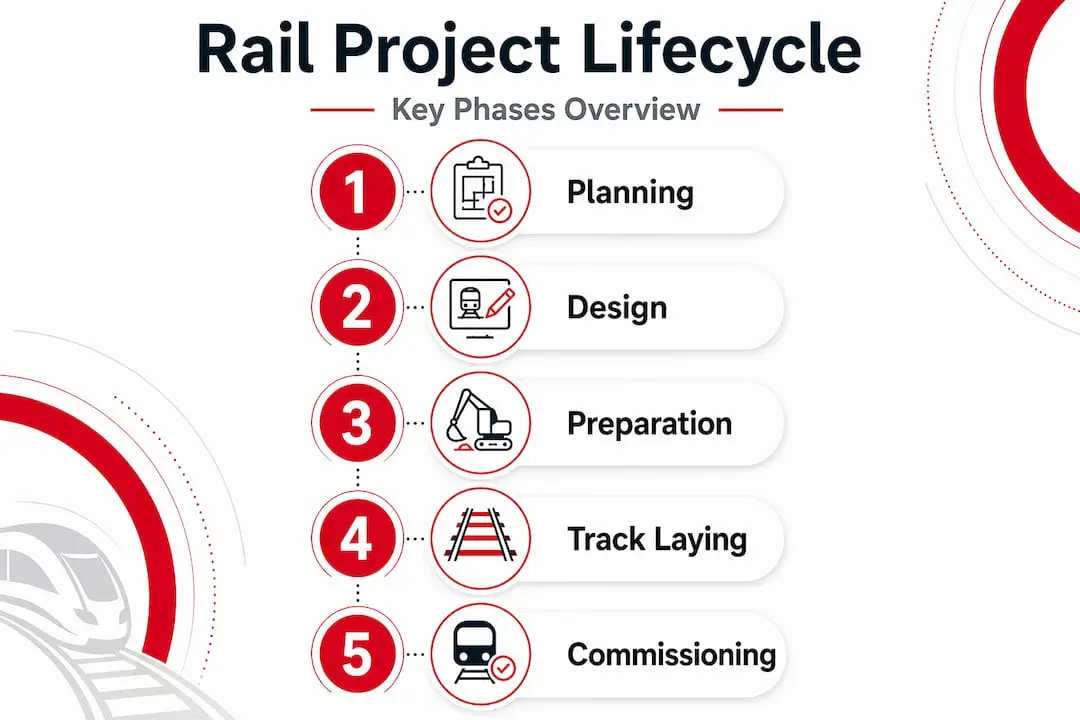
| Stage | Primary objective | Key activities |
|---|---|---|
| Feasibility and planning | Establish viability and scope | Site surveys, route analysis, stakeholder engagement, budget modelling |
| Engineering design | Translate requirements into technical specifications | Civil, structural, and systems design; regulatory submissions |
| Site preparation | Ready the physical environment | Land clearance, drainage, earthworks, utility diversions |
| Track laying | Install permanent way | Rail fastening, sleeper placement, ballasting |
| Special trackwork | Install switches and crossings | Turnout installation, alignment verification |
| Alignment and surfacing | Achieve geometric precision | Tamping, lining, levelling to tolerance |
| Inspection and testing | Verify performance and safety | Static checks, dynamic testing, systems integration verification |
Rail project planning at the earliest stages is where the most consequential decisions are made. Getting the scope, the risk register, and the stakeholder alignment right in feasibility prevents far costlier corrections during construction. Experienced teams for planning and quality control are not a luxury at this stage. They are a requirement.
The phased structure also supports safety assurance. Regulators and internal safety teams can review and formally accept each stage before authorising progression to the next. This staged acceptance model is what distinguishes rail infrastructure management from many other construction disciplines, where quality checks often happen after the fact rather than being baked into the delivery sequence.
Systems integration and commissioning challenges
If there is one aspect of rail project management that separates it from other infrastructure disciplines, it is the complexity of systems integration and commissioning. A railway is not simply a physical structure. It is an interconnected system of track geometry, signalling, traction power, rolling stock, communications, and control logic. Proving that all of those components work together safely is a dedicated phase in its own right.
Cross River Rail’s testing and commissioning illustrates this clearly. The programme uses four structured phases before any passenger can board a train:
- Static testing — individual components are checked in isolation before any power is applied to interconnected systems.
- Dynamic testing — trains run under controlled conditions to validate performance against design specifications.
- Integrated testing — the full system is operated as a network, identifying interface conflicts between subsystems.
- Operational readiness — staff are trained, emergency procedures are rehearsed, and maintenance processes are validated against safety regulator requirements.
That final phase deserves particular attention. Operational readiness includes running trains to real timetables, conducting safety scenario drills, and reviewing maintenance regimes. Only once this phase is formally signed off does the railway open to the public. It is painstaking, time-consuming work, and it is non-negotiable.
“Rail project management is fundamentally ‘systems-first’, managing complex interface challenges under safety-critical conditions.” — Rail Engineer
Pro Tip: When managing a commissioning programme, map every interface between subsystems on a single matrix early. Interface conflicts discovered during integrated testing are significantly more expensive to resolve than those identified during design. An interface register, maintained from day one, pays for itself many times over.
Governance, cross-network coordination, and technology
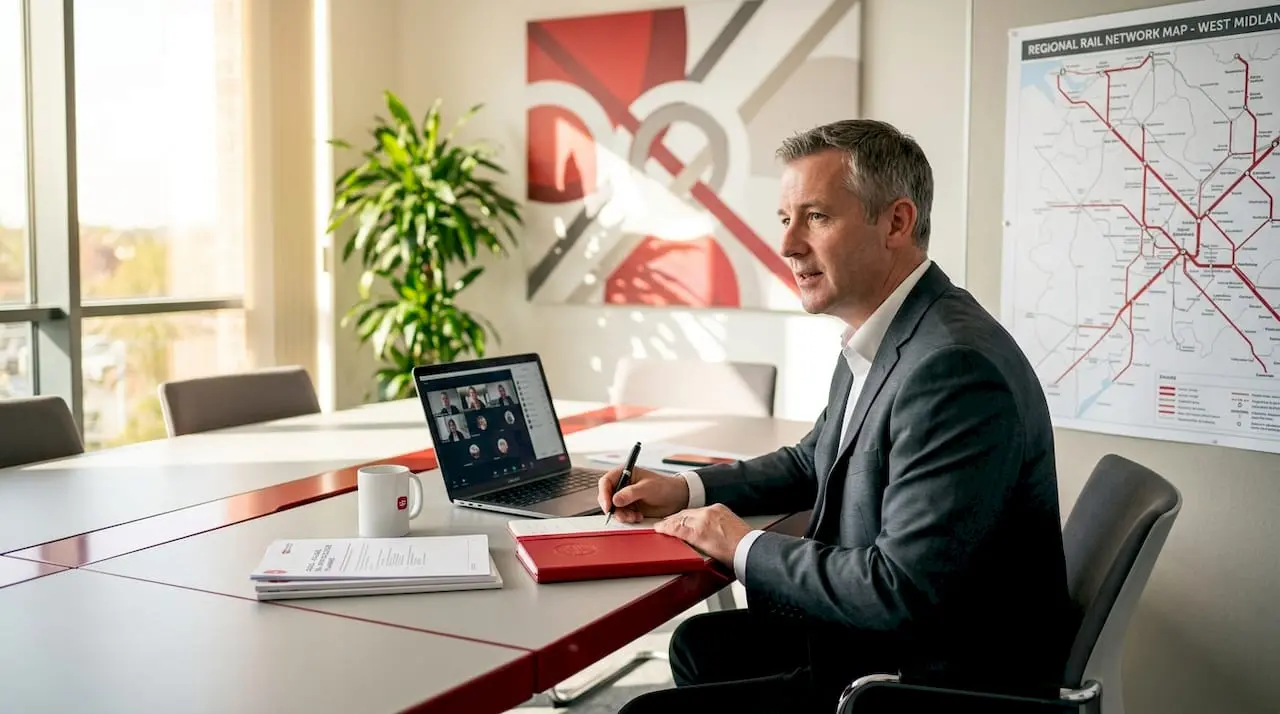
Major rail programmes rarely exist in isolation. They operate within wider national and international networks, which means rail project managers must understand governance structures that extend well beyond their own project boundary.
Signalling is the clearest example. The European Train Control System (ETCS), part of the broader European Rail Traffic Management System (ERTMS), is designed to allow trains to operate seamlessly across national borders without changing onboard equipment. ETCS is deployed on 10% of the TEN-T network and on 19% of the EU fleet as of 2024, with significant acceleration targets set for 2030 under the oversight of the European Union Agency for Railways (ERA).
Managing a project that must comply with ERTMS standards means coordinating with infrastructure managers, rolling stock manufacturers, national safety authorities, and the ERA simultaneously. The governance model for these programmes involves:
- National implementation plans aligned to EU deployment targets
- Technical committees reviewing interoperability compliance
- Safety cases submitted to national regulatory bodies
- Political oversight at ministerial level, given the scale of public investment
Accelerating ERTMS implementation is described by ERA as critical to a reliable and competitive European railway network. For rail project managers working on signalling upgrades or new infrastructure, understanding where their project sits within that wider programme is not optional background knowledge. It directly affects procurement strategy, design standards, and risk allocation.
Coordinating multi-stakeholder programmes across years, sometimes decades, also requires strong programme governance internally. Clear decision-making authority, change control processes, and earned value management are tools that translate abstract governance principles into daily delivery discipline.
Skills, methodologies, and the systems engineering mindset
Effective rail project management draws on a specific combination of technical understanding, methodological rigour, and interpersonal skill. You do not need to be a track engineer or a software developer, but you do need to understand enough about each discipline to ask the right questions and spot when an answer does not hold together.
The systems engineering approach provides the structural backbone. The V-diagram maintains a line of sight between programme goals and project execution, tracing requirements from the top-level brief down through detailed design and then back up through verification and validation testing. On a programme costing billions, this traceability is what prevents requirements from drifting silently through the delivery chain and resurfacing as expensive defects at commissioning.
In terms of methodology, rail project management draws on several well-established frameworks:
- PRINCE2 and APM Body of Knowledge for governance and delivery structure
- Systems engineering standards such as BS EN 15380 for rail applications
- Integrated baseline reviews to validate schedule and cost at key programme gates
- Risk workshops using Monte Carlo simulation for complex, long-duration programmes
Interpersonal capability is equally important. The skills for transport project professionals extend well beyond technical knowledge. Stakeholder management, written communication, and the ability to facilitate difficult conversations across disciplinary boundaries are what make a technically competent manager into an effective rail project leader.
Pro Tip: Build fluency in your programme’s risk register before anything else. On complex rail projects, the risk register is the most honest account of what the team does not yet know. Reading it regularly, and challenging assumptions within it, will tell you more about project health than any dashboard.
Getting started in rail project management
For those looking to build a career in this discipline, the pathway is structured but accessible. A background in engineering, planning, or project management provides strong foundations, but it is far from the only entry point. Many professionals transition from adjacent disciplines including transport planning, construction management, and operations.
Key steps to consider include:
- Pursuing APM (Association for Project Management) qualifications, which are widely recognised across UK rail programmes
- Exploring graduate schemes with major rail infrastructure clients such as Network Rail, Transport for London, and HS2 Ltd, as well as tier-one contractors
- Gaining exposure to systems engineering principles through courses or mentored project work, since this mindset is increasingly expected at mid-career level
- Building a professional network through industry events and forums, which surfaces opportunities long before they appear on job boards
Growing your transport career through networking is genuinely one of the most effective strategies in a sector where many roles are filled through direct recommendation. Staying connected to the wider rail community also keeps you informed about the direction of major programmes, which sharpens both your interview preparation and your strategic career planning.
A common pitfall for people entering rail infrastructure management is underestimating the documentation burden. Rail projects generate enormous volumes of technical records, safety submissions, and change logs. Developing strong habits around configuration management and record-keeping early in your career will serve you far better than any single qualification.
My perspective on the evolving complexity of rail projects
I have spent years watching rail programmes wrestle with the same fundamental tension. The technical complexity keeps growing, driven by digital signalling, electrification upgrades, and integration with smart city infrastructure. But the governance structures, and frankly the behaviours within large project teams, have not always kept pace.
What I have learned is that the projects which deliver well are not necessarily the ones with the most sophisticated tools. They are the ones where the project manager insists on clarity. Clarity about who owns each interface. Clarity about what “done” means at each stage gate. Clarity about what the risk register is actually telling you versus what the weekly highlight report would have you believe.
The future of railway project management will demand even more cross-disciplinary fluency. As autonomy, digitalisation, and decarbonisation reshape rail systems, the people managing these programmes will need to hold increasingly diverse technical conversations with authority. That is an opportunity, not a burden, for anyone willing to invest in genuine breadth of understanding.
— Rob
Start your rail project management career today
If this article has sparked your interest in railway project management or confirmed a direction you were already considering, the next step is finding the right opportunity. Jobs-in-Transport has been connecting transport professionals with meaningful roles since 2005, covering everything from graduate-level positions to senior programme delivery roles across the UK and internationally. Browse rail and transport project management jobs to see live vacancies, or create an online CV profile to get noticed by leading rail employers. You can also explore employer profiles to research organisations delivering the rail programmes you want to be part of.
FAQ
What does rail project management involve?
Rail project management covers the full lifecycle of a railway programme, from feasibility and engineering design through construction, systems integration, commissioning, and handover to operations. It requires coordinating multiple technical disciplines under safety-critical governance frameworks.
How many phases does a rail project lifecycle have?
A typical rail project moves through seven core phases: planning, engineering design, site preparation, track laying, special trackwork, alignment and surfacing, and inspection and testing. Phases progress logically to protect both safety and operational performance.
Why is systems integration so difficult in rail projects?
Rail systems involve thousands of interdependent components across track, signalling, traction, rolling stock, and control systems. Proving safe interoperability across all of them requires structured commissioning phases, as demonstrated by programmes like Cross River Rail.
What qualifications help in railway project management?
APM qualifications are widely recognised across UK rail programmes. Graduate schemes offered by Network Rail, Transport for London, and HS2 Ltd provide structured entry routes. Familiarity with systems engineering principles is increasingly valued at mid-career level.
What is ERTMS and why does it matter for rail project managers?
ERTMS is the European Rail Traffic Management System, designed to standardise train control across national networks. With ETCS on 10% of TEN-T by 2024 and acceleration required by 2030, rail project managers working on signalling or cross-border infrastructure must understand its governance and compliance requirements.


