
Traffic modelling is defined as the use of mathematical and computer-based tools to simulate how vehicles and road users move within a network, enabling engineers to test infrastructure scenarios and forecast demand before a single metre of road is built. Transport planners rely on platforms like PTV VISSIM, SUMO, and MATSim to replicate real-world conditions with enough fidelity to inform decisions worth millions of pounds. The discipline sits at the intersection of data science, civil engineering, and behavioural analysis, making it one of the most technically demanding and consequential skills in modern transport practice.
What is traffic modelling and why does it matter?
Traffic modelling, known formally as traffic simulation or transport demand modelling depending on scope, is the mathematical simulation of vehicle movement within a defined network to assess performance, identify bottlenecks, and evaluate design alternatives. The core purpose is not to predict the future with certainty. It is to give decision-makers a structured, evidence-based basis for comparing options.
The scale of the problem makes modelling indispensable. Traffic engineering manages networks where road users travel extraordinary distances every year, and even marginal improvements in flow efficiency translate into significant economic and safety gains. Without modelling, infrastructure decisions rely on professional judgement alone, which is neither defensible in planning inquiries nor sufficient for complex multi-junction schemes.

For transport planners and engineers, the practical value is direct. A model lets you test a proposed roundabout, a new signal phase, or a development access road against a calibrated base case before committing to construction. That ability to fail cheaply in a simulation rather than expensively on the ground is precisely why traffic modelling is shifting from a useful option to a non-negotiable step in infrastructure delivery.
What are the main types of traffic modelling?
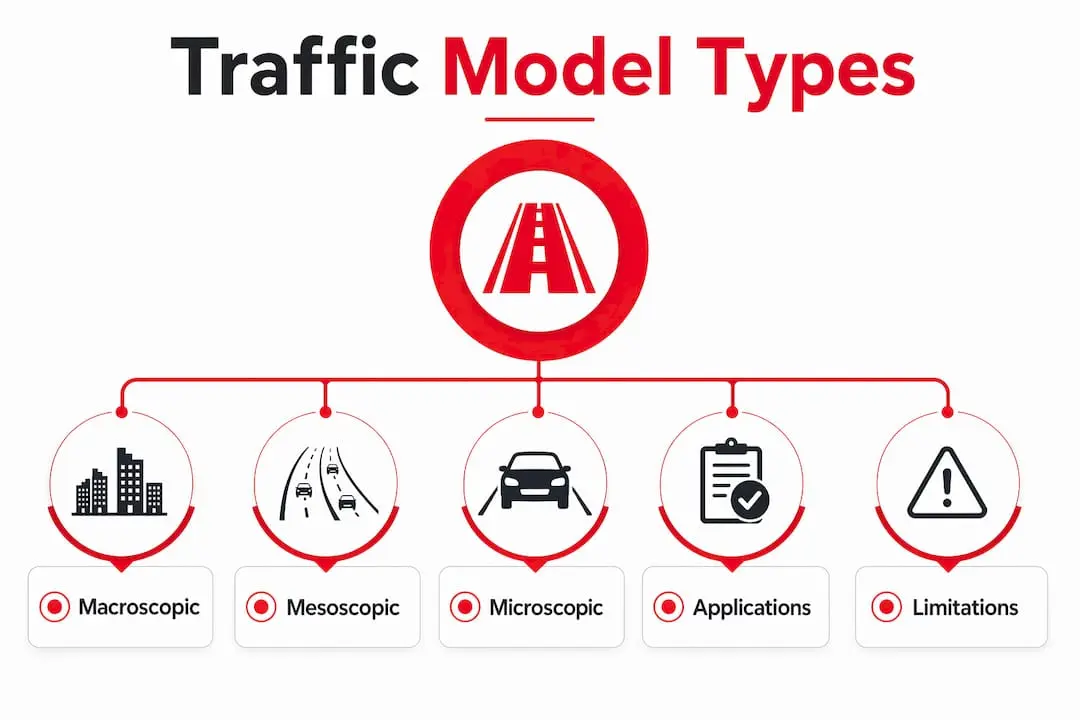
Traffic models are classified into three primary categories: macroscopic, mesoscopic, and microscopic. Each operates at a different level of detail, and choosing the wrong type for a project wastes time and produces misleading outputs.
Macroscopic models
Macroscopic models treat traffic as a fluid continuum, describing flow using aggregate variables such as density, speed, and volume. They are computationally efficient and well-suited to strategic network analysis, corridor studies, and regional demand forecasting. The trade-off is resolution. Individual vehicle interactions are invisible at this scale, which means junction-level behaviour cannot be assessed reliably.
Mesoscopic models
Mesoscopic models occupy the middle ground. They simulate individual vehicles or vehicle platoons but use simplified behavioural rules rather than full car-following logic. This balance makes them useful for city-scale studies where full microsimulation would be computationally prohibitive but aggregate models lack sufficient detail.
Microscopic models
Microscopic models simulate every vehicle individually, replicating driver behaviour, gap acceptance, lane changing, and signal response. Despite their detail, they rest on strong theoretical assumptions about driver behaviour, and their outputs are only as reliable as the calibration data underpinning them. PTV VISSIM is the industry benchmark for microscopic work, particularly at complex junctions and signal-controlled corridors.
| Model type | Scale | Typical use | Key limitation |
|---|---|---|---|
| Macroscopic | Network/regional | Strategic demand forecasting | No individual vehicle detail |
| Mesoscopic | City/corridor | Urban network studies | Simplified behavioural rules |
| Microscopic | Junction/corridor | Detailed operational analysis | Data-intensive, computationally heavy |
Pro Tip: If you are unsure which model type to use, start with the question: “What decision does this model need to support?” A strategic masterplan needs macroscopic outputs. A junction capacity assessment needs microscopic detail. Matching model type to decision type prevents over-engineering the analysis.
How do traffic simulation techniques work in practice?
Traffic simulation techniques translate real-world behaviour into mathematical rules that a computer can execute repeatedly across thousands of time steps. Three foundational methods underpin most modern tools.
Car-following models govern how each vehicle responds to the one ahead, adjusting speed based on gap distance and relative velocity. The Wiedemann model, used in PTV VISSIM, is one of the most widely implemented. Queuing theory describes how vehicles accumulate and discharge at bottlenecks, drawing on probability distributions to model arrival rates and service times. Cellular automata divide the road into discrete cells and update vehicle positions at each time step using simple rule sets, making them computationally fast for large networks.
Software tools differ significantly in how they implement these methods:
- PTV VISSIM excels in detailed intersection and signal analysis, offering high behavioural fidelity and extensive pedestrian modelling capabilities.
- SUMO (Simulation of Urban MObility) is open-source, balances computational efficiency with realistic dynamics, and integrates well with external data feeds.
- MATSim (Multi-Agent Transport Simulation) suits large-scale behavioural adaptation studies, modelling how travellers adjust their plans over repeated simulation days.
Tool selection requires assessing metrics like safe gap distance and travel-time accuracy rather than raw processing speed alone. A tool that runs quickly but misrepresents queue discharge behaviour will produce credible-looking but unreliable outputs.
Data inputs are equally critical. A simulation is only as good as the traffic counts, signal timings, turning movement surveys, and network geometry fed into it. Missing or outdated data at this stage compounds into significant error by the time results are presented to a planning authority.
Pro Tip: Begin with the simplest model that answers your question. Microsimulation is computationally intensive and should be reserved for corridors where detailed operational behaviour genuinely drives the decision. Starting simple also makes calibration faster and errors easier to identify.
Why is traffic modelling important for infrastructure design?
The importance of traffic modelling in infrastructure design comes down to one principle: decisions made at the planning stage influence network performance for decades. Models prevent costly over- or under-design by giving engineers quantified evidence for each design option rather than relying on rules of thumb.
Traffic flow analysis through modelling supports several distinct functions in the project lifecycle:
- Demand forecasting: Models project future traffic volumes under different growth and land-use scenarios, informing junction capacity and road geometry decisions.
- Development impact assessment: Comparing base and future scenarios identifies congestion and safety issues introduced by a new development, particularly in constrained brownfield networks where capacity is already marginal.
- Signal optimisation: Microsimulation allows engineers to test hundreds of signal timing combinations and identify the plan that minimises delay across a network.
- Safety analysis: Models reveal conflict points and queue spillback risks that would not be apparent from a static capacity calculation.
| Application | Benefit | Output used for |
|---|---|---|
| Demand forecasting | Quantifies future volumes | Junction design, road sizing |
| Development impact | Identifies congestion risk | Planning consent conditions |
| Signal optimisation | Reduces network delay | Signal timing plans |
| Safety assessment | Flags conflict points | Design modification |
The financial case is straightforward. Identifying a design flaw in a model costs hours of analyst time. Identifying the same flaw during construction costs orders of magnitude more, and identifying it after opening can mean years of remedial works and reputational damage for the project team.
What challenges should practitioners know about traffic modelling?
The most common mistake in traffic modelling is treating a calibrated model as a predictive machine. A model is a simplified reality, not a forecast engine. Its assumptions must be documented, justified, and communicated clearly to clients and decision-makers who may not share the practitioner’s technical background.
Calibration and validation are the most time-consuming phases of any modelling project, and they are also the most frequently underestimated. A poorly calibrated base case skews every scenario built on top of it. Validation against independent count data, travel-time surveys, and queue observations is not optional. It is the only mechanism that gives a model credibility in a planning inquiry or public examination.
Microscopic models carry specific risks. Their data requirements are substantial, their run times are long, and their outputs are sensitive to small changes in driver behaviour parameters. Practitioners should escalate to microsimulation only when the project genuinely demands that level of detail, not because the software is available or the client expects impressive visuals.
The deeper insight from experienced modellers is that consistent scenario comparison matters more than absolute accuracy in driver behaviour prediction. A model that reliably distinguishes between Option A and Option B under the same assumptions is far more useful than one that claims to replicate observed conditions perfectly but cannot be reproduced by a peer reviewer.
Pro Tip: Document every assumption in a modelling report appendix, including parameter values, data sources, and calibration statistics. This protects you professionally and gives reviewers the transparency they need to trust your outputs.
How to select the right traffic modelling approach for your project
Selecting the right approach starts with project scope and the decision the model must support. A regional transport strategy requires a strategic travel demand model. A junction improvement scheme requires microsimulation. Using a microscopic tool for a regional study wastes resources; using a macroscopic model for a signal timing assessment produces outputs that cannot answer the question.
Consider these factors when choosing a method and tool:
- Scale: Network-wide studies suit macroscopic or mesoscopic approaches. Corridor and junction studies suit microscopic tools.
- Data availability: Microsimulation requires detailed counts, turning movements, and signal data. If that data does not exist or cannot be collected within the project budget, a simpler model is more defensible.
- Timeframe: Full microsimulation calibration takes weeks. If the project timeline is tight, a simpler analytical model may be more appropriate and equally valid.
- Software capability: PTV VISSIM suits complex signal and pedestrian interactions. SUMO suits open-source, data-rich environments. MATSim suits large-scale behavioural studies where agent adaptation over time is relevant.
Skills in traffic engineering career paths increasingly include proficiency across multiple platforms, because real projects rarely fit neatly into one tool’s strengths. Engineers who can move between macroscopic demand models and microscopic simulation tools are significantly more valuable to consultancies and highway authorities alike.
Pro Tip: Use an iterative approach. Start with a simpler model to understand the network’s dominant behaviour, then escalate to microsimulation only for the specific elements where detail changes the answer. This saves time and produces more defensible outputs.
Key takeaways
Traffic modelling is most effective when model type, data quality, and project scope are aligned from the outset rather than adjusted retrospectively.
| Point | Details |
|---|---|
| Model type determines output quality | Match macroscopic, mesoscopic, or microscopic models to the decision being made, not to software availability. |
| Calibration is non-negotiable | A poorly calibrated base case invalidates every scenario built on it; validate against independent observed data. |
| Scenario comparison beats absolute accuracy | Models are approximations; their value lies in consistently distinguishing between design options. |
| Tool selection requires behavioural assessment | Evaluate tools on travel-time accuracy and gap acceptance realism, not processing speed alone. |
| Start simple, escalate deliberately | Begin with the least complex model that answers the question, then add detail only where it changes the outcome. |
Traffic modelling in practice: what I have learned
After years of working with transport teams across infrastructure schemes of varying scale, the pattern I see most often is practitioners reaching for microsimulation before they have answered a simpler question: does the level of detail actually change the recommendation? In most cases, a well-calibrated mesoscopic or even macroscopic model would have served the decision equally well at a fraction of the cost and time.
The other persistent misconception is that a model’s credibility comes from its complexity. Planning inspectors and technical reviewers are not impressed by elaborate visualisations if the calibration statistics are weak or the assumptions are buried in an appendix nobody reads. Credibility comes from transparency, reproducibility, and honest communication of uncertainty.
What I find genuinely exciting about the current period is the pace at which simulation technology is advancing. Tools are integrating real-time data feeds, machine learning for demand estimation, and autonomous vehicle behaviour modules. For transport planners and engineers who invest in professional development in modelling, the career opportunities are expanding rapidly. The discipline is no longer a niche specialism. It is central to how infrastructure gets approved, funded, and built.
My advice: treat every model as a communication tool as much as a technical one. The best modellers I have worked with spend as much time explaining their assumptions clearly as they do building the model itself.
— Rob
Advance your transport modelling career with Jobs-in-Transport

Traffic modelling expertise is one of the most sought-after skills in the transport sector right now, and the demand for qualified planners, engineers, and simulation specialists is growing across the UK and internationally. Jobs-in-Transport has connected transport professionals with specialist roles since 2005, covering highways, traffic management, transportation planning, and transport technology. Whether you are looking for your first modelling role or a senior position leading complex infrastructure schemes, you will find relevant transport jobs listed by the employers who matter. Visit Jobs-in-Transport to set up job alerts, upload your CV, and take the next step in your transport career.
FAQ
What is traffic modelling in simple terms?
Traffic modelling is the use of mathematical tools and software to simulate how vehicles move through a road network. It allows engineers to test design options and forecast congestion before infrastructure is built.
What are the three main types of traffic model?
The three types are macroscopic, mesoscopic, and microscopic. Macroscopic models treat traffic as a flow, mesoscopic models simulate vehicle groups with simplified rules, and microscopic models replicate individual vehicle behaviour in detail.
Which software is used for traffic modelling?
PTV VISSIM, SUMO, and MATSim are the most widely used platforms. VISSIM suits detailed junction analysis, SUMO balances efficiency and realism, and MATSim is designed for large-scale behavioural simulation.
Why is calibration so important in traffic modelling?
A poorly calibrated base model skews every scenario built on top of it. Calibration and validation against observed data are the steps that determine whether a model’s outputs are credible enough to inform planning decisions.
How do I choose between macroscopic and microscopic modelling?
Match the model type to the decision it must support. Strategic network studies suit macroscopic approaches; junction capacity and signal timing assessments require microscopic detail. Using a more complex model than the question demands wastes time without improving the answer.


