Traffic signal design is the process of planning and implementing traffic lights and control systems to manage the safe and orderly movement of vehicles and pedestrians at intersections. It sits at the intersection of civil engineering, data analysis, and human behaviour, requiring engineers to balance competing demands from drivers, cyclists, and pedestrians simultaneously. Standards such as the MUTCD 11th Edition Revision 1 provide the regulatory backbone, while signal controllers translate those standards into real-time decisions at every junction. Getting the design right reduces crashes, cuts congestion, and keeps people moving. Getting it wrong creates frustration, non-compliance, and genuine danger.
What is traffic signal design and why does it matter?
Traffic signal design is a branch of traffic signal engineering concerned with the physical placement, timing, and control logic of signals at road junctions. The discipline covers everything from where a signal pole sits relative to the kerb, to how many seconds a pedestrian phase lasts during peak hour. Poor design does not just slow traffic. It creates conditions where drivers lose confidence in the system and begin ignoring indications entirely.
The importance of traffic signal design becomes clear when you consider what signals actually do. They assign right of way to conflicting movements, protect vulnerable road users, and create predictable gaps in traffic flow for turning vehicles. A well-designed signal reduces the probability of right-angle collisions, which are among the most severe crash types at urban junctions. That safety function alone justifies the engineering rigour the discipline demands.
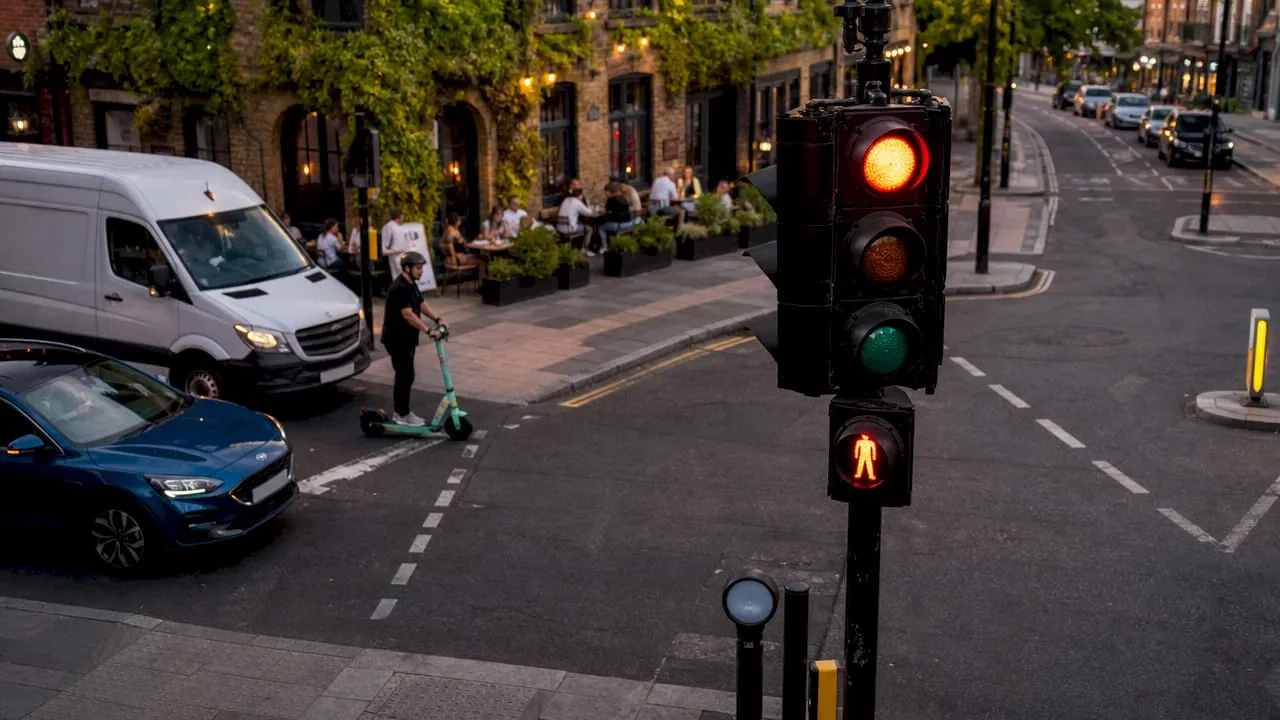
Traffic signal design principles draw on geometry, psychology, and statistics in equal measure. An engineer must understand sight lines, reaction times, and volume-to-capacity ratios before a single pole is specified. The discipline also requires familiarity with local authority standards, national guidelines, and increasingly, software tools that model queue lengths and delay under different phasing scenarios.
How do visibility and placement requirements shape signal design?
Signal visibility is the single most critical physical requirement in traffic signal design. MUTCD 11th Edition Revision 1 requires continuous visibility of at least two primary signal faces per approach from a minimum sight distance before the stop line. That requirement exists because a driver who cannot see a signal clearly cannot respond to it in time.
Angular placement matters as much as distance. Signals placed at approximately 20 degrees from the centre of the approaching lane maximise the driver’s ability to distinguish the active indication from surrounding street furniture and signage. When a signal face competes visually with illuminated shop fronts or overhead gantries, the design has failed before a vehicle arrives.
Pole placement must be planned simultaneously with pedestrian push-button locations to avoid accessibility conflicts and utility clashes. A pole positioned for optimal driver visibility may obstruct a tactile paving route or sit directly above a buried service. Resolving these conflicts early in the design process saves significant cost during construction.
Key visibility and placement principles include:
- Position signal heads so that at least two faces are visible per approach from the required sight distance.
- Place signal faces at roughly 20 degrees from the lane centreline to maximise indication clarity.
- Use backplates on signal heads in environments with complex visual backgrounds to improve contrast.
- Avoid physical obstructions such as tree canopies, parked vehicles, and overhead cables in the signal visibility zone.
- Coordinate pole locations with pedestrian push-buttons, tactile surfaces, and underground utilities from the outset.
Pro Tip: Use large-scale base maps derived from existing drainage or pavement plans during preliminary engineering. Base maps at 1 in. = 20 ft. give you accurate utility positions and kerb geometry before you commit to pole locations, cutting redesign time considerably.
How do different traffic control systems work?
Traffic control systems fall into three categories: fixed-time, actuated, and adaptive. Each suits a different traffic environment, and choosing the wrong type for a given junction is a common and costly mistake.
Fixed-time systems operate on a pre-set repeating schedule. The signal cycles through phases at the same intervals regardless of how many vehicles are actually waiting. This approach works well on corridors with highly predictable, consistent traffic volumes, such as town centre streets during weekday shopping hours. Outside those conditions, fixed-time systems waste green time on empty approaches and hold back queues unnecessarily.
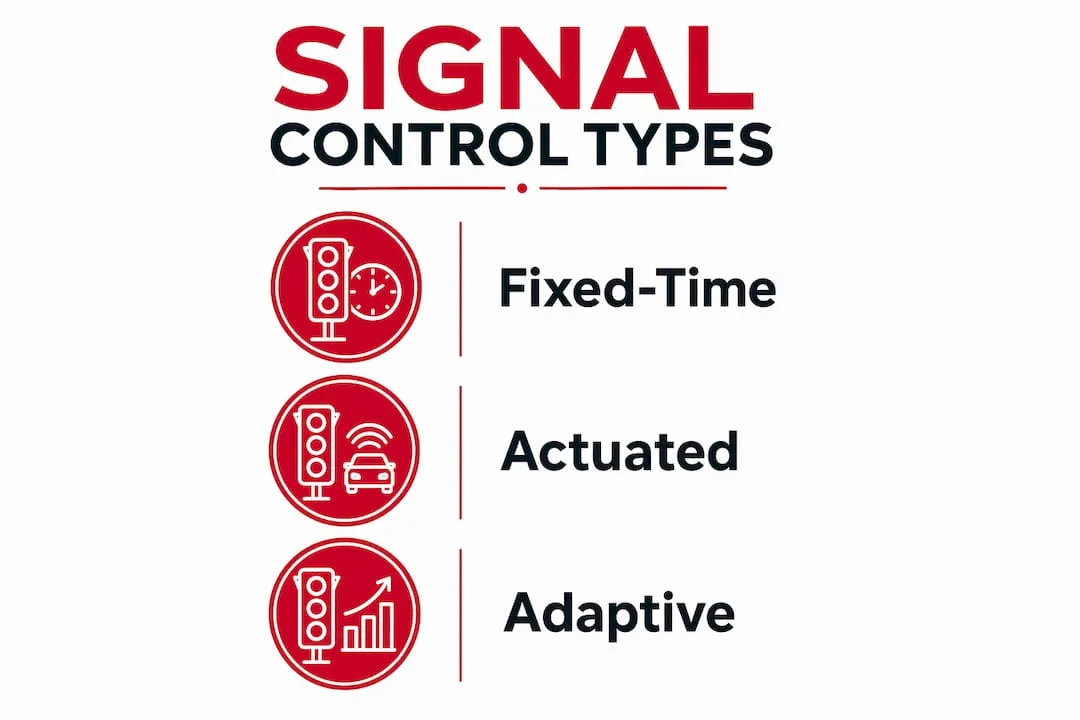
Actuated systems adjust their timing based on sensor input. Loop detectors, video cameras, or radar units detect vehicle presence and extend or cut short green phases accordingly. A side-road approach with light traffic gets a shorter green; a busy main road gets more time. Actuated systems represent a significant improvement over fixed-time control in locations with variable demand, which describes most urban junctions outside peak periods.
Adaptive systems go further still. They use real-time algorithms and networked communication to change signal phases and durations dynamically across multiple junctions simultaneously. The result is corridor-level optimisation rather than isolated intersection management. Adaptive traffic signal networks enable signals to communicate and optimise flows along entire corridors, representing a major shift in design philosophy. Reduced delays and lower vehicle emissions are the measurable outcomes.
Modern detection methods used in adaptive and actuated systems include:
- Inductive loop detectors embedded in the road surface, detecting vehicle presence by electromagnetic induction.
- Video detection cameras using image processing to count and classify vehicles, cyclists, and pedestrians.
- Radar and microwave sensors providing all-weather detection without road-surface installation.
- Thermal imaging units offering reliable detection in low-light and adverse weather conditions.
- Bluetooth and Wi-Fi sensors capturing connected device signals to estimate journey times and queue lengths.
Pro Tip: Multi-modal sensor detection capturing vehicles, bicycles, and pedestrians is now considered more critical than controller hardware quality for achieving effective intersection control. Specify your detection strategy before you specify your controller.
What timing and phasing decisions determine signal performance?
Cycle length is the total time for a signal to complete one full sequence of phases. Getting it right is one of the most consequential decisions in signal timing design. Short cycles reduce delay on high-volume approaches but may not provide enough time for pedestrians to cross safely. Long cycles minimise the number of phase changes but increase average waiting time, which directly affects driver behaviour.
Excessive cycle lengths increase driver frustration and raise the risk of non-compliance. When drivers wait through a long red with no visible cross-traffic, they begin to question the system’s logic. Some run the red. That is not a driver attitude problem. It is a design failure.
Phase sequencing determines which movements receive green simultaneously and in what order. A protected left turn phase, for example, prevents conflicts between turning vehicles and oncoming traffic. The sequence must account for pedestrian crossing phases, which require adequate time for the slowest users to cross the full width of the road. Integrating pedestrian phases without creating excessive overall cycle lengths is one of the genuine craft challenges in signal timing.
Green split allocation divides the available green time between competing phases. The split should reflect actual traffic volumes on each approach, not equal division. An approach carrying three times the volume of a side road should receive proportionally more green time.
| Timing element | Design principle | Risk of poor design |
|---|---|---|
| Cycle length | Match to peak volume and pedestrian crossing needs | Long cycles increase non-compliance |
| Phase sequence | Protect conflicting movements; integrate pedestrian phases | Missed conflicts raise crash risk |
| Green split | Allocate proportionally to approach volumes | Unequal splits create unnecessary queues |
| Pedestrian phase | Allow time for slowest user to cross full width | Short phases exclude vulnerable users |
Pro Tip: Always check pedestrian phase timing against the walking speed of an elderly person, not an average adult. Design for the slowest user and the junction works for everyone.
What are the emerging trends in traffic signal engineering for 2026?
Traffic signal engineering is shifting from static timing at isolated junctions to intelligent, networked systems that manage entire corridors in real time. This shift is not simply a technology upgrade. It represents a change in how engineers think about the problem. The junction is no longer the unit of analysis. The corridor, or even the network, is.
The integration of civil engineering with data science and IoT devices is now standard practice on major urban schemes. Signal controllers receive data from connected vehicles, weather sensors, and public transport tracking systems. That data feeds algorithms that adjust phase timing within seconds. The result is a system that responds to the actual state of the network rather than a model of what the network usually looks like.
Multi-modal detection capturing vehicles, bicycles, and pedestrians has become a design requirement rather than an optional enhancement. Junctions that detect only cars miss a significant proportion of road users and cannot optimise safely for mixed traffic environments. Modern sensor suites address this by combining video, radar, and thermal detection in a single unit.
Emerging priorities shaping signal design in 2026 include:
- Network-wide adaptive control systems that communicate across corridors to reduce stop-start driving patterns.
- Edge computing within signal controllers, enabling local processing of sensor data without reliance on central servers.
- AI-driven phase prediction that anticipates demand shifts before queues form.
- Cybersecurity integration as a foundational design element, protecting connected controllers from interference and attack.
- Multi-modal sensor suites that classify road users by type, enabling differentiated phase timing for cyclists and pedestrians.
Cybersecurity deserves particular attention. Signal controllers now operate as edge computing nodes on city IT networks. A compromised controller is not just a traffic problem. It is a public safety risk. Engineers specifying connected systems must treat cybersecurity as a core design requirement, not an afterthought.
Key takeaways
Effective traffic signal design combines physical placement, timing logic, and control technology to protect all road users and keep traffic moving efficiently.
| Point | Details |
|---|---|
| Visibility is non-negotiable | Two primary signal faces per approach must be continuously visible from the required sight distance. |
| Control system choice matters | Fixed-time, actuated, and adaptive systems each suit different traffic environments and volumes. |
| Timing errors cause safety risks | Excessive cycle lengths and poor green splits increase driver frustration and non-compliance. |
| Detection quality drives performance | Multi-modal sensor detection is now more critical than controller hardware for effective signal operation. |
| Cybersecurity is a design requirement | Connected signal controllers must be secured against interference as they operate on city IT networks. |
Why the fundamentals still win
The pace of change in traffic signal engineering is real. Adaptive networks, edge computing, and AI-driven controllers are reshaping what is possible at a junction. I have watched engineers get genuinely excited about the technology, and rightly so. But I have also seen schemes where the focus on software sophistication masked a basic visibility problem that a site visit would have caught in ten minutes.
The fundamentals do not become less important as technology advances. They become more important. An adaptive system built on a poorly placed pole with a partially obscured signal head will underperform a well-placed fixed-time controller every time. The algorithm cannot compensate for a driver who cannot see the signal.
What I find most encouraging about the current generation of traffic signal engineers is their willingness to treat human factors as a design input rather than a constraint. Pedestrian phase timing, signal legibility, and driver psychology are getting the same analytical attention as volume-to-capacity ratios. That shift in thinking is what will make the next generation of junctions genuinely safer, not just faster.
The challenge for practitioners is keeping pace with both the engineering fundamentals and the technology curve simultaneously. That requires ongoing education, peer networks, and access to the right career opportunities to build experience across different scheme types.
— Rob
Traffic signal design careers worth exploring
Traffic signal engineering sits within a broader transport sector that spans highways, urban planning, transport technology, and project management. Demand for engineers who understand both the physical design principles and the data-driven control systems is growing as cities invest in adaptive networks and connected infrastructure.

Jobs-in-transport has listed transport engineering roles across the UK and internationally since 2005. Whether you are a civil engineering graduate looking for your first traffic signal design role or an experienced engineer seeking a senior position in adaptive systems, the platform connects you with employers who need your specific skills. Browse current traffic engineering vacancies to see what is available right now across highways, traffic management, and transport technology.
FAQ
What is traffic signal design in simple terms?
Traffic signal design is the process of planning where traffic lights go, how they are timed, and how they respond to traffic. The goal is to move vehicles and pedestrians safely and efficiently through road junctions.
What standards govern traffic signal design in the UK?
UK traffic signal design follows the Traffic Signs Regulations and General Directions (TSRGD) and guidance from the Department for Transport. In the United States, the MUTCD 11th Edition Revision 1 sets the primary standard for signal placement and visibility.
What is the difference between actuated and adaptive traffic control systems?
Actuated systems adjust timing based on sensor detection at a single junction. Adaptive systems go further by communicating across multiple junctions to optimise flow along entire corridors in real time.
Why does cycle length matter in signal timing?
Cycle length determines how long drivers and pedestrians wait between green phases. Cycles that are too long increase frustration and raise the risk of drivers ignoring red signals, creating a direct safety hazard.
What role does cybersecurity play in modern signal design?
Connected signal controllers now operate as edge computing devices on city IT networks, making them potential targets for interference. Cybersecurity is now a foundational design requirement for any networked traffic signal scheme.


