
Transport engineering is one of the most misunderstood disciplines in the built environment. Ask most people what it involves and they will say roads. Maybe bridges. Perhaps traffic lights. But what is transport engineering in its fullest sense? It is a discipline that spans planning, geometric design, pavement engineering, freight logistics, traffic modelling, and system operations — a broad technical field that shapes how millions of people and goods move every single day. If you are an engineering student or early-career professional considering this path, understanding its true scope will change how you approach both your studies and your job search.
Table of Contents
- What transport engineering involves: core concepts and technical scope
- Integrating planning and operations in transport engineering
- Multimodal freight planning and legal frameworks in transport engineering
- Transportation modelling and performance measurement: tools for effective engineering
- Applying transport engineering knowledge to your career development
- Rethinking transport engineering: beyond roads and design
- Explore transport engineering careers with Jobs-in-Transport.com
- Frequently asked questions
What transport engineering involves: core concepts and technical scope
Transport engineering, or transportation engineering as it is also known, is the application of technology and scientific principles to the planning, functional design, operation, and management of infrastructure for any mode of transport. That includes roads, railways, airports, ports, pipelines, and even space transport systems.
Designing transportation facilities to meet capacity and geometry requirements is one of the central technical challenges in the field. In practice, this means making detailed decisions about:
- Facility sizing and lane capacity: How many lanes does a corridor need to handle projected traffic volumes without breaking down during peak hours?
- Vertical and horizontal alignment: The geometry of a road or railway track determines speed limits, sight distances, and safety outcomes. A poorly designed curve can cause accidents decades after construction.
- Pavement design: Choosing the right material and layer thickness for a road surface is not just about cost. It affects maintenance cycles, noise levels, and the environmental footprint of the whole route.
- Structural and drainage considerations: Culverts, retaining walls, and drainage channels are transport engineering decisions, not just civil engineering ones.
What makes transport engineering roles genuinely interesting is that these technical decisions do not exist in isolation. A lane width choice affects driver behaviour. A pavement material selection affects tyre noise in nearby homes. Every design decision ripples outward into the wider transport system and into people’s daily lives.
Pro Tip: When studying transport engineering basics, do not treat geometry and pavement design as separate modules. They interact constantly on real projects, and employers value graduates who understand those connections.

It is also worth noting that advanced transport technologies are reshaping even the most traditional areas of technical design, from smart pavement sensors to automated geometry checking tools. Understanding the fundamentals makes you better placed to work with these tools, not replaced by them.
Integrating planning and operations in transport engineering
The role of transport engineering extends well beyond the drawing board. One of the most important shifts in the field over the past two decades has been the move from purely project-driven thinking towards an objectives-driven approach.
Metropolitan transportation planning now integrates management and operations objectives as a performance-based approach, rather than simply deciding which projects to build and calling it done. This matters enormously for how transport engineers actually work day to day.
What does objectives-driven planning look like in practice? Consider these key dimensions:
- Measurable regional objectives: Instead of asking “shall we widen this road?” engineers ask “what level of congestion is acceptable on this corridor, and how do we get there?”
- System performance focus: Congestion, incident response times, freight reliability, and journey time variability all become engineering problems, not just policy ones.
- Operations as a core function: Traffic signal timing, variable message signs, incident management protocols — these are transport engineering responsibilities, not afterthoughts managed by someone else.
- Goods movement: The movement of freight through urban and inter-urban networks is a transport engineering concern involving road, rail, and waterway capacity planning simultaneously.
This planning and operations integration is where many students underestimate the field. They prepare for design work and are surprised to find that a significant proportion of transport engineering careers involve managing existing systems and improving their performance.
Building a strong CV for transport operations roles requires demonstrating that you understand both the technical and the performance measurement sides of the discipline. Employers want engineers who can read data and act on it, not just produce drawings.
Pro Tip: When applying for your first transport engineering position, highlight any coursework or project work that involved measuring system performance, not just designing infrastructure. That framing signals that you understand how modern transport engineering actually operates.
Multimodal freight planning and legal frameworks in transport engineering
One area of transport engineering that genuinely surprises students is the depth of legal and regulatory context that shapes engineering decisions. Nowhere is this clearer than in multimodal freight planning.
Multimodal freight planning means coordinating infrastructure investment and policy across every relevant transport mode at once, not treating road, rail, and port decisions as separate problems. State Freight Plans must be multimodal, addressing planning activities and investments across highway, rail, waterway, air, and pipeline modes within a single integrated framework. This is a legal requirement, not a best practice suggestion.
For engineers, this creates a specific set of coordination challenges:
- Understanding mode-specific constraints: A rail capacity bottleneck cannot be solved with road investment. Engineers need fluency across modes to identify where interventions actually help.
- Stakeholder coordination across sectors: Port authorities, rail operators, highway agencies, and aviation bodies rarely share the same planning cycles or funding sources. A transport engineer working in freight planning needs to navigate all of them.
- Regulatory compliance: Legal frameworks like State Freight Plans set minimum requirements for what must be addressed, but good engineering goes beyond compliance to optimise outcomes across the whole system.
- Data integration: Traffic counts, rail throughput data, port dwell times, and air freight volumes need to be brought together into a coherent picture. This is a transport engineering skill in its own right.
- Long-term investment prioritisation: Because freight infrastructure has a 30 to 50 year lifespan, the planning decisions made today shape economic geography for generations.
Staying across transport trends and freight engineering developments is increasingly important for early-career professionals. The shift to near-shoring supply chains and the growth of e-commerce are already changing what freight infrastructure needs to do, and transport engineers are at the centre of that response.
Transportation modelling and performance measurement: tools for effective engineering
Every transport engineering decision of any scale involves modelling. Modelling is not just a technical exercise — it is the primary way engineers test ideas before committing public funds to infrastructure that will exist for decades.
Understanding the main model types
| Model type | Basis | Best suited for |
|---|---|---|
| Trip-based (four-step) | Zonal trip data | Regional highway planning |
| Activity-based | Individual behaviour | Urban demand forecasting |
| Microsimulation | Vehicle interactions | Junction and corridor design |
| Freight models | Commodity flows | Multimodal freight planning |
The four-step model is still the workhorse of regional transport planning. Its components are:
- Trip generation: How many trips start and end in a given area?
- Trip distribution: Where do those trips go?
- Modal split: Which mode do people choose: car, rail, bus, walking?
- Traffic assignment: Which specific routes do those trips take through the network?
Each step introduces assumptions, and modelling is an analytical tool for forecasting travel demand, not a crystal ball. Recognising the limitations of your model is just as important as running it correctly.
Performance measurement focuses decision-makers on the characteristics that matter most in the transport system, making it possible to guide objectives-driven planning with real evidence. Without performance measures, modelling outputs have no benchmark against which to judge whether an intervention actually works.
Key performance measures in transport engineering include journey time reliability, network availability, accident rates, and freight throughput. Tracking these over time turns engineering from a one-off design activity into an ongoing management discipline.
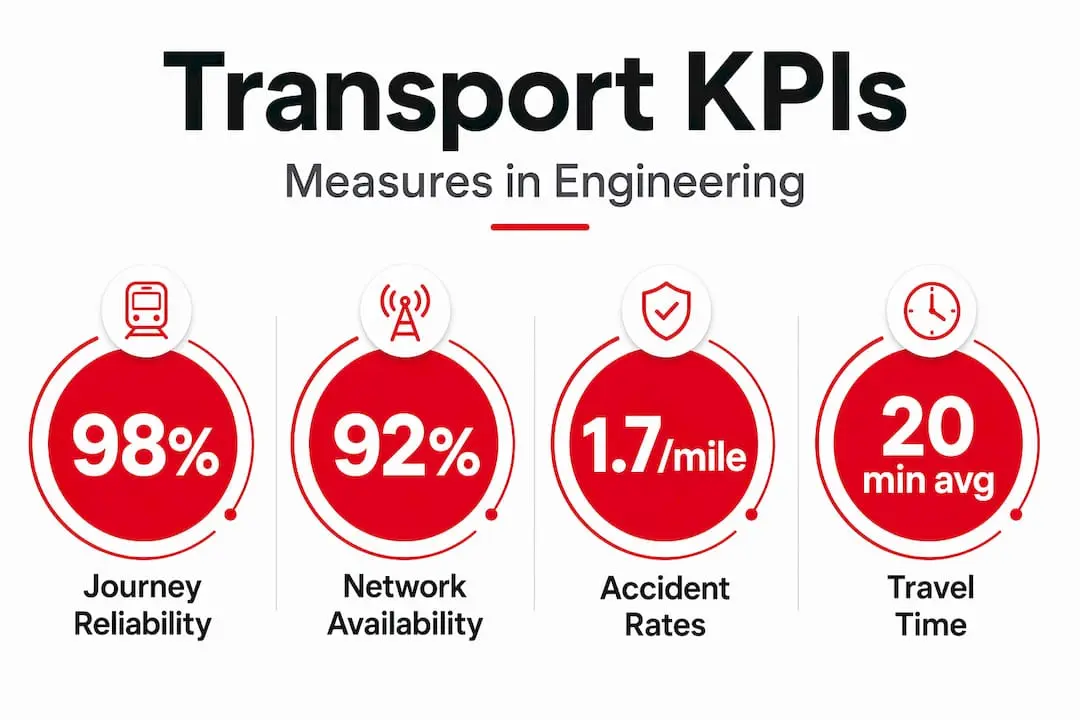
Understanding performance measurement in transport projects gives you a significant advantage in technical interviews and project work. Most graduates can describe the four-step model. Fewer can explain what a KPI framework for a transport corridor actually looks like in practice.
Pro Tip: When learning modelling tools, prioritise understanding why each step produces the outputs it does before focusing on software proficiency. Employers can train you on specific software. Critical judgement about model outputs is far harder to teach.
Roles involving transport modelling are among the most in-demand in the sector, particularly as data availability and computational power open up activity-based and real-time modelling approaches that were impractical even ten years ago.
Applying transport engineering knowledge to your career development
Understanding what transport engineering involves is only useful if you then do something with that knowledge. The good news is that the breadth of the discipline means there are genuine career pathways for people with very different strengths.
A transport engineering career might take you into:
- Highway and geometric design: Working on road alignments, junction layouts, and active travel infrastructure for local authorities or private consultancies.
- Traffic operations and management: Optimising signal timings, managing incidents, and improving network resilience for transport authorities.
- Transportation planning: Preparing transport assessments for major developments, modelling demand for new infrastructure, and advising on policy.
- Freight and logistics engineering: Designing and planning supply chain infrastructure, port facilities, and intermodal terminals.
- Transport technology: Working on connected and autonomous vehicles, smart infrastructure, and data systems that underpin modern network management.
Combining technical knowledge with planning and operations awareness makes you a much stronger candidate than someone who has only focused on one area. Exploring transport career opportunities across specialisms early in your career helps you discover where your interests and strengths genuinely lie.
Practically speaking, relevant experience matters. University project work, placements, and graduate schemes all count, but so does demonstrating that you understand the transport engineering landscape. Understanding the job search process in the transport sector can help you target applications more effectively and present your skills in the terms that employers actually use.
Rethinking transport engineering: beyond roads and design
Here is an uncomfortable truth that most transport engineering courses do not tell you clearly enough: the discipline has been defined too narrowly for too long, and it has cost the sector good engineers.
When students think of transport engineering as primarily a design discipline — roads, bridges, junctions — they self-select out of roles in operations, planning, and system management that are genuinely transport engineering work. They take jobs in other sectors when there were excellent transport engineering careers available, simply because those careers were not labelled the way they expected.
Transportation engineering spans planning and modelling, geometric and pavement design, and traffic operations and management, and it requires performance-measure thinking from the earliest stages of a project to succeed. That is not three separate disciplines loosely grouped together. It is one integrated field with multiple specialisms that need to talk to each other constantly.
The engineers who thrive in this sector are those who resist the temptation to become narrowly expert too early. The technical specialist who also understands planning processes is far more valuable than the one who does not. The modeller who can interpret operational data is more useful than one who cannot leave the spreadsheet.
We have seen this pattern repeatedly in the transport job market. The professionals advancing most quickly are not always the most technically brilliant in a single area. They are the ones who built enough cross-disciplinary understanding early in their careers to move fluidly between project types and client needs. Exploring innovations in transport engineering as they emerge, rather than waiting until they become standard practice, is part of that same mindset.
If you are studying transport engineering now, the most valuable thing you can do is read and engage beyond your own specialism. Operations people should understand modelling. Designers should understand planning policy. Freight engineers should understand urban mobility challenges. The connections between these areas are where the most interesting engineering problems actually live.
Explore transport engineering careers with Jobs-in-Transport.com
If this article has clarified what transport engineering involves and sparked a clearer sense of where your career could go, the next practical step is finding roles that match your interests and skills.
Jobs-in-Transport.com has been connecting transport professionals with specialist employers since 2005. Whether you are looking for your first graduate role in highway design, a position in transport planning, or a move into traffic operations, the platform lists opportunities across the UK and internationally. You can upload your CV, set up alerts for new roles, and browse employer profiles to understand who is hiring and what they value. Visit the jobseeker resources section to find practical guidance on applications and career development tailored to the transport sector.
Frequently asked questions
What are the main areas covered by transport engineering?
Transportation engineering covers planning, design, construction, maintenance, and operation of facilities across air, highway, railroad, pipeline, water, and space transport, all aimed at the safe and efficient movement of people and goods.
How does transport engineering relate to transportation planning and operations?
Transport engineering integrates technical design with planning and operations through objectives-driven, performance-based approaches that focus on measurable outcomes such as congestion management and journey time reliability, rather than just delivering individual projects.
What is multimodal freight planning in transport engineering?
It is the coordinated planning of freight infrastructure across all relevant modes simultaneously. State Freight Plans must be multimodal and comprehensive, covering highway, rail, waterway, air, and pipeline investments within a single legal framework.
Why are transportation models important in transport engineering?
Modelling forecasts travel demand and evaluates how infrastructure changes will affect system performance, allowing engineers and planners to test options and prioritise investments before committing public funds.
How can engineering students advance their career in transport engineering?
Build knowledge across planning, design, and operations rather than specialising too early, seek relevant placements, and use sector-specific jobseeker resources to target roles effectively and stay current with emerging technologies and trends shaping the transport sector.
Recommended
- Jobs in Transport, Bus jobs, Highways & Traffic jobs, Transportation Planning jobs, Transport Technology jobs, Project Management jobs, Transport Leaders jobs
- Jobs in Transport, Bus jobs, Highways & Traffic jobs, Transportation Planning jobs, Transport Technology jobs, Project Management jobs, Transport Leaders jobs


