
Transport modelling is defined as the use of mathematical and computational frameworks to simulate how people and goods move across transport networks, enabling planners and engineers to forecast demand and test infrastructure decisions before a single metre of road is built. The four-step travel demand model covering trip generation, distribution, mode choice, and route assignment forms the globally recognised foundation of the discipline. Software platforms such as PTV Visum, AIMSUN, and VISSIM translate these frameworks into working simulations that transport professionals use daily. Whether you are a civil engineering graduate or a seasoned transport planner, understanding what transportation modelling involves is the starting point for credible, evidence-based work.
What is transport modelling and why does it matter?
Transport modelling is the structured process of representing a transport system mathematically to analyse current performance and forecast future conditions. Its primary value lies in allowing decision-makers to evaluate infrastructure options, policy changes, and demand scenarios without the cost or risk of physical trial and error.
The importance of transport modelling becomes clear when you consider the scale of investment involved. A new motorway junction, a light rail extension, or a congestion charge zone each carries costs in the hundreds of millions of pounds. Comparative scenario analysis supports data-driven decisions by quantifying impacts on congestion, travel times, and network capacity before construction begins. That evidence base is what separates a credible business case from an assumption-driven proposal.

Transport modelling also underpins sustainability planning. The discipline has shifted towards multimodal analysis incorporating cycling, walking, and transit alongside private vehicle traffic to meet modern sustainability goals. This evolution reflects the priorities of organisations such as Transport for London, Highways England, and local transport authorities across the UK.
What are the core components of a transport model?
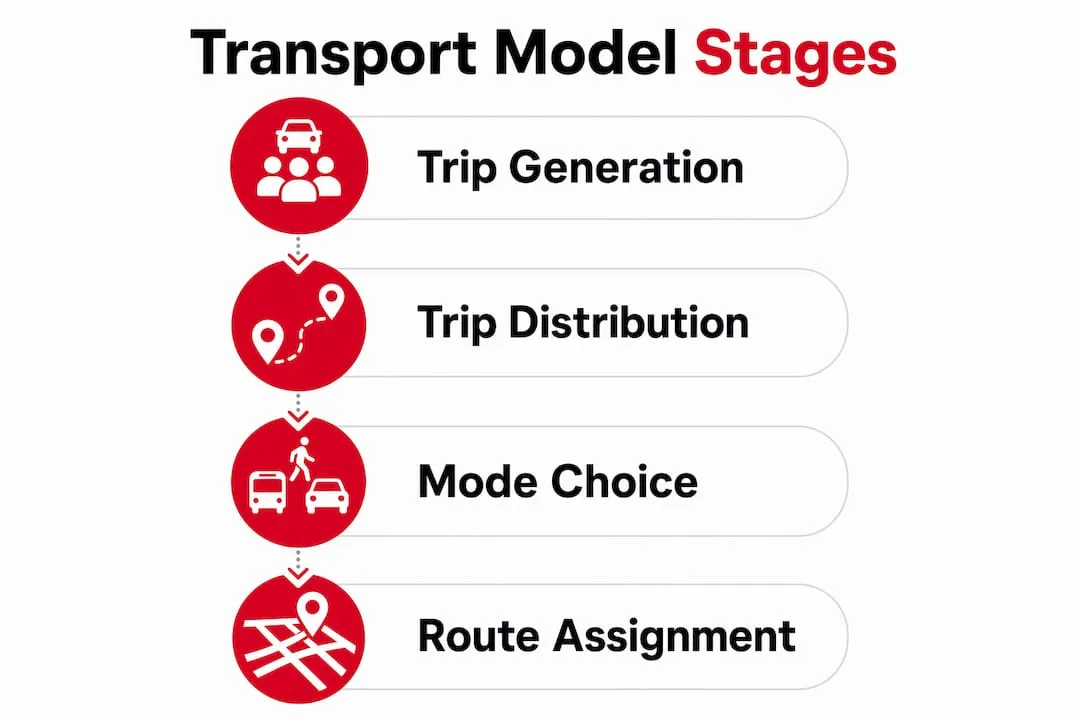
The standard workflow follows four sequential steps, each building on the output of the previous one.
- Trip generation estimates how many trips originate from and arrive at each zone in the study area, based on land use and socio-economic data.
- Trip distribution determines where those trips go, matching origins to destinations using gravity-type models.
- Mode choice allocates trips across available modes, such as car, bus, rail, or cycling, using utility functions that weigh cost, time, and comfort.
- Route assignment loads the distributed trips onto the network, predicting which links and junctions carry the most traffic.
Building a reliable model requires diverse data inputs including demographics, traffic counts, transit ridership, and land-use data. The quality of these inputs determines the quality of every output that follows.
The table below summarises the data types typically required at each stage.
| Model Stage | Primary Data Inputs | Scale |
|---|---|---|
| Trip Generation | Population, employment, car ownership | Regional to local zone |
| Trip Distribution | Origin-destination surveys, journey purpose | Zone-to-zone |
| Mode Choice | Fare data, journey times, service frequency | Corridor or network |
| Route Assignment | Link capacity, speed-flow curves, junction data | Network link level |
Understanding the distinction between demand and supply is also fundamental. Demand represents the travel people wish to make. Supply represents the network capacity available to accommodate it. The model iterates between the two until a state of equilibrium is reached, where no traveller can improve their journey by switching route or mode.
How does calibration and validation ensure reliability?
A transport model is only as trustworthy as its calibration and validation process. Calibration and validation involve comparing model outputs with observed real-world data to confirm the model faithfully replicates actual transport system behaviour.
Calibration adjusts model parameters, such as value-of-time coefficients or capacity restraint factors, until the model reproduces observed conditions within acceptable tolerances. Validation then tests the calibrated model against an independent dataset it has never seen, confirming its predictive reliability. The two processes are distinct and both are non-negotiable for credible work.
Common pitfalls that undermine model reliability include:
- Poor data quality. The principle known as “garbage in, garbage out” applies directly. Over-fitting to historical data weakens predictive power for future scenarios, so emphasis must be on quality inputs rather than sophisticated software alone.
- Insufficient validation datasets. Using the same data for both calibration and validation produces a model that performs well on paper but fails in practice.
- Ignoring model sensitivity. A model that produces identical results regardless of input changes is not a useful planning tool.
Pro Tip: When reviewing model outputs, always run sensitivity tests by varying key inputs by ±10–20% and observing how results change. If the model barely responds, your parameters may be over-constrained. If results swing wildly, your data quality needs attention before the model is used for policy decisions.
Models do not predict the future with certainty. They act as decision engines to test various scenarios and prepare for potential futures. Treating model outputs as a range of plausible outcomes rather than a single definitive forecast is the mark of a competent practitioner.
What types of transport models exist and how do they compare?
Transport modelling techniques span a wide spectrum of complexity and application. Choosing the correct type is pivotal to project success and resource efficiency.
The broadest distinction is between static equilibrium models and dynamic traffic assignment (DTA) models. Static models represent average flow conditions over a fixed period, typically a peak hour. DTA models capture temporal complexities of congestion forming and clearing over time, making them suitable for detailed operational studies such as incident management or signal optimisation.
Models also differ by spatial scale:
- Macroscopic models represent traffic as aggregate flows on links, using speed-flow relationships. PTV Visum operates primarily at this scale and is widely used for strategic network planning.
- Mesoscopic models combine aggregate flow with individual vehicle behaviour, offering a middle ground between detail and computational speed.
- Microscopic models simulate every individual vehicle and its interactions. AIMSUN and VISSIM both offer microscopic simulation, making them the tools of choice for junction design, roundabout analysis, and pedestrian modelling.
The comparison table below summarises the main model types, their complexity, and their typical applications.
| Model Type | Scale | Complexity | Typical Use Case |
|---|---|---|---|
| Static Equilibrium | Macroscopic | Low to medium | Strategic network planning, long-term forecasting |
| Dynamic Traffic Assignment | Macroscopic/Mesoscopic | Medium to high | Operational studies, congestion management |
| Microscopic Simulation | Individual vehicle | High | Junction design, signal timing, pedestrian flow |
| Multimodal Demand Model | Network-wide | Medium to high | Public transport planning, active travel assessment |
Multimodal modelling deserves particular attention. A model that only represents private car traffic is no longer fit for purpose in most UK planning contexts. Modern transport modelling software, including PTV Visum and AIMSUN, supports walking, cycling, and public transport assignment within a single integrated framework.
How is transport modelling applied in planning and infrastructure?
Transport modelling examples span the full range of planning and engineering work. The discipline connects directly to transport planning principles that influence policy and infrastructure investment at every level of government.
Practical applications include:
- Infrastructure appraisal. Modelling a proposed bypass, bridge, or rail station before design freeze allows engineers to identify capacity bottlenecks and test mitigation measures at minimal cost.
- Policy testing. Congestion charging schemes, parking restrictions, and low-emission zones are all modelled extensively before implementation. Transport for London used detailed demand modelling to forecast the impacts of the Ultra Low Emission Zone before its 2019 launch.
- Public transport planning. Bus network redesigns and rail timetable changes rely on ridership forecasting models to predict passenger flows and revenue impacts.
- Active travel assessment. Cycling and walking demand models now form a standard part of Local Transport Plans, particularly following the Department for Transport’s Active Travel guidance.
- Development impact assessment. Planning applications for large housing or commercial developments require Transport Assessments that use modelling to demonstrate network impacts and propose mitigation.
Forecasting future travel demand is perhaps the most consequential application. A model built today may be used to justify infrastructure that will serve communities for 50 years. The accuracy of socio-economic projections, land-use assumptions, and mode shift forecasts directly shapes the quality of those long-term decisions.
Career opportunities in this space are growing. Roles in transport planning, traffic modelling, and multimodal assessment appear consistently across transport sector job listings, reflecting sustained demand for professionals who can build, calibrate, and interpret models at both strategic and operational scales.
Key takeaways
Transport modelling is a structured, evidence-based discipline that requires quality data, rigorous calibration, and the right model type to produce results that genuinely inform planning and policy decisions.
| Point | Details |
|---|---|
| Four-step model is foundational | Trip generation, distribution, mode choice, and route assignment form the globally recognised framework. |
| Data quality determines output quality | Poor inputs compromise all modelling efforts regardless of software sophistication. |
| Calibration and validation are non-negotiable | Comparing outputs against observed data confirms model reliability before it influences decisions. |
| Model type must match the task | Static, dynamic, microscopic, and multimodal models each suit different project scales and questions. |
| Modelling supports decisions, not certainties | Models test scenarios and prepare for potential futures rather than predicting a single outcome. |
Why transport modelling is more art than algorithm
I have spent years watching talented engineers place enormous faith in model outputs, only to be caught out when reality diverges from the forecast. The uncomfortable truth is that a transport model is only as good as the assumptions baked into it, and those assumptions are made by people with incomplete information about an uncertain future.
The most common mistake I see from practitioners early in their careers is treating the model as an authority rather than a tool. A model that shows a scheme performs well does not mean the scheme will perform well. It means the scheme performs well given the assumptions you have made. That distinction matters enormously when you are presenting results to a local authority committee or a public inquiry.
What separates strong modellers from average ones is not software proficiency. It is the ability to communicate model outcomes to non-technical stakeholders in a way that is honest about uncertainty. Technical accuracy alone does not guarantee decision-making impact. A beautifully calibrated model that nobody understands will not move a budget committee.
My advice to anyone entering this field: learn the four-step model thoroughly, get comfortable with PTV Visum or AIMSUN early, and then invest just as much time in learning how to explain your results as you do in building them. The future of transport modelling lies in multimodal, data-rich environments where autonomous vehicles and real-time sensor data will reshape our inputs entirely. The practitioners who thrive will be those who combine technical depth with clear, confident communication.
— Rob
Build your transport modelling career with Jobs-in-transport

Transport modelling skills are in consistent demand across the UK and internationally, from local authority transport teams to global engineering consultancies. Whether you are a graduate looking for your first modelling role or an experienced planner seeking a senior position, Jobs-in-transport connects you with the opportunities that match your expertise. The platform lists roles across transport planning and modelling, highways, traffic management, and project management, all in one place. Jobs-in-transport has been serving transport professionals since 2005, making it the specialist resource for anyone serious about building a career in this field.
FAQ
What is transport modelling in simple terms?
Transport modelling is the process of using mathematical frameworks to simulate how people travel across a network, allowing planners to forecast demand and test infrastructure changes before they are built.
What is the four-step travel demand model?
The four-step model covers trip generation, trip distribution, mode choice, and route assignment. It is the globally foundational framework for forecasting the effects of land use and network changes on travel demand.
What software is used in transport modelling?
PTV Visum is widely used for strategic network planning, AIMSUN and VISSIM are preferred for microscopic simulation of junctions and pedestrian flows, and all three support multimodal analysis.
Why is calibration important in transport modelling?
Calibration adjusts model parameters until outputs match observed real-world data, confirming the model accurately replicates actual transport behaviour and can be trusted to inform policy decisions.
What is the difference between static and dynamic traffic assignment?
Static models represent average flow over a fixed period, while dynamic traffic assignment captures how congestion forms and clears over time, making it suitable for detailed operational studies.


