
Transportation demand management (TDM) is defined as a strategic approach to optimising transport system efficiency by influencing travel behaviour rather than expanding road capacity. The FHWA Office of Operations describes TDM as a set of policies and programmes designed to maximise traveller choices and shift demand away from single-occupancy vehicles, particularly at peak times. The Association for Commuter Transportation recognises TDM as a discipline in its own right, covering tools from employer travel plans and pricing incentives to active transport infrastructure and real-time digital travel information. For urban planners, transport policy makers, and researchers, understanding demand management is the foundation for building transport networks that are resilient, equitable, and sustainable.
What is transportation demand management and how does it work?
TDM is the practice of managing how, when, and whether people travel, rather than simply building more roads to accommodate growth. The core philosophy, as articulated by Wikipedia’s TDM entry, is that meeting unfettered travel demand is both impractical and unsustainable. Managing demand by expanding sustainable alternatives and providing incentives for sustainable travel is the only viable long-term path.
The approach works across three dimensions. First, it reduces the total number of trips made, for example through remote working policies. Second, it redistributes trips across time, spreading peak demand into off-peak periods. Third, it shifts trips between modes, moving people from private cars onto public transport, cycling, or walking.

Modern TDM, as the FHWA reports, has moved well beyond its origins in ridesharing programmes. It is now embedded in performance-based, objective-driven planning integrated with all levels of transport operations. That shift matters because it means TDM is no longer a bolt-on measure. It is a core component of how transport systems are designed, monitored, and evaluated.
What strategies and techniques does TDM use?
TDM strategies divide broadly into two categories: hard measures and soft measures. Hard measures use financial or physical mechanisms to change behaviour directly. Soft measures rely on information, persuasion, and incentives to encourage voluntary change.
Hard measures include:
- Congestion pricing and road user charging
- Workplace parking levies
- Reduced or priced car parking at destinations
- Dedicated cycling and pedestrian infrastructure
Soft measures include:
- Employer travel plans and personalised travel planning
- Real-time multimodal journey information via apps and digital displays
- Promotion of active travel through public campaigns
- Flexible and remote working arrangements
| Strategy | Primary benefit | Key challenge |
|---|---|---|
| Congestion pricing | Reduces peak-hour vehicle volumes | Public acceptance and perceived fairness |
| Employer travel plans | Targets commuter behaviour directly | Requires employer buy-in and resources |
| Active travel infrastructure | Shifts short trips to walking or cycling | Needs sustained capital investment |
| Real-time travel information | Supports informed modal choice | Depends on data quality and coverage |
| Remote working policies | Eliminates trips entirely | Not applicable to all job types |
The NSW Government’s travel demand management guidance highlights that TDM strategies deliver the strongest results when deployed during periods of disruption, such as infrastructure upgrades, major public events, or significant urban development. These are the moments when travellers are already reconsidering their routines.
Pro Tip: Time your TDM interventions to coincide with planned disruptions or infrastructure works. Travellers who are forced to change their routine are far more receptive to adopting new habits permanently.
How does TDM improve mobility and reduce congestion?
The central mechanism behind TDM’s effectiveness is its direct response to induced demand. Research on induced demand confirms that expanding road capacity leads to increased traffic over time, negating the congestion relief that new infrastructure was meant to provide. TDM counters this by managing demand to optimise existing infrastructure rather than triggering further growth in vehicle trips.
TDM influences travel behaviour across three dimensions simultaneously:
- Temporal shifting: spreading peak demand into shoulder periods through flexible working hours or off-peak pricing
- Spatial shifting: redistributing traffic across alternative routes or destinations
- Modal shifting: moving trips from private cars to public transport, cycling, or walking
The outcomes from well-implemented TDM programmes are measurable. Reduced vehicle kilometres travelled translates directly into lower carbon emissions, improved air quality, and public health gains. Fewer vehicles on the road at peak times reduces accident rates and cuts the economic cost of congestion.
| TDM outcome | Mechanism | Wider benefit |
|---|---|---|
| Reduced peak traffic volumes | Temporal and modal shifting | Lower emissions and fuel consumption |
| Increased public transport use | Pricing and travel planning | Reduced per-trip carbon footprint |
| Higher active travel rates | Infrastructure and promotion | Improved population health outcomes |
| Fewer vehicle kilometres travelled | Trip elimination via remote work | Reduced road wear and maintenance costs |
The FHWA’s performance-based planning framework requires TDM programmes to set formal, measurable objectives. That requirement is not bureaucratic overhead. It is what allows planners to demonstrate return on investment and secure continued funding.
Pro Tip: Connect every TDM programme to at least two measurable performance indicators from the outset. Programmes with clear metrics attract legislative support and survive budget reviews far more reliably than those without.
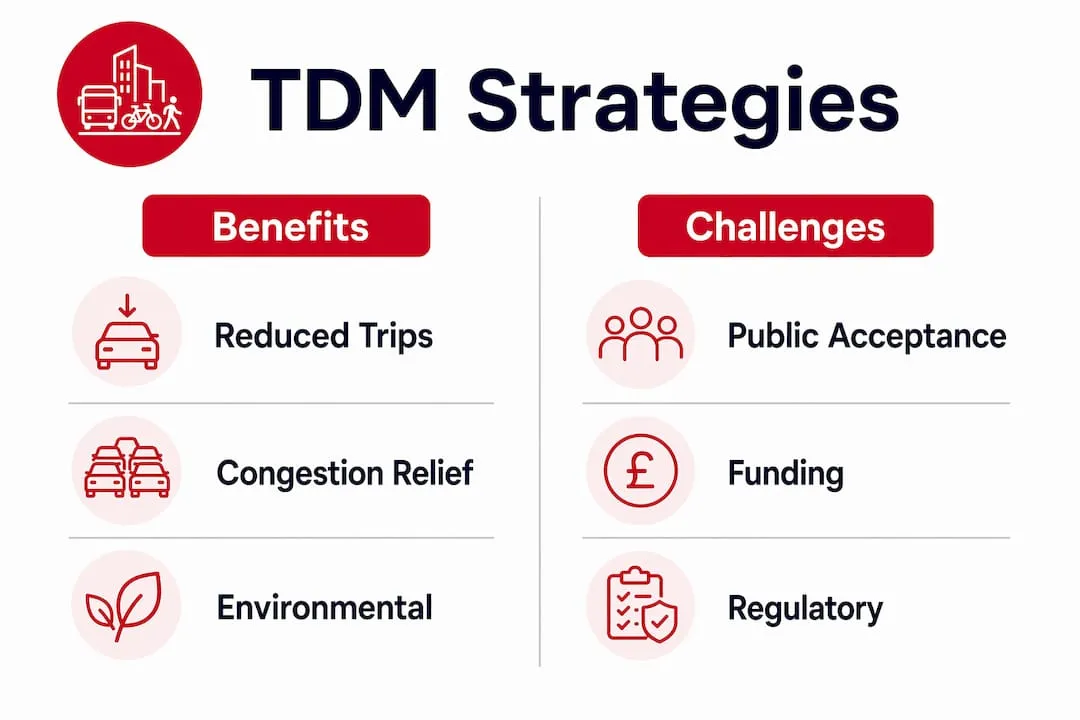
What are the challenges in implementing TDM?
Public acceptance is the most persistent barrier to TDM adoption. Congestion pricing, in particular, faces resistance because it is perceived as a tax on mobility rather than a tool for improving it. Marketopia’s analysis of TDM challenges identifies overcoming public acceptance and funding constraints as the two critical hurdles for advanced TDM strategies.
Funding is a structural challenge. TDM programmes often deliver diffuse benefits across a wide population, making it harder to build the concentrated political support that large infrastructure projects attract. Clear cost-benefit communication is not optional. It is the mechanism by which planners secure and retain resources.
The regulatory environment adds further complexity. State Commute Trip Reduction programmes require technical committee approval and legislative adoption before they can mandate or incentivise commuter behaviour change. That process takes time and demands sustained stakeholder engagement.
Timing is also a genuine strategic variable. NSW Government research shows that TDM success depends heavily on synchronising interventions with moments of change in traveller behaviour, such as a job change, a home relocation, or a major construction project. Attempting to shift deeply embedded habits outside these windows is significantly less effective.
Voluntary versus mandated approaches present a further policy choice. Voluntary programmes are easier to introduce but produce smaller, less consistent behaviour change. Mandated programmes, such as legislated Commute Trip Reduction plans, deliver more reliable outcomes but require a stronger political and legal foundation.
How does TDM fit into wider transport and urban planning?
TDM does not operate in isolation. It is most effective when embedded within a broader transport planning framework that connects land use, infrastructure investment, and policy levers into a coherent system.
The evolution of TDM reflects this integration. What began as a collection of ridesharing initiatives in the 1970s has become, as the FHWA confirms, a comprehensive, objective-driven planning approach integrated with transport operations at every level. Regional planning bodies now incorporate TDM targets into long-range transport plans, and legislative bodies in several jurisdictions have formally adopted TDM requirements.
The connections to wider policy goals are direct and significant:
- Climate change mitigation: TDM reduces vehicle kilometres travelled, cutting transport sector carbon emissions, which account for a substantial share of national greenhouse gas output in most developed economies.
- Public health: Higher rates of active travel and reduced air pollution from fewer vehicle trips produce measurable improvements in population health outcomes.
- Economic productivity: Congestion costs businesses through delayed freight and lost worker time. TDM reduces those costs without requiring the capital expenditure of new road construction.
- Equity: Well-designed TDM programmes expand access to sustainable travel options for people who cannot afford or cannot use private cars, improving mobility equity across income groups.
Commute Trip Reduction plans, as used in Washington State and referenced by the SRTC, are a strong example of coordinated TDM at the regional scale. They set targets for reducing single-occupancy vehicle trips, require employer participation above a threshold workforce size, and use data monitoring to evaluate progress against measurable objectives.
Data and monitoring are not afterthoughts in modern TDM. They are the mechanism by which programmes demonstrate value, attract continued investment, and adapt to changing travel patterns. Planners who build monitoring frameworks into TDM programmes from day one are better positioned to defend and expand those programmes over time.
Key takeaways
Transportation demand management works because it addresses the root cause of congestion by changing travel behaviour rather than adding capacity that generates further demand.
| Point | Details |
|---|---|
| Core definition | TDM manages travel behaviour through policies and incentives rather than expanding road infrastructure. |
| Hard vs soft measures | Pricing and infrastructure changes produce direct behaviour shifts; information and travel plans support voluntary change. |
| Induced demand | Building more roads increases traffic over time; TDM avoids this by optimising existing capacity. |
| Timing matters | Interventions aligned with life changes or disruptions produce significantly stronger behaviour change. |
| Integration is critical | TDM delivers the most value when embedded in performance-based regional transport planning with measurable objectives. |
Why TDM deserves a more central role in transport strategy
I have spent years watching transport projects prioritise infrastructure expansion over demand management, and the pattern is consistent. A new road or junction improvement delivers relief for a few years, then congestion returns to its previous level or worse. The induced demand effect is not a theory. It is what happens on the ground, repeatedly, across every type of urban and inter-urban network.
What strikes me most about TDM is that its most powerful tools are also its most underused. Employer travel plans, when properly resourced and monitored, can shift a meaningful percentage of peak-hour commuter trips. Personalised travel planning, trialled in cities including Perth and Gloucester, has demonstrated modal shift rates that most infrastructure schemes cannot match at equivalent cost. Yet these programmes rarely receive the political attention or funding that a new road scheme attracts.
The technology dimension is changing this. Real-time multimodal travel information, delivered through platforms like Citymapper or integrated transport apps, gives travellers the confidence to choose alternatives to the car. That confidence is what TDM has always needed to work at scale. Digital tools are now providing it at a fraction of the cost of physical infrastructure.
My advice to planners and policy makers is straightforward. Do not wait for the next major infrastructure project to introduce TDM as a mitigation measure. Build it into the transport strategy from the start, set measurable objectives, and time your interventions to coincide with the moments when travellers are most open to change. The evidence base is strong. The tools are available. The case for making TDM central rather than supplementary has never been clearer.
For those building careers in this field, transport career networking with practitioners already implementing TDM programmes is one of the fastest ways to develop practical expertise alongside theoretical knowledge.
— Rob
Build your career in transport planning and TDM

Transport demand management is reshaping how cities and regions approach mobility, and the professionals who understand it are in demand. Jobs-in-transport has connected transport professionals with specialist roles since 2005, covering transport planning jobs across highways, traffic management, transport technology, and project management. Whether you are a planner looking to specialise in TDM strategy, a policy analyst seeking a role with a regional transport authority, or a researcher moving into practice, the platform lists roles that align directly with the skills this field requires. Browse current vacancies and set up job alerts to stay ahead of opportunities in one of the most active areas of transport policy today.
FAQ
What is transportation demand management in simple terms?
Transportation demand management is a set of policies and programmes designed to reduce, redistribute, or reschedule travel demand rather than building more road capacity. It uses tools such as pricing, travel plans, and active transport promotion to improve how existing transport networks perform.
How does TDM differ from traditional transport planning?
Traditional transport planning focuses on expanding infrastructure to meet projected demand. TDM focuses on changing travel behaviour to reduce or shift demand, addressing the induced demand problem that makes capacity expansion a short-term fix.
What are the most effective TDM strategies?
Congestion pricing, employer travel plans, active travel infrastructure, and real-time multimodal travel information are among the most effective strategies. The NSW Government identifies timing interventions during periods of disruption as a key factor in maximising their impact.
Is TDM legally mandated or voluntary?
Both approaches exist. Commute Trip Reduction programmes in jurisdictions such as Washington State are legislatively mandated for large employers, while many other TDM programmes operate on a voluntary basis with financial incentives to encourage participation.
Why is TDM important for sustainable urban mobility?
TDM reduces vehicle kilometres travelled, cutting carbon emissions and improving air quality. It also expands access to sustainable travel options for people without access to private cars, supporting both environmental and equity goals in urban transport systems.


