
Transportation forecasting is not about predicting the future with precision. It is about providing defensible, evidence-based comparisons between planning scenarios to guide the decisions that shape how people and goods move. If you have ever wondered what is transportation forecasting beyond that familiar textbook definition, the answer is more nuanced and more practically powerful than most introductions suggest. This guide covers the core methodologies, the data that underpins them, their real-world applications in planning and logistics, and the AI-driven advances now reshaping what forecasters can actually deliver.
Table of Contents
- Key takeaways
- What is transportation forecasting?
- Core forecasting models and methods
- Data sources and inputs
- Applications in planning and decision-making
- Advances in forecasting: AI and data visualisation
- My honest take on forecasting in practice
- Build a career in transport forecasting
- FAQ
Key takeaways
| Point | Details |
|---|---|
| Forecasting compares scenarios | The goal is defensible scenario comparison for infrastructure and policy decisions, not exact traffic prediction. |
| Four-step model remains foundational | Trip generation, distribution, mode choice, and assignment form the basis of most transport demand models. |
| Data quality drives reliability | Household surveys, traffic counts, and land-use data must be thoroughly documented to produce credible forecasts. |
| AI is advancing capability | Graph neural networks and deep learning models are improving short-term traffic prediction accuracy significantly. |
| Transparency builds credibility | Clear documentation of assumptions is mandatory for federal review and essential for professional trust. |
What is transportation forecasting?
Transportation forecasting is the systematic process of estimating future travel demand and traffic conditions across a network, based on projected changes in population, land use, economic activity, and transport supply. The core purpose is to provide relative comparisons of policy and infrastructure scenarios to guide investments, typically within a 20-year planning horizon.
This distinction matters enormously in practice. Forecasting is a decision-support discipline. It does not tell you exactly how many vehicles will use a new motorway in 2040. It tells you whether building that motorway, widening an existing road, or investing in rail capacity produces better outcomes under a range of plausible futures. That framing changes how you commission, interpret, and communicate a forecast.
Transport demand forecasting sits at the intersection of behavioural science, spatial analysis, and engineering. It draws on how people decide to travel, where they choose to live and work, and how network capacity shapes those choices. The importance of transportation forecasting is therefore not limited to traffic engineering. It extends to land-use planning, public transport investment, emissions policy, and freight logistics, all domains where decisions made today lock in consequences for decades.
Core forecasting models and methods
The four-step model
The four-step model remains the backbone of most regional transport demand forecasting. The steps are trip generation, trip distribution, mode choice, and trip assignment. Each feeds the next: first you estimate how many trips are produced and attracted by zones, then where those trips go, then which mode travellers choose, and finally which routes they take through the network.
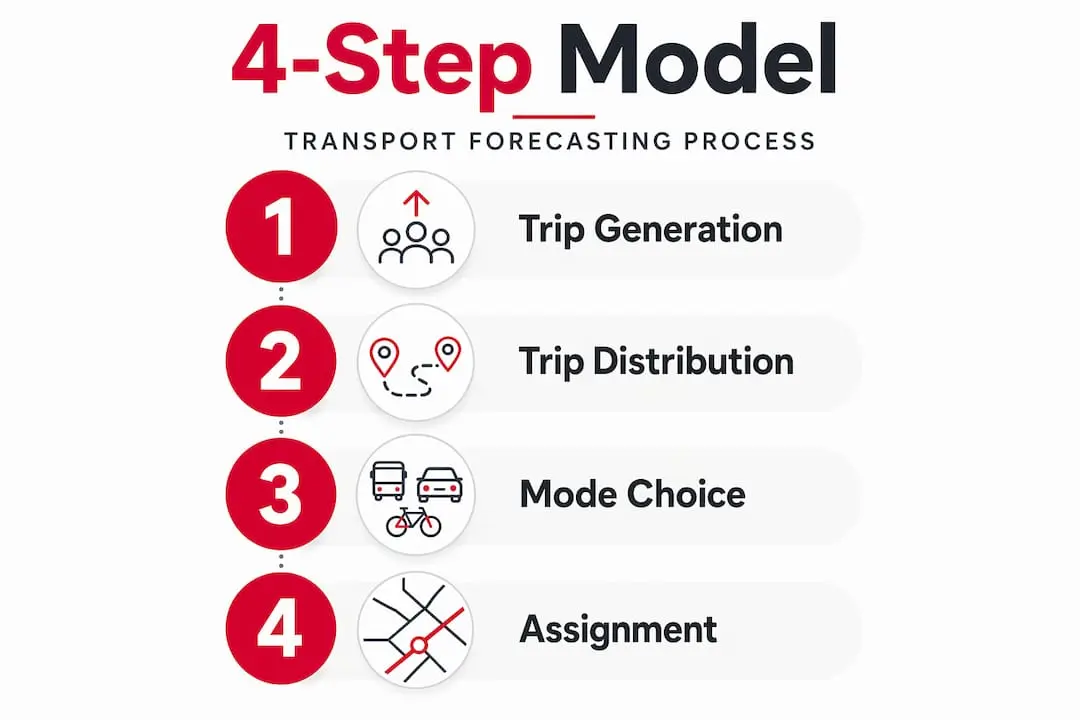
This framework is well understood, computationally tractable, and broadly accepted by planning authorities and funding bodies. Its longevity is a strength when you need a defensible, auditable output for a public inquiry or federal review.
Activity-based and dynamic models
Activity-based models (ABMs) replace the aggregate trip as the unit of analysis with individual or household activity patterns. Rather than asking “how many trips does this zone generate?”, an ABM asks “what sequence of activities does this person undertake, and what travel does that require?” The result is greater behavioural realism, particularly for modelling responses to pricing, scheduling, and land-use changes.
The SEMCOG regional model in the Detroit metropolitan area illustrates the current state of practice: a calibrated system incorporating both trip-based and activity-based elements, static and dynamic traffic assignment, multiple vehicle classes, and transit assignment, with a 2020 base year forecasting through to 2050. This kind of hybrid approach is increasingly standard for large metropolitan areas.
Dynamic traffic assignment (DTA) models go further by representing traffic flow as a time-dependent process rather than a static equilibrium. They are better suited to congestion analysis, incident management, and short-term operational questions.
| Model type | Typical use case | Key strength | Key limitation |
|---|---|---|---|
| Four-step model | Regional strategic planning | Transparent, well-validated | Aggregate behaviour, less responsive |
| Activity-based model | Policy appraisal, pricing schemes | Behavioural realism | Data-intensive, complex to build |
| Dynamic traffic assignment | Corridor operations, incident analysis | Time-dependent flow modelling | Computationally demanding |
| AI/ML hybrid | Short-term prediction, real-time operations | High accuracy with large datasets | Limited interpretability |
Pro Tip: Right-size your model to the planning question. Activity-based models offer detail but demand more data and computing resources. A strategic corridor study rarely justifies that overhead.
Data sources and inputs
What goes into a forecast
The quality of any transport demand forecast is bounded by the quality of its inputs. The primary data sources are household travel surveys, roadside traffic counts, land-use datasets, employment statistics, and public transport patronage records. These are combined with network representations that encode speed, capacity, and connectivity across the modelled area.

Socioeconomic projections are particularly consequential. Assumptions about population growth, household size, car ownership rates, and employment distribution drive the trip generation step and propagate forward through the entire model. Getting these wrong, or failing to document them transparently, undermines every output downstream.
Federal regulations require clear audit trails of input assumptions for models used in federally funded planning processes. This is not bureaucratic formalism. It is the mechanism by which forecasts remain contestable, reproducible, and credible over time.
Emerging data sources
Traditional survey-based data is increasingly supplemented by GPS traces from connected vehicles, mobile phone location data, IoT sensors embedded in infrastructure, and real-time traffic feeds. These sources offer much greater temporal and spatial resolution than conventional counts or periodic surveys.
The practical challenge is integration. Raw GPS or mobile data requires significant processing before it can feed a calibrated demand model. Privacy governance and data licensing add further complexity. Still, for short-term forecasting and model validation, these sources are becoming indispensable.
Pro Tip: When using emerging data sources such as GPS traces, always cross-validate against conventional traffic counts before accepting derived trip matrices. Sensor bias and coverage gaps can introduce systematic errors that are not obvious until late in the modelling process.
Applications in planning and decision-making
Transportation forecasting methods are applied across a broader range of contexts than many practitioners initially appreciate. Here are the primary domains where forecasts directly shape decisions:
-
Infrastructure investment appraisal. Forecasts quantify the demand that justifies a new road, rail line, or interchange. They support cost-benefit analyses by projecting traffic volumes, journey time savings, and residual capacity under different investment scenarios.
-
Environmental and emissions analysis. Vehicle kilometres travelled, speed profiles, and fleet composition forecasts feed directly into air quality and carbon emissions models. This is now a mandatory component of major scheme appraisal in the UK and across most developed planning systems.
-
Freight and logistics planning. Effective demand forecasting shifts logistics operators from reactive to proactive capacity management, informing fleet sizing, carrier contract decisions, and warehouse location. For supply chain planners, transportation demand forecasting is the foundation of network design. You can read more about how this applies in practice in container delivery scheduling within modern haulage operations.
-
Scenario testing and risk management. Forecasts allow planners to test how a network performs under different futures: higher fuel prices, accelerated remote working, autonomous vehicle adoption, or a major employer relocating. This scenario comparison function is arguably the most valuable thing forecasting provides.
-
Public transport network planning. Patronage forecasts inform decisions about service frequency, rolling stock procurement, and fare structure. They are integral to the business cases that secure government funding for transit investment.
Advances in forecasting: AI and data visualisation
AI and deep learning in transport forecasting
Modern transportation forecasting increasingly integrates machine learning to handle the scale and complexity of contemporary urban networks. Graph neural network and Transformer architectures excel at capturing multi-node spatial interactions and long-term temporal dependencies in traffic flow data, outperforming traditional statistical models on short-term prediction tasks.
Hybrid approaches are particularly promising. Graph-BiLSTM architectures, for instance, combine the spatial representation power of graph networks with bidirectional long short-term memory for segment-level travel time forecasting. The results show meaningful accuracy gains over conventional methods, especially in networks with complex interdependencies.
That said, the challenges are real:
- Data scarcity. Many networks, particularly outside major urban centres, lack the volume of historical data needed to train deep learning models reliably.
- Model interpretability. A black-box neural network is difficult to defend in a public inquiry or planning appeal.
- Validation complexity. Overly complex models with credulous assumptions can produce outputs that are difficult to validate against observed conditions, undermining practical decision support.
- Computational demands. Real-time deep learning inference at network scale requires infrastructure investment that many transport authorities cannot readily justify.
The role of data visualisation
Data visualisation has become a critical component of the forecasting process, not just a presentational afterthought. When stakeholders, elected officials, and funding bodies need to understand and justify major capital investment decisions, a well-constructed visualisation of forecast outputs can be more persuasive than any technical appendix.
Interactive heat maps of projected congestion, animated traffic flow diagrams, and scenario comparison dashboards are now routine tools in transport consultancy. Their value lies in translating model outputs into decisions.
Pro Tip: Design your visualisation outputs at the start of the modelling process, not at the end. Knowing what you need to communicate to stakeholders shapes the outputs you extract from the model, and prevents you from discovering too late that your model cannot produce what the client actually needs to see.
My honest take on forecasting in practice
I have always found it telling that the most experienced transport planners are the most cautious about their own model outputs. In my experience, the professionals who get into trouble are those who treat a forecast as a precise answer rather than a structured comparison of possibilities.
The over-reliance on precise forecast volumes for operational details, such as turn-lane length or signal timing, is a specific failure mode I have seen repeatedly. Raw demand model outputs are not designed for that level of granularity. They need post-processing, operational modelling, and a clear understanding of what the model was actually calibrated to represent.
What I find genuinely encouraging about the current direction of the field is the growing emphasis on transparency. Model validation challenges and the difficulty of auditing complex assumptions are now acknowledged openly in the academic literature, which is healthier than the quiet confidence that characterised some earlier practice. A forecast you can explain, defend, and test is worth far more than a sophisticated model whose assumptions nobody can reconstruct.
The future of transportation forecasting lies in combining the structural rigour of established demand modelling frameworks with the pattern-recognition capabilities of modern AI, while being honest about where each approach breaks down. That combination, done carefully and transparently, is genuinely powerful.
— Rob
Build a career in transport forecasting
Transport forecasting expertise is in sustained demand across the UK and internationally. From transportation planning consultancies and local highway authorities to logistics operators and rail infrastructure bodies, the ability to build, run, and interpret travel demand models is a career skill that opens doors at every level of the profession.
If you are looking to move into forecasting or progress within it, Jobs-in-Transport has been connecting transport professionals with employers since 2005. Whether your background is in traffic modelling, data analysis, or strategic planning, you will find relevant transport planning roles across highways, traffic management, transport technology, and project management. The platform hosts roles from junior modellers through to technical directors, covering the full breadth of the sector. Visit Jobs-in-Transport.com to explore current opportunities and set up job alerts for roles matching your specialism.
FAQ
What is transportation forecasting in simple terms?
Transportation forecasting is the process of estimating future travel demand and traffic conditions using models that account for population growth, land use, and network capacity. Its primary purpose is to compare planning scenarios, not predict exact future volumes.
What are the main transportation forecasting methods?
The most widely used methods include the traditional four-step model (trip generation, distribution, mode choice, and assignment), activity-based models, dynamic traffic assignment, and increasingly, AI and machine learning hybrid approaches for short-term prediction.
Why is transport demand forecasting important?
Transport demand forecasting underpins investment decisions, environmental appraisals, freight planning, and public transport network design. Without it, planners cannot assess the relative merits of competing infrastructure or policy options in a defensible, evidence-based way.
What data is needed for transportation demand forecasting?
Core inputs include household travel surveys, traffic counts, land-use data, employment statistics, and socioeconomic projections. Increasingly, GPS traces, mobile location data, and IoT sensor feeds supplement these traditional sources to improve model calibration and validation.
How is AI changing transportation forecasting?
AI methods, particularly graph neural networks and Transformer-based architectures, are improving short-term traffic flow prediction accuracy by capturing complex spatial and temporal dependencies. The main challenges remain interpretability, data scarcity in smaller networks, and the difficulty of validating highly complex models against observed conditions.


