
Transportation infrastructure is defined as the fixed physical assets that enable the movement of people and goods across a network, including roads, railways, airports, seaports, bridges, tunnels, and terminals. Without this physical foundation, modern economies cannot function. The global transport infrastructure market reached approximately $690.38 billion USD in 2024. That figure reflects how central these systems are to national productivity, trade, and urban life. Whether you are a student, a planning professional, or simply curious about how cities work, understanding transport infrastructure is the starting point for understanding how societies move.
What is transportation infrastructure and how does it work?
Transport infrastructure refers to the permanent, capital-intensive physical systems that form the backbone of any transport network. The recognised industry term is transport infrastructure, used across government, engineering, and urban planning disciplines. Roads, rail tracks, airport runways, port quays, pipelines, and intermodal terminals all qualify. What they share is permanence and scale. You cannot pick up a motorway and relocate it.
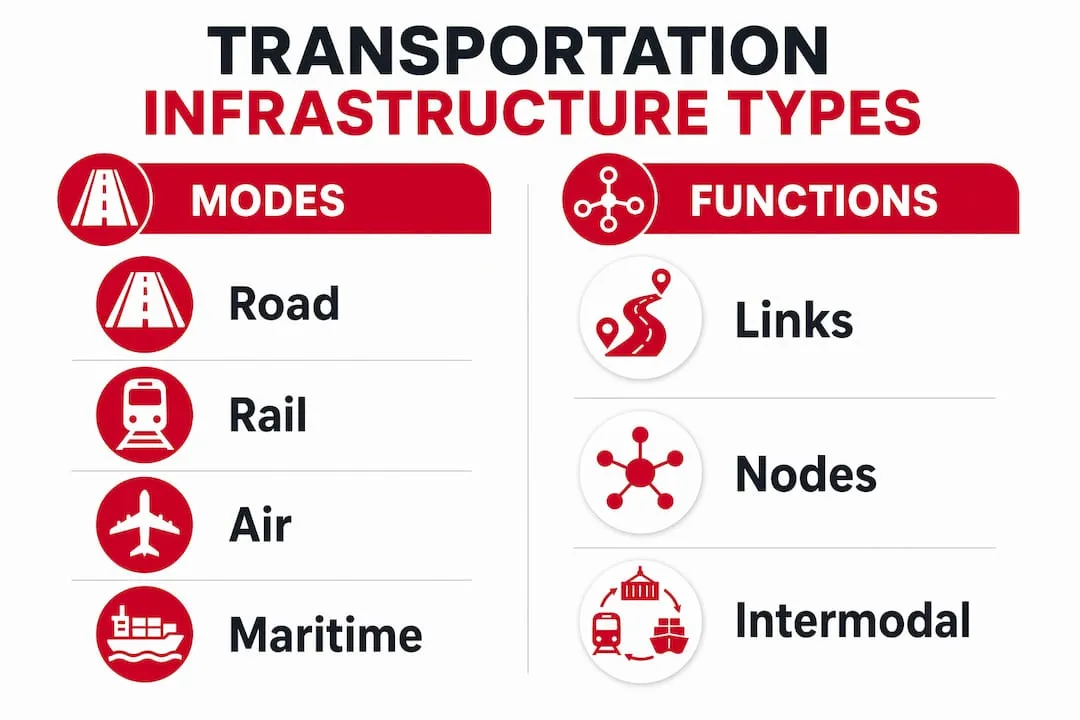
The network operates through two distinct layers: links and nodes. Links are the corridors that connect places, such as a motorway between Birmingham and Manchester, or a rail line between London and Edinburgh. Nodes are the hubs where journeys begin, end, or transfer, such as Heathrow Airport, the Port of Felixstowe, or Birmingham New Street station. Both layers must function together for the network to deliver reliable movement.

Infrastructure also spans multiple transport modes. Road infrastructure covers everything from motorways to local streets. Rail infrastructure includes track, signalling, and stations. Air infrastructure centres on runways, terminals, and air traffic control facilities. Maritime infrastructure covers ports, docks, and navigation channels. Each mode has its own engineering standards, regulatory frameworks, and investment cycles.
Pro Tip: When studying a transport network, always identify the nodes first. Nodes concentrate demand and generate the most complex planning challenges.
What are the main types of transportation infrastructure?
The main categories of transport infrastructure can be grouped by mode and function. The table below summarises the principal types, their primary function, and a real UK example for each.
| Mode | Infrastructure Type | Primary Function | UK Example |
|---|---|---|---|
| Road | Motorways, A-roads, bridges | Surface movement of vehicles | M25 London Orbital |
| Rail | Track, stations, signalling | Passenger and freight rail movement | East Coast Main Line |
| Air | Runways, terminals, control towers | Aviation movement and passenger handling | Heathrow Airport |
| Maritime | Ports, docks, navigation channels | Shipping and freight handling | Port of Felixstowe |
| Intermodal | Freight terminals, logistics hubs | Transfer between modes | DP World London Gateway |
Intermodal infrastructure deserves particular attention. These are the facilities where goods or passengers transfer between modes, for example from a container ship to a freight train. Most significant bottlenecks occur at intermodal nodes rather than along main corridor links. Optimising transfer points is therefore more cost-effective than expanding entire networks. This is a finding that surprises many planners who instinctively focus on building more roads or adding track capacity.
Beyond mode, infrastructure is also classified by ownership and governance. In the UK, Highways England (now National Highways) manages the strategic road network. Network Rail owns and operates most rail infrastructure. Local authorities manage the majority of urban roads. This fragmented ownership structure creates coordination challenges that planners must navigate constantly.
How does transport infrastructure drive economic development?
Transport infrastructure is one of the most powerful levers for economic growth available to governments. Every £1 invested in transport infrastructure generates approximately £1.50 in broader economic activity. That return comes through multiple channels simultaneously.
The economic benefits of strong transport infrastructure include:
- Labour market access: Better connections expand the pool of workers employers can reach, and the range of jobs workers can access. The Elizabeth Line in London, for instance, brought an estimated 1.5 million additional workers within 45 minutes of the City.
- Trade and logistics efficiency: Ports and freight terminals reduce the cost of moving goods. Lower logistics costs make domestic producers more competitive internationally.
- Land value uplift: Property values near new rail stations and motorway junctions typically rise. This effect is well documented around Crossrail stations in London.
- Agglomeration effects: Concentrating economic activity in well-connected cities raises productivity. Firms cluster near good infrastructure because proximity to suppliers, clients, and talent reduces costs.
- Regional rebalancing: Infrastructure investment in underserved regions can redirect economic activity away from congested centres.
Urban planning and transport infrastructure are inseparable. Cities grow along transport corridors. The expansion of the London Underground in the early 20th century directly shaped the suburban growth of areas like Metroland in Middlesex. Today, the same logic applies to HS2 and its anticipated effect on development around Birmingham Curzon Street station. Successful infrastructure projects require alignment with social, environmental, and national development goals, not just technical design. Projects that ignore land use planning tend to generate traffic without generating prosperity.
What are the challenges in transportation infrastructure planning?
Planning transport infrastructure is genuinely difficult. The assets last for decades, sometimes centuries, but the demand they serve changes constantly. Long-term lifecycle considerations including feasibility studies, environmental impact assessments, and cost-benefit analyses are mandatory before any major scheme proceeds. These processes exist because mistakes at the planning stage are extraordinarily expensive to correct once construction begins.
One of the most counterintuitive challenges is induced demand. Building new capacity can attract new users, so congestion returns quickly after a road is widened or a new junction is added. Los Angeles provides the most cited example globally: decades of motorway expansion failed to reduce congestion because each new lane generated new vehicle trips. UK planners now factor induced demand explicitly into traffic modelling for major road schemes.
Hub vulnerability is a related concern. Transport networks rely on consolidation at key nodes to achieve efficiency. But that same consolidation creates systemic risk. When a major transport hub fails, cascading delays spread rapidly across the entire network. The closure of Gatwick Airport during the drone incident in december 2018 disrupted over 1,000 flights and affected approximately 140,000 passengers. A single node failure produced network-wide consequences within hours.
Maintenance is chronically underfunded relative to new construction. Political incentives favour ribbon-cutting over pothole-filling. Yet deferred maintenance compounds costs over time. A road surface that costs £10,000 to maintain today may cost £100,000 to reconstruct in ten years if left unattended.
Pro Tip: Use the Level of Service framework to assess infrastructure health across speed, safety, and comfort metrics, not just vehicle volume. It gives a far more complete picture of where investment is genuinely needed.
How do modern transport systems integrate infrastructure and operations?
Infrastructure and operations are distinct but interdependent layers. Infrastructure assets and operational systems must be managed separately because their failure modes, costs, and management disciplines differ fundamentally. A cracked bridge deck is an infrastructure failure. A delayed train caused by a scheduling error is an operational failure. Confusing the two leads to misdiagnosed problems and wasted resources.
The table below clarifies the distinction and shows where the two layers interact.
| Layer | Examples | Managed By | Failure Type |
|---|---|---|---|
| Infrastructure | Roads, rail track, runways, ports | National Highways, Network Rail, port authorities | Physical deterioration, structural failure |
| Operations | Scheduling, traffic control, maintenance planning | Train operating companies, airlines, logistics firms | Service disruption, capacity mismanagement |
| Integration point | Signalling systems, traffic management centres, terminal management software | Joint or contracted arrangements | Coordination failure, data gaps |
Modern transport systems use information technology to close the gap between these two layers. Traffic management centres monitor road conditions in real time and adjust signal timings to reduce congestion. Network Rail’s Integrated Control Centres coordinate train movements across the national rail network. Port community systems at Felixstowe and Southampton allow shipping lines, hauliers, and customs authorities to share data, cutting dwell times for containers.
The most reliable networks are those designed with integration in mind from the outset. When infrastructure designers and operations managers work together during the planning phase, the resulting systems are more adaptable and easier to maintain. Retrofitting operational technology onto poorly designed infrastructure is expensive and rarely fully effective. This is why transport engineering now treats physical design and operational planning as a single discipline rather than two separate specialisms.
Key takeaways
Transport infrastructure is the fixed physical foundation that determines how efficiently people, goods, and economies move, and its planning, investment, and maintenance decisions shape national prosperity for generations.
| Point | Details |
|---|---|
| Definition is precise | Transport infrastructure means fixed capital assets: roads, rail, ports, airports, and terminals. |
| Economic returns are measurable | Every £1 invested generates approximately £1.50 in broader economic activity. |
| Nodes matter most | Major bottlenecks occur at intermodal transfer points, not along main corridors. |
| Induced demand is real | Adding capacity alone does not reduce congestion; demand modelling must account for new trips generated. |
| Infrastructure and operations are separate | Distinguishing physical assets from operational systems is critical for correct diagnosis and resource allocation. |
Why infrastructure thinking needs to change
I have spent years watching transport projects get approved on the strength of traffic models that nobody truly believes. The numbers look credible, the benefit-cost ratios clear the Treasury threshold, and the scheme proceeds. Then, ten years after opening, congestion is back and the promised regeneration has not materialised. The problem is rarely the engineering. It is the framing.
Transport infrastructure is still too often treated as a supply-side solution to a demand-side problem. We build more capacity and assume demand will behave. It does not. Induced demand is not a theoretical concern. It is a documented, repeatable outcome that planners have known about since the 1960s. The fact that it still catches decision-makers off guard suggests the problem is political, not technical.
What I find genuinely encouraging is the shift towards integrated planning. Schemes like the West Midlands Rail Programme and Transport for London’s ongoing work on freight consolidation show that the sector is learning to treat infrastructure and operations as a single system. That is the right direction. The professionals who will shape the next generation of transport networks are those who understand both the physical assets and the operational logic that brings them to life. Career development in transport now demands that breadth of knowledge, and the sector is better for it.
— Rob
Build your career in transportation infrastructure

Transportation infrastructure planning, engineering, and project management are among the most in-demand specialisms in the UK jobs market right now. Whether you are a graduate exploring your options or an experienced professional looking for your next role in highways, traffic management, or transport technology, Jobs-in-Transport has the listings to match your ambitions. The platform has connected transport professionals with employers since 2005, covering everything from graduate schemes to senior leadership positions. Browse current transport infrastructure jobs across the UK and internationally, and upload your CV to get noticed by the employers who are actively hiring in your specialism today.
FAQ
What is the difference between transport infrastructure and transport operations?
Transport infrastructure refers to fixed physical assets such as roads, rail tracks, and airports. Transport operations cover the dynamic processes that use those assets, including scheduling, traffic control, and maintenance planning.
Why does transportation infrastructure matter for economic growth?
Every £1 invested in transport infrastructure generates approximately £1.50 in broader economic activity through improved labour market access, trade efficiency, and agglomeration effects.
What are the main types of transportation infrastructure?
The main types are road, rail, air, maritime, and intermodal infrastructure. Each mode has distinct physical assets, regulatory frameworks, and investment requirements.
What is induced demand in transport planning?
Induced demand occurs when new road or network capacity attracts additional users, causing congestion to return despite the expansion. It is a core challenge in capacity planning.
Where do most transport network bottlenecks occur?
Most significant bottlenecks occur at intermodal transfer nodes such as ports and freight terminals, rather than along main corridor links. Optimising these nodes delivers greater efficiency gains than expanding entire routes.


