
Transportation policy is the strategic framework of rules, investments, and guidelines developed by governments and stakeholders to manage the movement of people and goods. It balances economic growth, environmental sustainability, and social equity across every scale of governance, from local councils to supranational bodies. For policymakers, researchers, and students working in urban and regional planning, understanding what transport policy is and how it functions is not optional background knowledge. It is the foundation on which every planning decision rests.
What is transportation policy and what does it include?
Transportation policy, also referred to in academic and governmental literature as transport policy, is defined as the strategic framework managing mobility while balancing economic, environmental, and social goals. It covers investments in infrastructure, regulations governing vehicle standards and operator licences, public transport pricing, safety standards, and land use guidelines. The scope is deliberately broad because mobility touches nearly every aspect of public life.
The transport policy definition used by the UK government and bodies such as the European Parliament treats it as an integrated system rather than a collection of isolated rules. This matters because a pricing decision on rail fares, for example, directly affects labour market access for low-income workers. Policy cannot be read in isolation from its social consequences.

What does transportation policy include in practice? The answer spans physical infrastructure such as roads, rail, and ports; regulatory frameworks governing operators and vehicles; fiscal instruments such as fuel duty and congestion charges; and planning guidelines that shape where development occurs relative to transport corridors. Each of these levers interacts with the others, which is precisely why the field demands specialists who understand the whole system.
What criteria define a good transport policy?
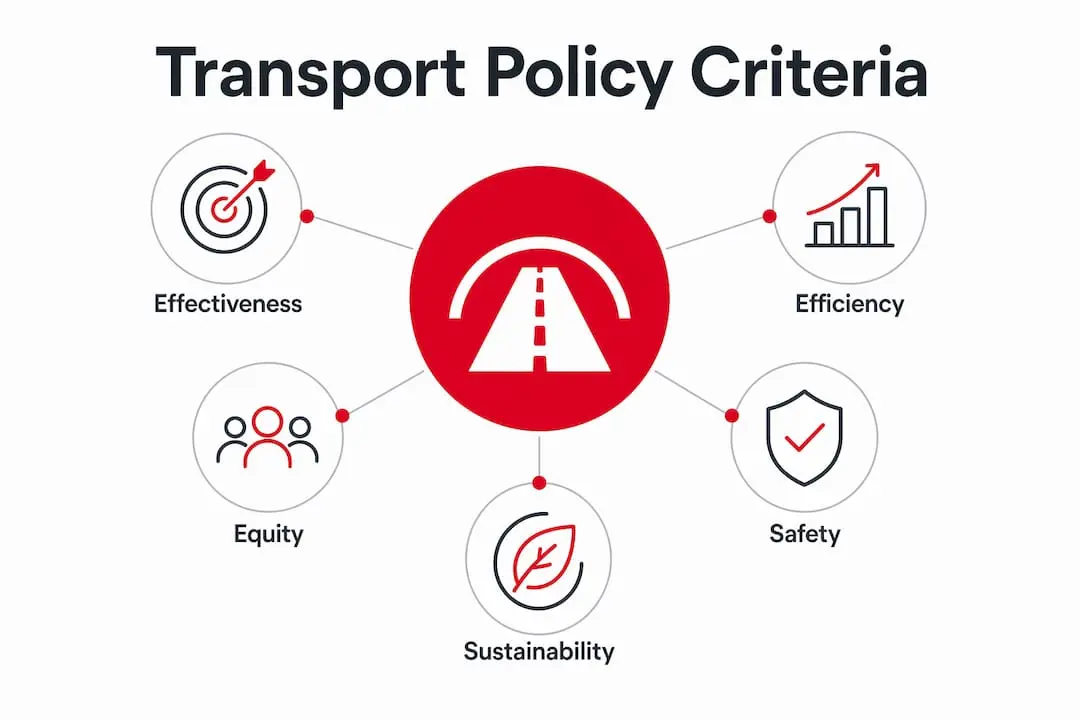
Evaluating transport policy requires more than measuring whether a road was built on time and on budget. Good transport policy must be effective, efficient, and fair, with additional criteria including ease of implementation, flexibility, and long-term robustness. These six dimensions allow analysts to assess policies across multiple axes rather than collapsing everything into a single cost-benefit ratio.
The criteria break down as follows:
- Effectiveness: Does the policy achieve its stated goals? A congestion charge that reduces vehicle kilometres travelled by a measurable percentage is effective. One that displaces traffic to adjacent roads without reducing overall emissions is not.
- Efficiency: Are resources allocated to produce the greatest benefit? This includes financial cost but also time, political capital, and administrative burden.
- Fairness: Are the benefits and costs distributed equitably across population groups? Policies that improve connectivity for car owners while worsening conditions for non-drivers fail this test.
- Ease of implementation: Can the policy be delivered within existing institutional capacity, or does it require structural reform before it can function?
- Flexibility: Can the policy adapt as circumstances change, including shifts in technology, demographics, or climate conditions?
- Long-term robustness: Does the policy remain fit for purpose across a range of plausible futures, not just the most optimistic scenario?
Trade-offs between these criteria are common and unavoidable. A policy that scores highly on efficiency may score poorly on fairness if its benefits accrue predominantly to wealthier users. Recognising these tensions is central to transportation policy analysis at any level of government.
Pro Tip: When evaluating a transport policy, map each criterion explicitly before forming a judgement. Analysts who skip this step tend to overweight the criteria they find easiest to quantify, typically cost and speed, while underweighting equity and long-term robustness.
The role of health and safety in transport intersects with several of these criteria, particularly effectiveness and fairness, since road casualty rates are not distributed evenly across income groups or geographic areas.
How does interdisciplinary knowledge shape transport policy?
Transportation policy is a wicked problem demanding interdisciplinary collaboration because no single discipline can resolve its social, environmental, and economic complexities. This is not a rhetorical flourish. It reflects the structural reality that a transport corridor decision simultaneously involves engineering constraints, land value economics, public health outcomes, carbon accounting, and community displacement risk.
The disciplines that feed into transport policy development include:
- Urban planning: Determines how land use patterns generate or suppress travel demand.
- Environmental science: Quantifies emissions, air quality impacts, and climate exposure from transport systems.
- Economics: Models pricing mechanisms, investment returns, and distributional effects.
- Sociology: Examines how mobility shapes social inclusion, access to employment, and community cohesion.
- Public health: Links transport mode choices to physical activity levels, pollution exposure, and road injury rates.
- Engineering: Defines the physical constraints and technical performance of infrastructure.
The problem is that political science and transport engineering communities rarely integrate, causing transport policy to miss critical social and political dimensions such as the systematic exclusion of non-drivers from planning assumptions. A transport model that treats car ownership as the default condition will consistently underestimate the mobility needs of older people, disabled people, and low-income households.
Structured collaboration and systems thinking are not optional extras in this context. They are the mechanism by which competing disciplinary insights are synthesised into a coherent policy position. Ethical and political implications arise at every stage of this synthesis, particularly when scientific evidence points in one direction and political incentives point in another.
What political and social dynamics influence transportation policy?
Transportation policy is inherently political, shaped by competing interests, resource allocation decisions, and governance structures that reflect existing power relationships. The idea that transport planning is a neutral, technical exercise is a persistent myth. Every infrastructure investment embeds assumptions about whose mobility matters most.
Several dynamics consistently shape how transport policies are formed and implemented:
- Competing interests: Road freight operators, cycling advocates, rail operators, and residential communities all have legitimate but often conflicting claims on transport investment and regulation.
- Resource allocation: Budget decisions at national and local level determine which modes receive investment, which communities gain connectivity, and which are left behind.
- Governance fragmentation: In the UK, transport powers are split between central government, combined authorities, and local councils, creating coordination challenges that purely technical solutions cannot resolve.
- Public acceptance: Even technically sound policies fail without public legitimacy, as the gilets jaunes protests in France demonstrated when a fuel tax increase was perceived as regressive.
“Purely technical solutions often fail without political and social considerations. Policymakers must navigate power dynamics as actively as they navigate engineering constraints.”
Political leadership and champions can determine the success of controversial transport policies. London’s congestion charge, introduced in 2003 under Mayor Ken Livingstone, succeeded not because it was technically elegant but because a determined political champion absorbed the reputational risk and drove it through sustained opposition. Without that leadership, the scheme would have stalled at the consultation stage, as similar proposals had done in other cities.
How do regional and international transport policy frameworks compare?
Transport policy operates simultaneously at local, national, and supranational levels, and the goals, mechanisms, and challenges differ significantly across these scales.
In the UK, local transport authorities must produce Local Transport Plans under the Transport Act 2000, focusing on vision-led, outcomes-focused policies rather than the discredited “predict and provide” model. This shift acknowledges that building more road capacity to meet forecast demand tends to generate additional traffic rather than resolve congestion. The modern approach sets outcomes first, such as reducing carbon emissions or improving access to employment, and then selects interventions that serve those outcomes.
At the supranational level, the EU common transport policy prioritises market harmonisation, safety, and sustainable mobility, with over 30 years of legal and strategic evolution behind it. EU directives promote intermodal freight to reduce emissions, and the policy framework explicitly frames transport as a major driver of greenhouse gas emissions and public health outcomes.
The table below illustrates the key differences between these frameworks:
| Feature | UK local transport plans | EU common transport policy |
|---|---|---|
| Governance level | Local and regional authorities | Supranational (27 member states) |
| Primary mechanism | Statutory plans under Transport Act 2000 | Directives, regulations, and funding programmes |
| Core goals | Connectivity, sustainability, local growth | Market harmonisation, safety, emissions reduction |
| Planning approach | Vision-led, outcomes-focused | Strategic and legislative harmonisation |
| Key challenge | Fragmented local powers and funding gaps | Balancing national interests with shared targets |
The contrast reveals a fundamental tension in transport policy governance. Local plans must respond to specific community needs and political contexts, while supranational frameworks must create conditions for cross-border mobility and fair competition. Neither level can fully substitute for the other.
Practical challenges in implementing transport policy today
Adaptive Policy Making allows transport policies to respond flexibly to uncertain long-term developments such as climate change, demographic shifts, and technological disruption. This approach avoids locking governments into infrastructure commitments that may become obsolete, a real risk given that autonomous vehicles, remote working patterns, and net zero targets are all reshaping travel demand in ways that were not anticipated even a decade ago.
Congestion charging schemes in cities such as London, Stockholm, and Singapore demonstrate that pricing instruments can shift behaviour when designed well and implemented with political commitment. Equity concerns remain the most persistent barrier. Schemes that charge all vehicles equally regardless of driver income are regressive, and this objection has derailed proposals in cities from Edinburgh to New York.
Pro Tip: Build equity impact assessments into the policy design stage, not as an afterthought during consultation. Policies that address distributional concerns from the outset face significantly less political resistance and are more likely to survive changes in administration.
For those specialising in transport careers, understanding these implementation challenges is as important as mastering the technical content of policy frameworks. The gap between a well-designed policy and a successfully delivered one is almost always political and organisational rather than technical.
Key takeaways
Effective transportation policy requires the simultaneous integration of technical rigour, interdisciplinary knowledge, political awareness, and long-term adaptive capacity.
| Point | Details |
|---|---|
| Clear policy definition | Transport policy covers infrastructure, regulation, pricing, and planning guidelines as an integrated system. |
| Six evaluation criteria | Effectiveness, efficiency, fairness, ease of implementation, flexibility, and robustness all matter equally. |
| Interdisciplinary necessity | No single discipline resolves transport’s social, environmental, and economic complexities alone. |
| Political realism | Champions and governance structures shape outcomes as much as technical quality does. |
| Adaptive planning | Vision-led, outcomes-focused approaches outperform the outdated predict-and-provide model. |
Why transport policy needs both rigour and political courage
I have spent years working at the intersection of transport recruitment and professional development, and the pattern I see repeatedly is this: technically excellent analysts who underestimate the political dimension of their work. They produce rigorous policy analysis, present clear evidence, and then watch their recommendations disappear into a consultation process that was never designed to act on them.
The uncomfortable truth about transport policy is that the quality of the evidence rarely determines the outcome. What determines the outcome is whether someone with authority and appetite for risk decides to own the proposal. London’s congestion charge is the canonical example, but the same dynamic plays out at every scale, from a local cycling infrastructure scheme to a national rail investment programme.
What I find most encouraging about the current generation of transport planners is their willingness to engage with social equity and climate science as core competencies rather than peripheral concerns. The skills required for traffic engineers and transport planners are genuinely broadening, and that is the right direction. The field needs people who can read a traffic model and a political context with equal fluency.
The shift away from predict-and-provide is real and significant. But it will only deliver better outcomes if planners are also willing to make the case for their vision in rooms where the default assumption is that more road capacity is always the answer.
— Rob
Explore transport policy careers with Jobs-in-transport
Understanding the transport policy framework is the first step. Translating that knowledge into a career is the next one.
Jobs-in-transport has connected transport professionals with employers across the UK and internationally since 2005. Whether you are moving into transportation planning roles from a research background, or looking to apply your policy expertise in local government or the private sector, the platform lists positions across highways, traffic management, transport technology, and project management. Browse current vacancies and set up job alerts to stay ahead of opportunities in a sector where policy expertise is increasingly valued.
FAQ
What is the transport policy definition used in the UK?
Transport policy in the UK is defined as the strategic framework through which government manages the movement of people and goods, covering infrastructure investment, regulation, pricing, and planning. Local transport authorities produce statutory Local Transport Plans under the Transport Act 2000.
How does transportation policy affect society?
Transportation policy shapes access to employment, healthcare, and education by determining which communities receive connectivity investment. It also drives public health outcomes through air quality and road safety standards, and contributes significantly to national carbon emissions.
What are the main types of transportation policies?
Transport policies fall into several categories: infrastructure investment policies, regulatory frameworks governing operators and vehicles, fiscal instruments such as fuel duty and congestion charges, and land use planning policies that link development to transport corridors.
Why is transportation policy considered a political issue?
Transport policy allocates scarce public resources and determines whose mobility is prioritised, making it inherently political. Purely technical solutions consistently fail without political champions willing to navigate competing interests and public resistance.
What does a transport policy framework typically include?
A transport policy framework includes a vision statement, measurable outcomes, investment priorities, regulatory mechanisms, and an adaptive review process. The UK’s Local Transport Plan guidance and the EU’s common transport policy both follow this structure, though at different governance scales.


