
An urban transport strategy is a framework for optimising the movement of people and goods within cities, prioritising sustainable, inclusive, and efficient mobility over simple vehicular flow. Transport accounts for 25% of energy-related greenhouse emissions, with 95% of that output reliant on fossil fuels. By 2050, 70% of the global population will live in urban areas. Those two facts together make urban transport planning one of the most consequential disciplines in public policy. Statutory frameworks such as Sustainable Urban Mobility Plans (SUMPs) and Local Transport Plans (LTPs) give planners the structure to act. This guide explains what those frameworks contain, what the regulations now require, and how to build a strategy that actually delivers.
What is urban transport strategy and why does it matter?
Urban transport strategy is a systems approach that integrates planning, policy, behaviour change, and investment to shape how people move through cities. It is not a single technology fix or an infrastructure wish list. The goal is to connect people to jobs, services, and each other while reducing emissions, road deaths, and social exclusion.
The scale of the challenge makes this definition consequential. Road collisions kill 1.2 million people every year globally. That figure represents a failure of urban mobility systems, not just driver behaviour. A well-designed urban mobility strategy treats safety, air quality, and access to essential services as primary outputs, not afterthoughts.

The recognised industry term for this discipline is integrated urban mobility planning, though urban transport strategy is widely used by the UK’s Department for Transport and by EU institutions. Both terms describe the same outcomes-focused process. Planners who understand both terms communicate more effectively across national and European policy contexts.
Core components of an effective urban transport strategy
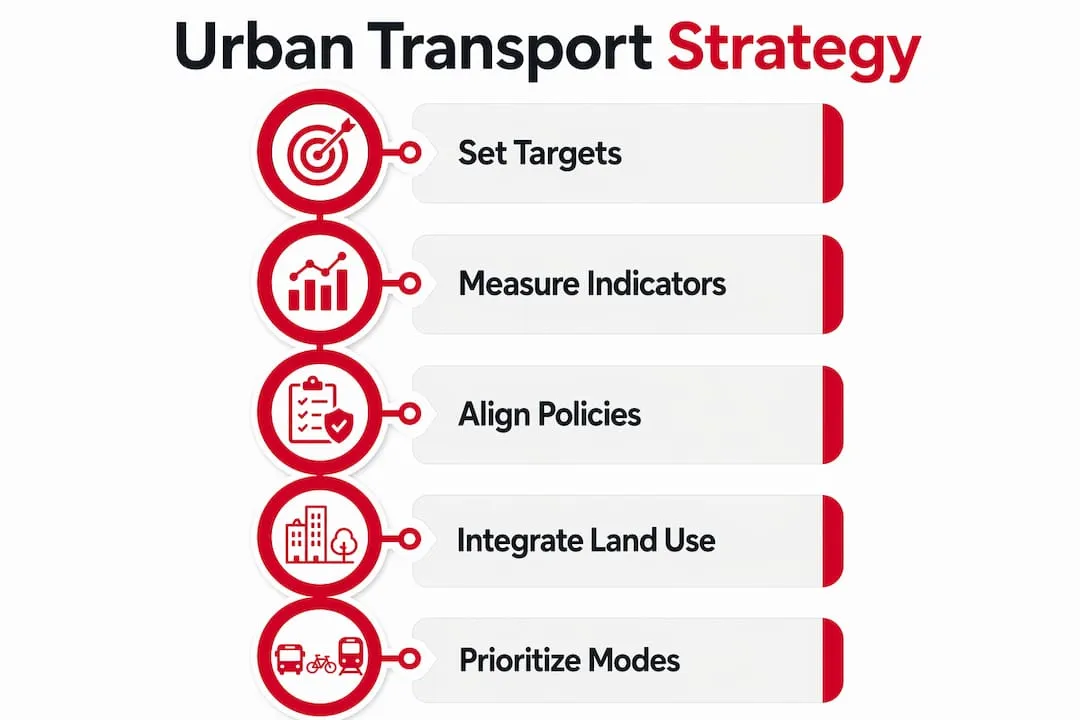
The strongest strategies share a common architecture. They set long-term targets, define measurable indicators, and align transport decisions with land use and spatial development. The components below are not optional extras. They are the minimum specification for a strategy that holds up under scrutiny.
Multi-modal connectivity sits at the centre of every credible plan. Effective strategies prioritise walking, cycling, public transport, and non-motorised transport over infrastructure-heavy projects like junction expansions, which consistently fail to reduce congestion over the long term. Modal shift targets give this priority teeth.
Performance indicators translate ambition into accountability. The table below shows the four indicator categories used most frequently in LTPs and SUMPs.
| Indicator category | What it measures |
|---|---|
| Road safety | Fatalities and serious injuries per billion vehicle kilometres |
| Air quality | NO2 and particulate matter concentrations at key corridors |
| Accessibility | Percentage of residents within 400 metres of a frequent transit stop |
| Modal shift | Share of trips made by walking, cycling, and public transport |
Land use integration is the component most often missing from weaker strategies. Transport investment shapes where people live and work. A strategy that ignores spatial development plans will generate the very congestion it was designed to prevent.
Pro Tip: Embed your transport strategy inside the local development plan from the outset. Strategies written in isolation from planning policy consistently underperform because they cannot influence where growth is directed.
What regulatory frameworks shape urban transport strategies in 2026?
Statutory requirements now set a clear floor for what urban transport strategies must contain and when they must be delivered.
-
Local Transport Plans (England) are a legal requirement under the Transport Act 2000. The UK’s Department for Transport guidance requires LTPs to be vision-led and outcomes-focused, shifting away from the ‘predict and provide’ model that dominated planning for decades. Plans must align with the UK’s ‘Better Connected’ national strategy and link explicitly to infrastructure funding allocations.
-
Sustainable Urban Mobility Plans (EU) are mandatory for urban nodes on the Trans-European Transport Network (TEN-T). EU urban nodes must adopt SUMPs and report standardised mobility data by 2027. That deadline is not aspirational. Non-compliance affects access to EU Cohesion Fund and Connecting Europe Facility funding.
-
Data reporting obligations are now embedded in both frameworks. The EU mandates standardised urban mobility data reporting linked directly to policy evaluation and funding decisions. This means cities without digital data infrastructure face a structural disadvantage in the funding competition.
-
Alignment with the EU Green Deal requires SUMPs to demonstrate measurable progress on emission reductions and zero-emission mobility. Plans that cannot show a credible pathway to decarbonisation will not satisfy the 2027 compliance threshold.
The practical implication for planners is clear. Strategy development is no longer a discretionary exercise. It is a funded, time-bound, and audited obligation.
Common pitfalls in urban transport strategy development
Most strategy failures share the same root causes. Recognising them early saves years of wasted effort.
-
Static planning. A strategy written once and shelved becomes irrelevant within two to three years. Vision-led plans must be regularly reviewed against performance metrics to remain effective. Build a review cycle into the governance structure before the strategy is published.
-
Ignoring spatial integration. Lack of integration between transport and land-use planning is the single most common cause of implementation failure. Transport corridors planned without reference to housing allocations produce mismatched demand from day one.
-
Over-reliance on infrastructure expansion. Adding road capacity generates additional traffic within a predictable timeframe. The ‘predict and provide’ model has been discredited by decades of evidence. Demand management, pricing, and behaviour change programmes deliver more durable results.
-
Weak institutional capacity. Interdepartmental coordination between highways, planning, public health, and economic development is difficult to sustain. Strategies that depend on cross-departmental cooperation without formal governance structures tend to stall at implementation.
-
Insufficient community involvement. Plans developed without meaningful public engagement face political resistance at the delivery stage. Consultation is not a box-ticking exercise. It surfaces local knowledge that technical modelling misses.
Pro Tip: Assign a named senior officer as strategy owner with a mandate that crosses departmental boundaries. Strategies without a clear internal champion rarely survive the transition between political administrations.
How to implement and monitor an urban transport strategy
Turning a strategy document into delivered outcomes requires a structured implementation roadmap. The steps below reflect current best practice across EU and UK contexts.
-
Establish a baseline. Map existing travel patterns, modal shares, air quality data, and road safety records before setting targets. Targets without baselines cannot be evaluated.
-
Align with funding cycles. Infrastructure investment must be sequenced to match national and regional funding windows. Explicit links between strategy targets and infrastructure funding improve both delivery rates and accountability.
-
Deploy digital tools. Cities are investing in digital twins and real-time mobility management tools to comply with EU data obligations and improve decision-making. A digital twin models the city’s transport network in real time, allowing planners to test interventions before committing capital.
-
Set measurable indicators and review quarterly. Annual reviews are too infrequent to catch implementation drift. Quarterly indicator reviews allow course corrections before problems compound.
-
Engage stakeholders continuously. Stakeholder engagement is not a phase. It runs throughout the strategy lifecycle, from needs assessment through to post-implementation review.
EU-funded projects demonstrate what this looks like in practice. MOVE21, SCALE-UP, and UPPER piloted zero-emission mobility, enhanced freight integration, and improved first-to-last mile connectivity across multiple European cities. Their shared lesson is that data-driven governance and multimodal integration produce measurably better outcomes than single-mode infrastructure investment.
| Implementation tool | Primary benefit |
|---|---|
| Digital twin modelling | Tests interventions before capital commitment |
| Real-time mobility dashboards | Enables quarterly performance reviews |
| Integrated funding frameworks | Aligns delivery timelines with budget cycles |
| Multimodal data platforms | Satisfies EU standardised reporting requirements |
Key takeaways
An effective urban transport strategy integrates multi-modal planning, land-use policy, data governance, and statutory compliance into a single, regularly reviewed framework.
| Point | Details |
|---|---|
| Define outcomes first | Set measurable targets for safety, air quality, accessibility, and modal shift before selecting interventions. |
| Meet statutory deadlines | EU urban nodes must adopt SUMPs and report standardised data by 2027 or risk losing access to EU funding. |
| Integrate land use | Align transport strategy with spatial development plans from the outset to prevent mismatched demand. |
| Use digital tools | Digital twins and real-time dashboards improve both compliance and the quality of strategic decisions. |
| Review continuously | Quarterly indicator reviews prevent implementation drift and keep strategies relevant as conditions change. |
Why most urban transport strategies fail before they start
After working across transport policy for many years, the pattern I see most often is not technical failure. It is institutional failure. A strategy can be technically excellent and still achieve nothing if it sits in a silo.
The strategies that actually deliver share one characteristic: they are treated as living governance documents, not published reports. The teams behind them hold regular cross-departmental meetings, update their data quarterly, and revise targets when evidence demands it. They treat the shift away from ‘predict and provide’ not as a philosophical position but as a practical discipline that shapes every funding decision.
The uncomfortable truth is that most strategies are written to satisfy a statutory requirement, then filed. The 2027 SUMP deadline will expose this gap sharply. Cities that have been treating mobility planning as a compliance exercise will find themselves unable to demonstrate the data governance that EU funding now requires.
My strongest advice to planners is this: build the monitoring framework before you write the strategy. If you cannot describe how you will measure success on day one, the strategy will not survive contact with reality. The data infrastructure is not a technical afterthought. It is the foundation.
— Rob
Transport careers in urban mobility and planning
Urban transport strategy is one of the most active areas of recruitment in the UK and internationally right now. Demand for planners, project managers, and transport technologists is growing as local authorities and consultancies race to meet statutory deadlines and deliver net-zero commitments.
Jobs-in-Transport has connected transport professionals with specialist roles since 2005. The platform covers transportation planning, highways, traffic management, transport technology, and project management positions across the UK and beyond. Whether you are a planner building your first LTP or a senior strategist moving into a director-level role, Jobs-in-Transport lists the positions that match your experience. You can also view employer profiles to research organisations shaping the future of urban mobility before you apply.
FAQ
What is the difference between an LTP and a SUMP?
A Local Transport Plan (LTP) is a statutory requirement for transport authorities in England under the Transport Act 2000. A Sustainable Urban Mobility Plan (SUMP) is the EU equivalent, mandatory for urban nodes on the TEN-T network, with a compliance deadline of 2027.
What does sustainable transport mean in an urban context?
Sustainable transport refers to modes and systems that meet current mobility needs without compromising future generations, prioritising walking, cycling, and public transit while reducing fossil fuel dependence and greenhouse emissions.
Why do urban transport strategies fail?
The most common causes are lack of integration between transport and land-use planning, insufficient institutional capacity for cross-departmental coordination, and treating the strategy as a static document rather than a regularly reviewed governance framework.
What is a digital twin in urban transport planning?
A digital twin is a real-time virtual model of a city’s transport network. Planners use it to simulate the effects of interventions before committing capital, improving both the quality and speed of strategic decisions.
How should planners measure the success of a transport strategy?
Planners should track four indicator categories: road safety (fatalities and serious injuries), air quality (NO2 and particulate matter), accessibility (proximity to frequent transit), and modal shift (share of trips by sustainable modes), reviewed at least quarterly.


