
A transport survey is a structured data collection process that captures travel behaviours, patterns, and preferences to support informed transport planning and infrastructure decisions. Transport professionals and public sector project managers rely on these surveys to turn subjective assumptions into objective, verifiable evidence. Without that evidence, planning applications fail, infrastructure investments miss their targets, and policy decisions rest on outdated guesswork. Understanding why conduct transport surveys matters is the first step to getting them right.
Why conduct transport surveys: objectives and benefits
Transport surveys serve one primary purpose: replacing assumptions with data. Transport directors confirm that surveys align scarce infrastructure funds with real travel patterns rather than old assumptions. That alignment is what makes the difference between a bus route that fills seats and one that runs empty.
The benefits extend well beyond individual projects. Surveys underpin travel demand models, inform policy evaluation, and provide the technical foundation that planning authorities require before approving development applications. Survey data validates road capacity and safety designs that local highway authorities need before granting approval. Without that validation, applications face rejection or costly appeal.
The core objectives of a transport survey typically include:
- Measuring current travel volumes, modes, and routes across a study area
- Identifying gaps between existing infrastructure capacity and actual demand
- Supporting transport assessments for new residential or commercial developments
- Updating travel demand models with current behavioural data
- Evaluating the effectiveness of existing transport policies and interventions
- Providing collision and safety data across a defined review period
Pro Tip: Frame your survey objectives in writing before selecting any methodology. Objectives that are vague at the start produce data that cannot answer the questions your planning authority will ask at the end.
The cost argument for surveys is straightforward. Rapid survey tools can gather data from more than 3,000 respondents in as little as 20 seconds each. That speed makes broad data collection achievable even on modest project budgets, removing the excuse that surveys are too expensive to conduct properly.
What methodologies and tools are used in transport surveys?
The right methodology depends on what you need to measure. Household travel surveys use diary methods, asking participants to record every trip made over a defined period. These diaries capture mode choice, trip purpose, departure time, and journey length in a level of detail that traffic counts alone cannot provide.

Electronic questionnaires have become the standard for attitudinal and behavioural data. They average around 40 minutes per respondent for detailed surveys, though rapid assessment tools compress this significantly. Attitudinal and lifestyle questions improve travel demand models by capturing behavioural variance that socio-economic data alone misses. A model built only on age and income will not predict mode shift as accurately as one that also captures attitudes towards cycling or remote working.
| Survey type | Primary use | Typical data collected |
|---|---|---|
| Household travel diary | Regional demand modelling | Trip frequency, mode, purpose, timing |
| Electronic questionnaire | Attitudinal and behavioural insight | Preferences, lifestyle, willingness to change mode |
| Traffic count | Junction and road capacity assessment | Vehicle volumes, turning movements, classification |
| Topographical survey | Infrastructure design and safety | Road geometry, sight lines, gradients |
| Collision data review | Safety assessment | Incident frequency, severity, location patterns |
| Origin-destination survey | Network flow analysis | Where trips start and end across a study area |
Sampling strategy is as important as survey type. Convenience sampling, email recruitment, and online panels each introduce different biases. Statistical weighting corrects those biases by adjusting raw results to match census distributions. Without weighting, a survey that over-represents car owners will produce a skewed picture of travel behaviour across the whole population.
Pro Tip: Always specify your weighting variables before fieldwork begins. Age, gender, household size, and car ownership are the minimum. Agree these variables with your modelling team so the weighted outputs feed directly into your demand model without rework.
Traffic counts, topographical surveys, and collision data form the quantitative backbone of most transport assessments. Collision data requires a five-year review period for safety assessments. That five-year window is not arbitrary. It smooths out year-to-year variation and gives highway authorities confidence that the safety picture is representative rather than distorted by a single unusual year.
What are the common pitfalls in transport surveys?
Poor survey practice does not just produce bad data. It produces rejected planning applications, delayed projects, and wasted budget. The most common failure is collecting data during non-neutral periods.
Data collected during school holidays or local disruptions fails to represent typical traffic conditions. Highway authorities will reject it. The project then faces the cost of repeat surveys, revised assessments, and extended timelines. That outcome is entirely avoidable with proper survey scheduling.
The most frequent pitfalls transport professionals encounter include:
- Surveying during school holidays, bank holidays, or periods of local disruption such as road closures or major events
- Using data that has aged beyond the limits accepted by the relevant highway authority
- Failing to weight sample data, leaving recruitment biases uncorrected in the final dataset
- Selecting survey locations that do not cover the full study area defined in the planning brief
- Relying on a single survey type when the assessment requires corroborating data from multiple sources
- Submitting data without a clear audit trail showing collection dates, methods, and quality checks
Outdated or distorted data will not be accepted by highway authorities, and the resulting delays add direct costs to the project. The financial case for getting surveys right first time is strong. Repeat surveys, revised transport assessments, and planning appeal costs far exceed the investment in a properly planned and executed survey programme.
Major regional surveys have recognised this problem by shortening their update cycles. Regional travel surveys are shifting from once-a-decade exercises to four or five-year cycles to keep pace with changing travel behaviours. That shift reflects a wider recognition that stale data produces stale decisions.
How to plan a transport survey for reliable, accepted results
Reliable results begin before any fieldwork takes place. The single most effective step a project team can take is agreeing a scoping note with the relevant planning and highway authorities before survey design is finalised.
Scoping notes agreed with local authorities prevent wasted effort and confirm that the transport assessment will be based on accepted data and assumptions. A scoping note covers survey dates, locations, study area boundaries, forecast years, and the modelling tools to be used. Agreeing these details upfront removes the risk of completing a full survey programme only to find the authority requires a different approach.
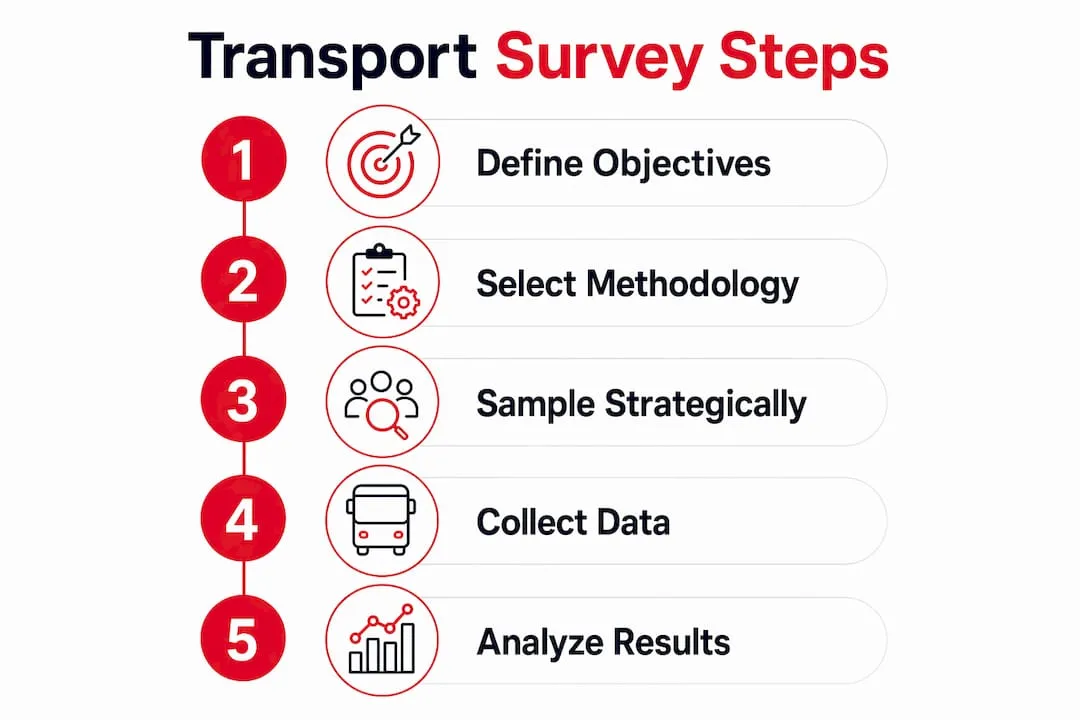
A structured approach to survey planning follows these steps:
- Define objectives clearly. State what decisions the survey data will support and what questions it must answer.
- Agree a scoping note. Submit a draft to the planning authority and highway authority for comment before committing to fieldwork.
- Select survey types and timing. Match methodology to objectives and schedule fieldwork during neutral periods that represent typical conditions.
- Design the sample and weighting strategy. Specify target sample sizes, recruitment methods, and weighting variables before fieldwork begins.
- Conduct fieldwork with quality controls. Apply real-time checks on response rates, data completeness, and interviewer consistency.
- Weight and validate the data. Adjust raw results to match census distributions and cross-check against independent data sources such as traffic counts.
- Integrate findings into the transport assessment. Present survey results with a clear methodology statement and audit trail that the authority can verify.
Pro Tip: Build a data review date into your project programme. Survey data has a shelf life. If your project timeline extends beyond the authority’s accepted data age, plan a refresh survey rather than submitting data that will be challenged.
The importance of transport surveys in the planning process is not diminishing. Authorities are applying greater scrutiny to data quality as development pressures increase and infrastructure budgets tighten. A well-planned survey programme is now a prerequisite for any transport assessment that expects to pass examination without challenge.
Key takeaways
Transport surveys are the technical foundation of every credible planning application, infrastructure investment, and policy decision in the transport sector.
| Point | Details |
|---|---|
| Surveys replace assumptions with evidence | Objective data aligns infrastructure investment with real travel patterns, not outdated estimates. |
| Methodology must match objectives | Choose between household diaries, electronic questionnaires, traffic counts, and collision reviews based on what the assessment requires. |
| Neutral data collection periods are non-negotiable | Data gathered during school holidays or disruptions will be rejected by highway authorities, causing costly delays. |
| Statistical weighting corrects sampling bias | Raw survey data must be weighted to census distributions before it can reliably inform demand models. |
| Scoping notes prevent rework | Agreeing survey parameters with planning and highway authorities before fieldwork protects the project from late-stage rejection. |
The case for treating surveys as a professional discipline, not a box-tick
Transport surveys have a reputation problem. Too many project teams treat them as a compliance exercise: something to commission, complete, and file. That attitude produces exactly the kind of thin, challenged data that causes planning delays.
What I have observed across transport planning projects is that the teams who get surveys right treat them as a professional discipline in their own right. They invest time in scoping, they engage authorities early, and they think carefully about what the data needs to prove before a single respondent is recruited. The accuracy of survey data is not a technical nicety. It is the difference between a planning application that sails through examination and one that spends eighteen months in appeal.
The emerging challenge is behavioural change. Remote working, electric vehicles, and shifting attitudes to public transport have altered travel patterns faster than traditional survey cycles can track. The move towards four and five-year regional survey cycles is a positive step, but individual project surveys need to reflect this too. Attitudinal questions are no longer optional extras. They are the mechanism by which surveys capture the variance that socio-economic data alone cannot explain.
My honest view is that the profession needs to invest more in survey literacy at the project management level. Transport planners understand survey design. Project managers often do not. When a project manager cuts the survey budget or compresses the fieldwork window to save time, the consequences arrive later in the form of rejected data and extended programmes. The cost of that outcome always exceeds the saving made upfront.
— Rob
Transport survey careers at Jobs-in-transport
Transport professionals who understand survey methodology, data analysis, and planning assessment are in demand across the UK. The skills that make a good transport surveyor, including statistical literacy, stakeholder engagement, and regulatory knowledge, translate directly into roles across transport planning and project management.

Jobs-in-transport has connected transport professionals with employers since 2005. The platform lists roles across highways, traffic management, transportation planning, and transport technology. Whether you are a graduate entering the field or a senior planner looking for your next project, browse current vacancies to find roles where survey expertise is valued and rewarded. Employers across the public and private sectors post regularly, and job alerts keep you ahead of new opportunities as they appear.
FAQ
What is the purpose of a transport survey?
A transport survey collects structured data on travel behaviours, volumes, and patterns to support planning decisions, infrastructure investment, and regulatory approval. Without survey data, transport assessments lack the objective evidence that highway authorities require.
How often should transport surveys be updated?
Major regional surveys are moving to four or five-year cycles to reflect changing travel behaviours. For individual development projects, data age limits are set by the relevant highway authority and must be checked before fieldwork is commissioned.
What happens if transport survey data is rejected?
Rejected data forces repeat surveys, revised transport assessments, and extended project timelines. Poor-quality or non-neutral-period data is a leading cause of planning application delays and appeals in the UK.
What is a scoping note in transport survey planning?
A scoping note is a document agreed between the project team and the planning and highway authorities before fieldwork begins. It confirms survey dates, locations, study area boundaries, and modelling tools, preventing costly rework later in the project.
Why does statistical weighting matter in transport surveys?
Raw survey data reflects the biases of the recruitment method used. Statistical weighting adjusts results to match census distributions, correcting those biases and producing data that accurately represents the wider population being studied.
Recommended
- Jobs in Transport, Bus jobs, Highways & Traffic jobs, Transportation Planning jobs, Transport Technology jobs, Project Management jobs, Transport Leaders jobs
- Jobs in Transport, Bus jobs, Highways & Traffic jobs, Transportation Planning jobs, Transport Technology jobs, Project Management jobs, Transport Leaders jobs


