
Diversity in the transport sector is still too often treated as a box-ticking exercise rather than a genuine driver of operational results. That framing is both outdated and costly. Recent research in aviation has linked executive-level gender diversity directly to measurable efficiency gains, while workforce studies consistently show that participation gaps across transport roles weaken talent pipelines and push up recruitment costs. This guide gives transport industry professionals and hiring managers the evidence, frameworks, and practical steps needed to build diverse teams that perform better, attract broader talent, and remain fully compliant with evolving regulatory standards.
Table of Contents
- The business case for diversity in transport jobs
- Overcoming barriers: What hiring managers need to know
- Regulations, fairness, and safety: Navigating legal and practical constraints
- From theory to action: Building a sustainable diversity strategy
- Our take: Diversity, fairness, and measurable outcomes in practice
- Find diverse talent and transport job opportunities
- Frequently asked questions
Key Takeaways
| Point | Details |
|---|---|
| Measurable performance gains | Diversity, especially at leadership levels, boosts efficiency and sustainability in transport organisations. |
| Overcoming recruitment barriers | Intentional strategies are needed to widen the talent pipeline and counter stereotypes in the transport sector. |
| Legal and safety compliance | Merit-based hiring and regulatory standards must shape diversity initiatives in transport jobs. |
| Practical strategy framework | Successful diversity strategies combine inclusive policies and talent pipeline investment with clear targets. |
The business case for diversity in transport jobs
With the wider context established, let’s examine how diversity directly affects performance and recruitment outcomes in transport jobs.
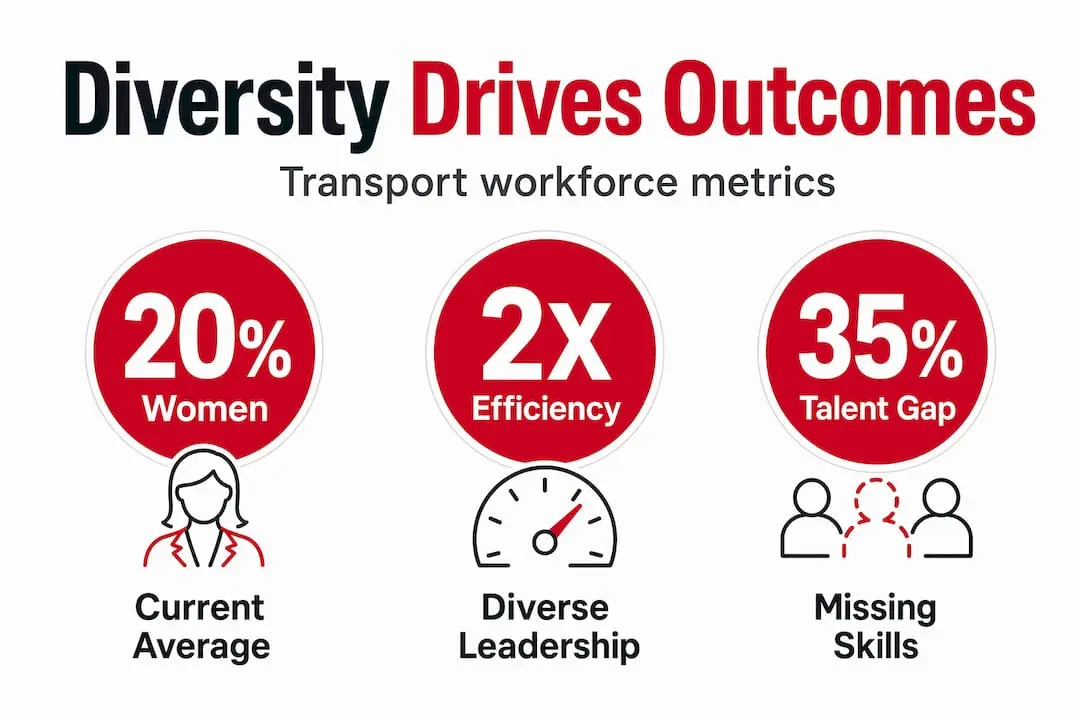
For too long, diversity programmes in transport have been treated as separate from core business objectives. The evidence says otherwise. Research into the aviation sub-sector found that airlines with more women in executive roles consistently demonstrated superior capacity utilisation and operational efficiency compared to less diverse organisations. This is not correlation without mechanism. Diverse leadership teams bring broader perspectives to complex decision-making environments, challenge assumptions that homogenous groups tend to accept without scrutiny, and model inclusive cultures that improve staff retention at all levels.
The participation gap is a real operational problem. Women represent just 20% of the transport workforce in most developed markets, with even lower representation in engineering, traffic management, and senior leadership. Similar gaps exist for ethnic minority professionals and disabled workers. These are not merely fairness issues. A narrow recruitment pool makes it structurally harder to fill specialist roles, raises average cost-per-hire, and creates succession planning risks for organisations that cannot afford operational disruption.

Transport employers that have explored the benefits of working in transport as a genuine recruitment proposition find that positioning the sector as welcoming and flexible widens the candidate funnel significantly. Combined with inclusive workplace policies, this approach improves both the quantity and quality of applicants.
Key performance impacts of workforce diversity in transport:
- Broader problem-solving capacity in multi-disciplinary project teams
- Lower staff turnover when employees from under-represented groups feel genuinely included
- Stronger employer brand in competitive graduate and apprenticeship markets
- Improved customer and community relations, particularly in public transport roles
- Greater resilience in workforce planning when multiple talent pools are actively engaged
| Diversity dimension | Current transport average | Best-practice target | Primary performance benefit |
|---|---|---|---|
| Gender (all roles) | ~20% women | 40%+ women | Efficiency, retention |
| Ethnic minority representation | Below national average | Proportional to local population | Innovation, community trust |
| Disabled workers | Under-represented | Reflective of working age population | Broader skill base |
| Senior leadership gender balance | Approx. 15% women | 30%+ women | Strategic decision quality |
According to workforce research at San José State University, transport workforce participation gaps persist even when diverse talent genuinely exists, suggesting the sector is failing at attraction and retention rather than facing an absence of qualified candidates. That finding should reshape how hiring managers approach recruitment planning.
Pro Tip: Before launching any diversity initiative, audit your current leadership team composition. The research on airline efficiency suggests that diversity at the top, not just at entry level, is where operational gains are most consistently demonstrated. Connect this finding to your own transport recruitment steps when building your next hiring plan.
Overcoming barriers: What hiring managers need to know
Understanding the business case, hiring managers must now consider the most common and critical barriers they face.
Stereotypes are the most persistent and most underestimated barrier in transport recruitment. When job advertisements use language and imagery that signals the role is designed for a particular demographic, candidates from other groups self-select out before the organisation ever sees their CV. The industry body Motor Transport has flagged directly that the talent pool could narrow unless the sector actively challenges these perceptions. The warning is not hypothetical. With an ageing workforce in many transport specialisms, demographic narrowing is already beginning to bite.
The solution is not to lower standards. It is to systematically remove the unnecessary filters that keep qualified candidates away. This includes reviewing job descriptions for coded language, using diverse interview panels, setting structured competency-based assessments, and partnering with universities, colleges, and community organisations that serve under-represented groups.
Steps to remove structural barriers in transport hiring:
- Audit every job advertisement for gendered or exclusionary language before posting
- Require at least two shortlisted candidates from under-represented groups for every role
- Train all hiring managers in structured, competency-based interviewing to reduce unconscious bias
- Partner with specialist transport talent recruitment agencies that maintain diverse candidate networks
- Collect and review demographic data at every stage of your hiring funnel to identify where diverse candidates drop out
- Establish mentoring and sponsorship programmes that support career progression, not just entry
The Kinetic bus operator case study illustrates what committed action looks like in practice. Kinetic launched a structured action plan to achieve gender balance by 2030, combining recruitment improvements with workplace culture changes and leadership targets. The plan is multi-year, measurable, and publicly accountable. That level of commitment is what separates genuine diversity strategy from symbolic gestures.
“Diversity strategies that combine pipeline improvements with inclusive day-to-day practices consistently outperform those that address only one dimension. Recruitment without retention is a revolving door.”
What most hiring managers miss is that pipeline actions and inclusion policies must run in parallel. Recruiting more diverse candidates into a workplace culture that does not value them leads to rapid attrition, wasted investment, and reputational damage. If you are specialising in transport careers as a recruiter or HR professional, framing diversity as an integrated strategy rather than a standalone HR project is essential.
| Approach | Pipeline focus | Inclusion focus | Likely outcome |
|---|---|---|---|
| Recruitment-only | High | Low | Short-term gains, high turnover |
| Culture-only | Low | High | Retention of existing staff, stagnant diversity |
| Integrated strategy | High | High | Sustainable workforce change |
| No action | Low | Low | Narrowing talent pool, compliance risk |
Regulations, fairness, and safety: Navigating legal and practical constraints
After examining barriers, the next challenge is to navigate the legal and operational realities that can complicate diversity efforts.
Transport is, in many specialisms, a safety-critical sector. Bridge engineers, traffic management professionals, and aviation controllers are roles where competence is not negotiable. Any diversity strategy that appears to compromise merit-based assessment in these contexts will rightly face resistance from both regulators and professionals. The good news is that genuine diversity initiatives do not require this trade-off. Broadening your recruitment reach and removing unnecessary barriers actually improves the quality of your shortlist. You are not lowering standards. You are stopping those standards from being applied inconsistently.
The regulatory environment is tightening in ways that directly affect how organisations implement diversity, equity, and inclusion programmes. In the United States, enforcement actions have demonstrated that transport funding could be cut where DEI practices are deemed unlawful. While UK regulatory frameworks differ, the principle carries across: diversity strategies must be legally compliant, merit-based, and defensible under scrutiny. This is not an argument against diversity. It is an argument for doing it properly.
Industry leaders in traffic technology and transport planning have made the point clearly that transportation leaders must stand firm on the correct interpretation of diversity principles, protecting fairness and genuine opportunity rather than retreating from diversity goals under political pressure. The distinction matters enormously. Diversity that widens access and removes unfair barriers is both legally sound and operationally valuable. Diversity that is perceived as preferential treatment or as compromising safety standards will be rejected, rightly, by the workforce.
Practical principles for legally compliant diversity in transport:
- All hiring decisions must be based on demonstrable competency and merit
- Positive action (advertising in diverse media, targeted outreach) is legal; positive discrimination (selecting a less qualified candidate on the basis of protected characteristics) is not
- Document your diversity rationale clearly so that any challenge can be met with evidence
- Review your diversity strategy with legal counsel before implementing targets or quotas
- Ensure that soft skills in transport assessments, which are often more subjective, are standardised to reduce bias
Pro Tip: Frame your diversity strategy internally as “widening access to the best talent” rather than “meeting quotas.” This language aligns with legal requirements, reduces workforce resistance, and focuses effort on the actions that actually improve outcomes.
From theory to action: Building a sustainable diversity strategy
With regulations addressed, it is time to turn theory into actionable steps for building and sustaining diversity strategies.
Sustainable diversity in transport requires a structured approach with clear ownership, measurable outcomes, and long-term commitment. One-off initiatives and awareness campaigns produce minimal lasting change. The research on workforce participation in transportation consistently shows that intentional, sustained investment is the differentiating factor between organisations that move the needle and those that do not.
A practical framework for transport employers:
- Audit your current position. Gather demographic data on your workforce by role, level, and department. Identify where under-representation is most pronounced and where diverse candidates are dropping out of the hiring funnel.
- Set specific, time-bound targets. Vague commitments to “improve diversity” produce vague results. Following the Kinetic model of a structured, multi-year action plan, set targets at both entry level and leadership level with clear review dates.
- Invest in pipeline development. Partner with schools, universities, and community organisations. Offer work experience, apprenticeships, and graduate schemes that actively reach under-represented groups. Consider your transport infrastructure jobs as career pathways, not just vacancies.
- Redesign your recruitment process. Remove barriers identified in your audit. Standardise assessments. Diversify your sourcing channels. Advertise roles in media that reaches under-represented candidates.
- Invest in day-to-day inclusion. Flexible working policies, accessible workplaces, active employee networks, and visible diverse role models all contribute to a culture where people from all backgrounds stay and progress.
- Measure and report openly. Track diversity metrics at every stage of the employee lifecycle. Share progress internally and externally. Accountability accelerates action.
| Stage | Action | Measure of success |
|---|---|---|
| Audit | Collect workforce demographic data | Baseline established within 3 months |
| Planning | Set role-level and seniority-level targets | Targets agreed and published |
| Pipeline | Partnerships with diverse talent sources | Number of diverse applications per role |
| Recruitment | Structured, bias-reduced processes | Diverse shortlists and hires |
| Retention | Inclusive culture and flexible policies | Reduced turnover in under-represented groups |
| Review | Quarterly data review and public reporting | Year-on-year improvement in representation |
The organisations that achieve lasting change treat diversity as an operational priority with the same rigour applied to safety, cost, and service quality. It requires budget, leadership commitment, and consistent execution.
Our take: Diversity, fairness, and measurable outcomes in practice
Here is the uncomfortable truth that most diversity commentary in transport avoids: symbolic initiatives are not just ineffective, they are actively harmful. When organisations publish diversity commitments without changing their recruitment processes, promote inclusion messaging without addressing pay gaps or progression barriers, or set targets without accountability mechanisms, they signal to under-represented professionals that the sector is not serious. The most damaging outcome is not the absence of progress. It is the cynicism that follows repeated empty promises.
What actually works? The evidence is clear that workforce participation gaps persist in transport even where talent exists, which means the problem is structural, not demographic. Fix the structure: the job descriptions, the interview panels, the career progression systems, the flexible working policies. Measure outcomes at every stage. Hold leaders accountable for results.
The fairness argument also deserves a harder look. Inclusion and fairness are not in conflict. They are complementary. A fair recruitment process, properly designed, should produce diverse outcomes because it removes the unfair barriers that currently filter out qualified candidates. When someone argues that diversity compromises fairness, they are usually defending a process that was never truly fair to begin with.
The research on airline efficiency gains from leadership diversity is instructive precisely because it ties diversity to measurable operational outcomes rather than values alone. That is the framing transport hiring managers need to adopt internally. Not “we should be more diverse because it is right” but “we will be more effective, more resilient, and better at attracting talent if we are more diverse.” Both things are true. But the second argument wins boardroom support, secures budget, and drives action.
We have seen, working across transport recruitment since 2005 through our work at Jobs-in-Transport.com, that organisations which embed diversity into their core talent strategy rather than treating it as a separate workstream consistently outperform those that do not. The transport sector cannot afford to continue excluding half the available talent. The skills shortage is too acute and the operational demands too high.
Find diverse talent and transport job opportunities
Building a more diverse transport team starts with access to the right talent pools and resources. Whether you are a hiring manager looking to broaden your recruitment reach or a professional seeking an employer that values inclusion, the right platform makes the difference.

Jobs-in-Transport.com has connected transport employers with skilled professionals across the UK and internationally since 2005. Our platform offers targeted transport jobs and recruitment services, employer profiles, and CV hosting that help organisations reach a wider, more diverse candidate base. For job seekers, our job seeker resources section provides practical tools to find roles in organisations committed to inclusive workplaces. Explore how transport industry recruitment through a specialist platform can help you build the diverse, high-performing team your organisation needs.
Frequently asked questions
What evidence links diversity in transport jobs to performance improvements?
Research in the aviation sub-sector has shown that airlines with women executives achieve measurably better operational efficiency and capacity utilisation, providing a strong evidence base for diversity’s direct impact on performance in transport organisations.
What are the most common barriers to diversity in the transport sector?
Industry bodies have warned that talent pools could narrow as stereotypes and under-developed recruitment pipelines continue to filter out qualified candidates from under-represented groups before they ever reach interview stage.
How do regulations affect diversity recruitment in transport?
Enforcement actions have demonstrated that transport funding can be affected where DEI practices are deemed non-compliant, meaning all diversity strategies must be designed around merit, legal compliance, and demonstrable fairness.
What practical steps can transport employers take to enhance diversity?
Following the example of structured employer action plans, such as Kinetic’s gender balance strategy, employers should audit current representation, set time-bound targets, invest in pipeline development, and measure outcomes at every stage of the employee lifecycle.


