
Logistics is the profession responsible for moving goods, managing supply chains, and keeping global trade functioning at every level. The reasons to work in logistics are concrete: the sector is growing faster than most industries, compensation is rising sharply, and the roles available span everything from warehouse operations to C-suite strategy. Whether you are a new graduate weighing your options or a career changer seeking stability and progression, supply chain management offers a path that rewards both practical skill and strategic thinking.
Why work in logistics in 2026?
The logistics sector is one of the most reliably expanding areas of employment in the UK and globally. The sector is projected to grow 17 to 18% through 2034, surpassing national employment averages and generating 1.8 million annual job openings. That figure is not abstract. It means employers like Amazon Logistics, DHL, and XPO Logistics are actively competing for qualified candidates at every level of experience.
The UK market reflects this growth directly. The UK logistics sector added over 120,000 jobs between 2020 and 2025, supported by £3.2 billion in investment in automation and digital infrastructure in 2025 alone. That level of capital investment signals long-term commitment from major operators, not a short-term hiring spike.

E-commerce has been the single biggest structural driver of this growth. Every online order placed in the UK requires a logistics professional to plan, coordinate, or execute its delivery. The rise of same-day and next-day delivery expectations has pushed courier sector growth to new highs, creating demand for roles well beyond the warehouse floor. Regional job hubs in the Midlands, Yorkshire, and the North West now rival London for volume of logistics vacancies, making this a genuinely national career opportunity.
| Role type | Typical entry point | Growth outlook |
|---|---|---|
| Warehouse operative | No formal qualification required | Stable, automation-adjacent |
| Logistics coordinator | A-levels or equivalent | Strong, high demand |
| Supply chain analyst | Degree or CILT qualification | Very strong, tech-driven |
| Transport manager | CPC licence, experience | Consistent, regulatory demand |
The breadth of entry points is one of logistics’ most underappreciated advantages. You do not need a specific degree to start, and the sector actively recruits from adjacent industries including retail, manufacturing, and the armed forces.
How are logistics roles changing with technology?
The logistics profession is not standing still. 76% of logistics professionals report increased job functions over the past two to three years, and over 90% now use AI or advanced automation in their daily operations. This is a profession in active transformation, and that creates opportunity for people who are willing to learn.
Automation does not eliminate logistics jobs. For every three warehouse roles replaced by automation, two new technology-related logistics positions are created. The net effect is a shift in the type of work required, not a reduction in headcount. Warehouse supervisors now oversee robotic picking systems. Logistics coordinators manage exception alerts from transport management software. Data analysts interpret route optimisation outputs to reduce fuel costs and delivery times.
New roles emerging in 2026 include supply chain data analysts, automation system operators, digital freight coordinators, and last-mile technology specialists. These positions did not exist in meaningful numbers five years ago. They require digital fluency, comfort with data dashboards, and the ability to translate operational data into business decisions. Understanding technology’s role in transport is no longer optional for career progression. It is the baseline expectation.
- Supply chain data analysts interpret real-time inventory and demand signals
- Automation system operators manage robotic fulfilment and conveyor systems
- Digital freight coordinators use platforms like FourKites and project44 to track shipments
- Last-mile technology specialists optimise delivery routing using AI-driven tools
Pro Tip: If you are entering logistics from another sector, a short course in data literacy or supply chain software such as SAP or Oracle TMS will make your CV stand out immediately to hiring managers.
The continuous learning requirement is real, but it is also a career asset. Professionals who invest in digital skills consistently outpace peers in both salary growth and promotion speed.
What skills and qualifications drive logistics career growth?
Employers in logistics consistently prioritise a specific combination of skills. Digital literacy, problem-solving, communication, and certified qualifications top recruiter surveys year after year. The good news is that most of these can be developed on the job or through structured professional development, without a three-year degree.
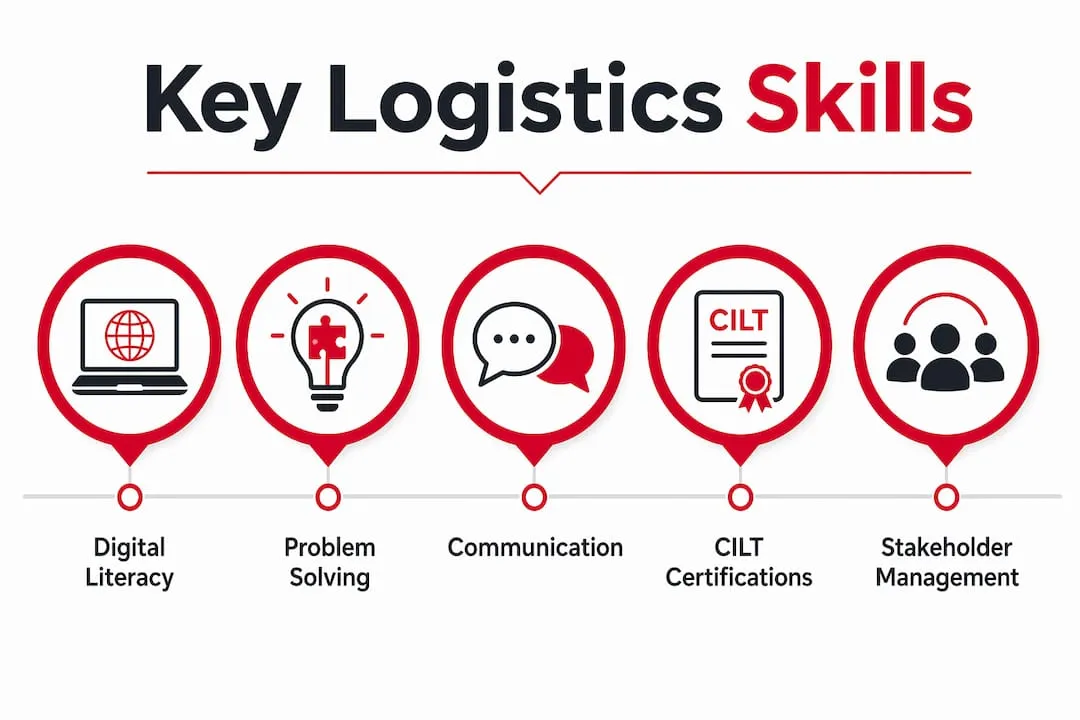
The Chartered Institute of Logistics and Transport (CILT) offers qualifications at every career stage, from Level 2 awards for new entrants to Level 6 diplomas for senior managers. The Institute for Supply Management (ISM) provides globally recognised certifications including the CSCP and CPSM, both of which carry weight with multinational employers. Professional qualifications and CPD are strongly linked to faster career progression and higher salaries. This is one area where the investment pays back quickly.
Career progression in logistics rarely follows a straight line, and that is a feature rather than a flaw. The most effective route to senior leadership typically involves deliberate lateral moves across functions such as warehousing, procurement, and transport planning. Each move builds a broader operational picture that makes you far more valuable at director or C-suite level than a specialist who has stayed in one lane.
Here is a practical progression pathway for a new entrant:
- Start in an operational role such as logistics coordinator or warehouse supervisor to build ground-level understanding
- Complete a CILT Level 3 or 4 qualification within the first two years to formalise your knowledge
- Move laterally into procurement, transport planning, or inventory management to broaden your expertise
- Pursue a CILT Level 6 or ISM CSCP certification to qualify for senior analyst or management roles
- Build visibility through internal projects, cross-functional teams, or industry events to accelerate promotion
Pro Tip: A well-structured CV that highlights measurable outcomes, such as cost savings achieved or delivery accuracy improved, will consistently outperform a generic list of duties. Read the guidance on building a strong CV before applying for your first logistics role.
Negotiation and stakeholder management skills are frequently overlooked by new entrants but are critical for roles above coordinator level. Logistics professionals regularly negotiate with carriers, suppliers, and internal budget holders. Developing these skills early accelerates your path to management.
What are the real benefits of working in logistics?
Compensation in logistics has improved significantly. The average salary for logistics professionals reached £126,400 in 2026 for senior roles, with 57% of professionals receiving an average pay rise of 7%. Entry-level positions start at approximately £54,489. These figures reflect a profession that is rewarding experience and expertise at a meaningful rate.
The logistics workforce is ageing, which creates a genuine talent gap that benefits new entrants and career changers. Employers are actively seeking younger professionals and those transitioning from other sectors, which means competition for well-prepared candidates is lower than in saturated graduate markets like finance or law.
Role diversity is another underrated advantage. Logistics roles range from manual warehouse operative positions to strategic supply chain management, with salaries scaling accordingly. This means you can enter at a level that suits your current experience and build upward, or move sideways into a specialism that matches your interests.
| Benefit | What it means in practice |
|---|---|
| Job security | Sector growth of 17 to 18% through 2034 creates sustained demand |
| Salary progression | Senior roles average over £126,000 with consistent annual increases |
| Role variety | Manual, analytical, managerial, and technology-focused paths available |
| Global relevance | Skills transfer across industries, countries, and sectors |
| Career entry flexibility | No single qualification required to start; multiple pathways exist |
Beyond pay, the daily variety of logistics work is a genuine draw. No two days are identical when you are managing live shipments, responding to supplier delays, or coordinating cross-border freight. Logistics professionals now operate as critical business leaders with clear pathways to the C-suite. ISM senior faculty have noted this shift explicitly, describing logistics as a profession that now directly influences company revenue and competitive positioning.
Key takeaways
Logistics offers one of the most accessible, well-compensated, and future-proof career paths available to UK job seekers in 2026.
| Point | Details |
|---|---|
| Industry growth is structural | The sector is projected to grow 17 to 18% through 2034, driven by e-commerce and global trade. |
| Technology creates roles, not redundancies | Automation shifts job types rather than eliminating them, with new tech roles emerging consistently. |
| Qualifications accelerate progression | CILT and ISM certifications are directly linked to faster promotion and higher salaries. |
| Compensation is rising | Senior logistics professionals averaged over £126,000 in 2026, with 57% receiving pay rises. |
| Entry is flexible | Multiple pathways exist from warehouse operative to supply chain analyst, with no single required degree. |
Logistics careers are more strategic than most people realise
I have spent years watching candidates dismiss logistics as a stepping stone rather than a destination. That view is outdated and, frankly, costly to the people who hold it.
The professionals I see advancing fastest in this sector are not necessarily the ones with the most impressive degrees. They are the ones who understand operations at ground level, can read a data dashboard, and know how to communicate a supply chain risk to a board that has never set foot in a warehouse. That combination is rare, and employers pay well for it.
What surprises most career changers is how quickly logistics rewards adaptability. Someone who moves from retail management into a logistics coordinator role and picks up a CILT qualification within 18 months can be earning significantly more than they did in their previous career within three years. The talent gap is real. Employers are not waiting for perfect candidates. They are investing in people who show up with the right attitude and a willingness to learn the technical side.
The one honest caution I would offer is this: the workload is increasing. The 76% of professionals reporting expanded job functions are not exaggerating. Logistics is demanding, and the pace has accelerated with technology adoption. But the rewards, financial and professional, have kept pace. If you want a career where your decisions have visible, real-world consequences and where the learning never stops, logistics is a strong choice.
— Rob
Start your logistics career with Jobs-in-Transport

Jobs-in-Transport has been connecting transport and logistics professionals with UK employers since 2005. Whether you are a new graduate exploring your first role or an experienced professional ready for a step up, the platform lists vacancies across logistics coordination, supply chain management, transport planning, and warehouse operations. The current job listings cover roles at every level, from entry-level positions with major operators to senior supply chain management roles with competitive salaries. Search by location, specialism, or salary band to find opportunities that match your profile. New vacancies are added weekly, and CV hosting means employers can find you too.
FAQ
Is logistics a good career choice in 2026?
Logistics is a strong career choice in 2026. The sector is projected to grow 17 to 18% through 2034, with 1.8 million annual job openings and rising salaries across all levels.
What qualifications do you need to work in logistics?
No single qualification is required to enter logistics. CILT and ISM certifications are the most recognised professional credentials and are directly linked to faster career progression and higher pay.
How much can you earn in a logistics career?
Entry-level logistics roles pay approximately £54,489, while senior professionals averaged over £126,000 in 2026. The majority of professionals received a pay rise of around 7% that year.
Will automation replace logistics jobs?
Automation shifts the type of work rather than eliminating roles. For every three warehouse jobs replaced by automation, two new technology-related positions are created, requiring digital skills and system oversight.
Is logistics a good career for career changers?
Logistics actively recruits from adjacent sectors including retail, manufacturing, and the armed forces. The ageing workforce creates a genuine talent gap, and employers are investing in candidates who bring transferable skills and a willingness to learn.
Recommended
- Our promise | Jobs-in-Transport.com
- Jobs in Transport, Bus jobs, Highways & Traffic jobs, Transportation Planning jobs, Transport Technology jobs, Project Management jobs, Transport Leaders jobs
- Jobs in Transport, Bus jobs, Highways & Traffic jobs, Transportation Planning jobs, Transport Technology jobs, Project Management jobs, Transport Leaders jobs


