
Hiring for transport roles is genuinely high stakes. A poorly written job description does not just attract the wrong candidates; it can expose your organisation to discrimination claims, regulatory scrutiny, and costly tribunal proceedings. Job descriptions serve as recruitment tools, performance baselines, and legal documents, and weak ones lead directly to mismatched hires and legal risk. This guide walks you through every stage of crafting transport job descriptions that attract qualified candidates, satisfy UK compliance requirements, and give your hiring process a solid foundation from day one.
Table of Contents
- Why job descriptions matter in transport roles
- Preparing to write: Essential requirements for transport job descriptions
- Structuring your job description: Format and language best practices
- Highlighting transport-specific competencies and compliance
- Verifying and reviewing your transport job description
- The uncomfortable truth about writing transport job descriptions
- Connect with the right talent for your transport roles
- Frequently asked questions
Key Takeaways
| Point | Details |
|---|---|
| Clarity is crucial | Clear, specific job descriptions attract suitable applicants and prevent misunderstandings. |
| Compliance prevents risk | Incorporate key legal and operational requirements to safeguard your organisation from tribunal and regulatory issues. |
| Bias-free language | Inclusive, jargon-free job descriptions uphold equality and widen your talent pool. |
| Competency-led hiring | Focusing on skills and competencies over years of experience avoids discrimination and builds effective teams. |
| Review before posting | Always check for clarity, legal compliance, and relevance, using peer or HR review when possible. |
Why job descriptions matter in transport roles
Transport is not like most sectors. A poorly defined role in an office environment might result in a disengaged employee. In transport, the consequences are far more serious: unsafe drivers, audit failures, regulatory penalties, and reputational damage. Getting the job description right is, therefore, not an administrative formality. It is a business-critical task.
Job descriptions serve as recruitment tools, performance baselines, and legal documents. Poor ones lead to mismatched hires, discrimination risks, and employment tribunal proceedings. In a sector where licensing, driver hours, and health and safety legislation are non-negotiable, this risk is amplified. A vague description that fails to specify a Certificate of Professional Competence (CPC) requirement, for example, could see you hiring someone who is not legally permitted to perform the role.
Consider also the operational consequences. When a job description lacks specificity about shift patterns, vehicle types, or geographic scope, candidates arrive with inaccurate expectations. Turnover rises, recruitment costs escalate, and service continuity suffers. For a fleet manager overseeing 50 vehicles, the downstream impact of one poor hire is measurable in delays, compliance breaches, and driver welfare concerns.
| Consequence | Impact area | Severity |
|---|---|---|
| Mismatched hire | Recruitment and retention | High |
| Tribunal claim | Legal and financial | Critical |
| Non-compliant driver | Regulatory and safety | Critical |
| High turnover | Operational continuity | Medium |
| Poor performance reviews | HR and management | Medium |
A well-written description also functions as a performance management tool. When a driver or transport planner is reviewed six months into the role, the job description provides the original benchmark against which their performance is measured. Staying current with transport news and insights also helps you align role requirements with evolving regulatory expectations.
“A job description is not just a hiring tool. In transport, it is the first line of defence against regulatory non-compliance and a foundation for every performance and conduct conversation that follows.”
Now that we understand the risks and value of job descriptions, let us clarify what you need before drafting one.
Preparing to write: Essential requirements for transport job descriptions
Before you type a single word of your job description, you need to do some groundwork. Skipping this preparation phase is one of the most common mistakes transport employers make, and it explains why so many descriptions end up either too vague or unrealistically demanding.
Start with the job title. Use a clear, standard job title that accurately reflects the role, avoiding gendered, jargon-filled, or inflated titles. “Transport Planner” is better than “Transport Solutions Ninja.” “Fleet Operations Manager” is clearer than “Head of Mobility Excellence.” Inflated titles confuse candidates and may deter strong applicants who are unsure whether they are qualified.

Next, separate your requirements into two categories. Separate essential from desirable requirements in the person specification, and focus on skills and competencies rather than years of experience to avoid indirect discrimination. For example, requiring “10 years in logistics” may inadvertently exclude younger candidates or those who have progressed quickly. Requiring instead that a candidate “can demonstrate the ability to manage multi-stop route planning for fleets of 20 or more vehicles” is both more specific and legally safer.
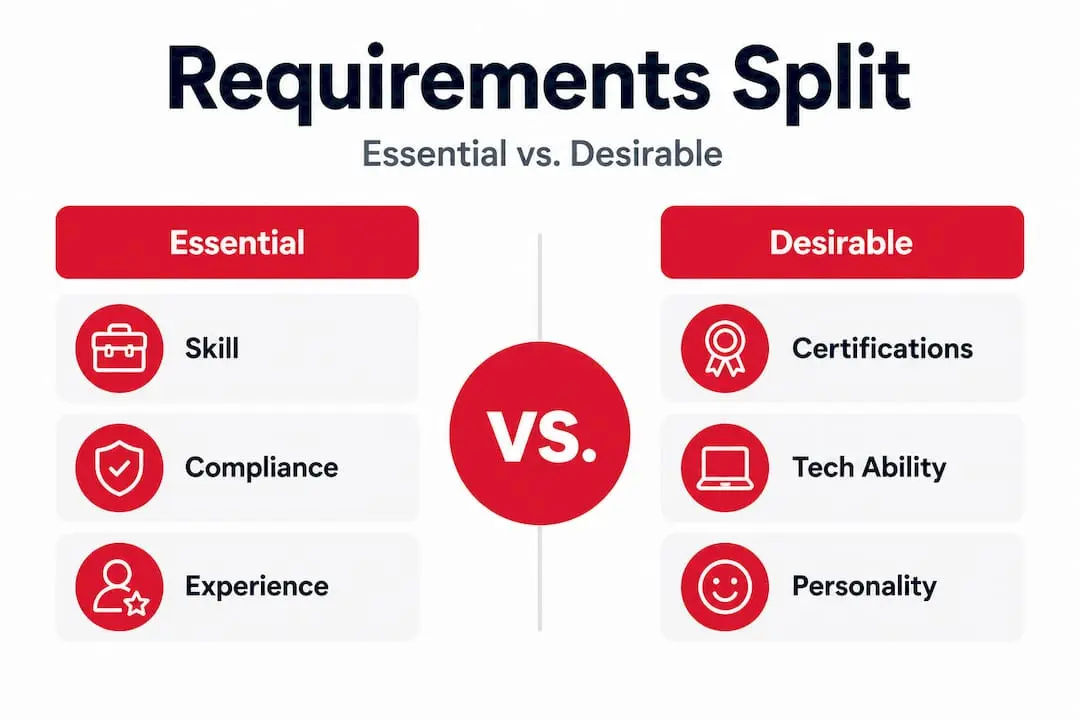
| Requirement type | Example for transport planner role | Legally appropriate |
|---|---|---|
| Essential skill | Proficiency in transport management systems | Yes |
| Essential compliance | Valid CPC qualification | Yes |
| Desirable skill | Experience with GPS fleet tracking software | Yes |
| Indirect discriminator | 15 years of experience minimum | Questionable |
| Gendered language | “He will manage the fleet” | No |
Compliance requirements are non-negotiable in transport roles and must be captured at this stage. Think about driver hours regulations, tachograph knowledge, HSE obligations, operator licence conditions, and any sector-specific certifications. These are not optional extras; they are the legal minimum for many roles. Review our promise on compliance to understand the standard you should be aiming for.
Key questions to answer before drafting:
- What are the essential qualifications and licences for this role?
- What operational technology will the candidate use daily?
- What shift patterns, geographic coverage, or physical demands apply?
- What are the performance expectations in the first 90 days?
- Who does this role report to, and who does it line manage?
Pro Tip: Speak directly to the current postholder or line manager before writing the description. They will surface operational realities that no template captures, from the specific TMS platform used to the seasonal pressures that define the role.
With clear requirements and the right information gathered, you are ready to structure your description for maximum clarity and impact.
Structuring your job description: Format and language best practices
Format is not a cosmetic concern. A well-structured job description is easier to scan, more likely to reach compliant candidates, and signals professionalism to applicants. Disorganised descriptions with walls of text send talented candidates straight to the next listing.
Use inclusive, bias-free language, avoid jargon and clichés, structure with headings and bullets for scannability, and review for legal compliance with the Equality Act 2010 before publishing. These are the four pillars of a well-formatted job description, and they apply equally whether you are recruiting a Traffic Signal Technician or a Transport Network Director.
A standard structure for transport roles should follow this sequence:
- Job title and team or department
- Location and travel requirements
- Salary range and employment type
- Role overview (two to three sentences)
- Key responsibilities (bulleted list, six to ten items)
- Essential requirements (bulleted, evidence-based)
- Desirable requirements (bulleted, clearly labelled)
- Compliance and regulatory obligations
- Benefits and working conditions
- How to apply and closing date
Avoid phrases such as “must be able to hit the ground running,” “dynamic self-starter,” or “passionate about transport.” These clichés are meaningless and subtly exclude candidates who do not match the implied personality type. Instead, be precise. “Able to manage multiple route planning queries within agreed SLAs” tells candidates exactly what is expected.
Bias in language is often unintentional. The word “dynamic” statistically attracts more male applicants. “Nurturing” attracts more female applicants. Neither is appropriate in a transport job description. Aim for neutral, task-focused language throughout. Tools that scan for coded bias can help, but a manual review by someone unfamiliar with the role is equally effective.
For guidance on broader logistics best practices, it is worth benchmarking your descriptions against sector standards to ensure you are not inadvertently narrowing your talent pool.
Pro Tip: Write your job description in plain English at roughly an 8th-grade reading level. If a capable candidate without a degree cannot understand the requirements, you may be accidentally filtering out excellent operational talent in favour of paper qualifications.
Review the about us page on Jobs-in-Transport.com for further context on the calibre of candidates active in the UK transport job market.
Now let us look at how to describe key competencies and compliance needs in transport job specifications.
Highlighting transport-specific competencies and compliance
This is where transport job descriptions diverge most sharply from generic HR templates. The sector has regulatory requirements, operational pressures, and technological demands that simply do not appear in a standard job description guide. Getting this right separates the employers who attract qualified, experienced candidates from those who attract anyone who owns a driving licence.
For transport roles, emphasise compliance including driver hours, tachographs, and HSE obligations, alongside safety, logistics systems such as TMS and GPS, route planning, and problem-solving under pressure. These are not peripheral details; they are the core of the role.
Transport-specific competencies to include:
- Knowledge of Working Time Directive and drivers’ hours rules
- Experience with digital tachograph analysis and record keeping
- Familiarity with operator licence obligations and Traffic Commissioner requirements
- Proficiency in Transport Management Systems (TMS) such as Mandata or Microlise
- GPS fleet tracking and real-time route optimisation
- Ability to manage vehicle defect reporting and roadworthiness checks
- HSE audit readiness and health and safety risk assessment
Quantification makes a significant difference. Stating that a candidate must “manage a fleet” is far weaker than “manage a fleet of 35 HGVs across six regional depots with a combined operational budget of £4 million.” The latter gives candidates a clear sense of scope, helps you benchmark salary appropriately, and signals that you understand your own operation.
| Competency area | Weak phrasing | Strong phrasing |
|---|---|---|
| Fleet management | Manage vehicles | Oversee fleet of 35 HGVs, 6 depots |
| Compliance | Follow regulations | Maintain tachograph records per DVSA standards |
| Technology | Use logistics software | Proficient in Mandata TMS and FleetCheck |
| Problem-solving | Handle disruptions | Manage real-time delays and driver defect reports |
Browse active transport job listings on Jobs-in-Transport.com to see how other employers in the UK are framing these competencies. It is one of the quickest ways to benchmark your own descriptions against live market standards.
“Specificity is not bureaucracy. In transport, a precise job description is what separates a safe, compliant operation from one that fails its next DVSA audit.”
To wrap up the core guide, let us explore verification and review to ensure your description is compliant and effective.
Verifying and reviewing your transport job description
Drafting the description is only part of the process. Before you publish, you need a structured review that checks for compliance, clarity, and inclusivity. Many organisations skip this step, which is precisely why so many transport job descriptions contain unintentional bias, legal exposure, or simply unclear expectations.
Follow this review sequence:
- Check every essential requirement against the Equality Act 2010. Can you justify why each criterion is genuinely necessary?
- Remove any language that implies a preference for age, gender, nationality, or disability status.
- Read the description aloud. If it sounds awkward or unclear, rewrite those sections.
- Ask a colleague who has no direct knowledge of the role to read it. What questions do they have? Those are gaps you need to fill.
- Cross-reference compliance requirements with current DVSA and HSE guidance.
Use inclusive, bias-free language, structure with headings and bullets for scannability, and review for legal compliance before publishing. This is not optional; it is the minimum standard for responsible recruitment.
Pro Tip: Create a reusable review checklist specific to your transport operations. Include fields for licence requirements, regulatory obligations, TMS proficiency, and salary benchmarks. This saves time on every subsequent hire and ensures consistency across your team.
“The review stage is where good intentions become actual compliance. Do not publish a job description that no one outside of the hiring team has read.”
For background on how our platform supports responsible recruitment, visit our company background page.
Having covered verification and review, let us take a step back and offer a fresh perspective based on years in the transport sector.
The uncomfortable truth about writing transport job descriptions
Most job description templates are written by HR generalists with no operational knowledge of transport. They follow a logical structure but miss the lived reality of the role entirely. The result is descriptions that attract candidates who look good on paper but struggle the moment they face a real-time fleet crisis or a DVSA roadside check.
The uncomfortable truth is that the best transport job descriptions are written collaboratively, not in isolation by a recruitment team. They involve the transport manager who deals with tachograph discrepancies at 6am, the compliance officer who manages the operator licence, and ideally a current postholder who understands the daily pressure of the role.
In transport, edge cases include real-time disruptions such as delays and defects, regulatory audits covering CPC and tachographs, and the constant need to balance efficiency with compliance and safety. None of these realities appear in a generic template, and candidates who have not been forewarned of them are far more likely to leave within their probationary period.
The sector also changes quickly. New zero emission vehicle regulations, evolving digital tachograph requirements, and shifting traffic management technologies mean that a job description written three years ago is already out of date. Keeping up with current compliance news is not optional for hiring managers; it is how you ensure your descriptions remain legally sound and operationally relevant.
Treat your job description as a living document. Review it annually, update it when the role changes significantly, and never copy-paste last year’s version without checking it against the current regulatory landscape. The employers who get this right consistently hire better candidates, experience lower turnover, and sail through compliance audits because everyone in the organisation knew what the role required from the very first conversation.
Connect with the right talent for your transport roles
Writing a strong job description is just the first step. Getting it in front of the right candidates is where the real work begins.

Jobs-in-Transport.com has been connecting UK transport employers with qualified, experienced professionals since 2005. Whether you are hiring a Traffic Signal Engineer, a Transport Planner, or a Fleet Operations Manager, our platform puts your vacancy in front of a targeted audience who are actively seeking roles in the sector. You can post a transport job directly on our platform and access a growing database of transport-specific CVs. For a full overview of how we support employers at every stage of recruitment, learn about our hiring solutions and find the right fit for your team.
Frequently asked questions
What are the must-have elements in a UK transport job description?
Include a clear job title, essential and desirable criteria, compliance details, and a structured format. A clear, standard job title that accurately reflects the role is the foundation of every effective description.
How can I ensure my transport job description is bias-free and legally compliant?
Review for inclusive language, remove unnecessary jargon, and check alignment with the Equality Act 2010 before publishing. Bias-free, structured language with clear headings and bullets is both legally safer and more attractive to candidates.
What transport-specific requirements should I highlight?
Emphasise compliance requirements such as driver hours regulations, tachograph knowledge, and safety legislation alongside operational skills. Transport roles require emphasis on logistics systems, route planning, and real-time problem-solving under pressure.
Is experience or competency more important in person specifications?
Competencies and demonstrable skills are more defensible and more effective than minimum years of experience. Focusing on skills over experience reduces the risk of indirect discrimination and widens your talent pool.
How do I quantify job scope for transport roles?
Use fleet size, operational budget, or geographic coverage to give candidates a clear picture of the role’s scale. Benchmarks such as fleet size or budgets are useful reference points, but always adapt them to reflect the specific operational context of your vacancy.
Recommended
- Our promise | Jobs-in-Transport.com
- Jobs in Transport, Bus jobs, Highways & Traffic jobs, Transportation Planning jobs, Transport Technology jobs, Project Management jobs, Transport Leaders jobs
- Jobs in Transport, Bus jobs, Highways & Traffic jobs, Transportation Planning jobs, Transport Technology jobs, Project Management jobs, Transport Leaders jobs
- Best job application tips: Stand out and land interviews | Easy CV
- Build a job posting checklist for fair hiring


